Evaluation-Editing of articles
Evaluation process
To guarantee quality and consistency with the aims of the journal, articles submitted for possible publication in RIE will be evaluated by specialists in the field by means of a double-blind review, ensuring the anonymity of authors and reviewers throughout the process.
Stages of the process:
Initial assessment (estimated time 10 days): The editorial process of RIE begins with an initial review by the management team, which assesses the relevance and quality of the manuscripts received. Those that do not meet the minimum standards do not go on to the next phase. The most common reasons why manuscripts are not considered for publication at this initial stage include one or more of the following aspects:
- Lack of coherence between objective(s) and method.
- Errors in the selection of the population and the sample or of the informants.
- Superficial use of information gathering techniques.
- Lack of relationship between the method selected and the results obtained.
- Absence of in-depth discussion with other authors.
- Low relevance of the study in relation to the state of the question.
- Lack of relationship with the discipline of education.
Manuscripts that pass this first assessment are assigned to a section editor.
Pre-review, review of the formal structure of the article (estimated time 3 weeks): To ensure objectivity, independence and transparency, the data associated with the original file is anonymized. The section editor assigns a pre-reviewer to examine the suitability of the article to the predetermined formal template, evaluating the following criteria:
- Summary/abstract in Spanish and English with IMRCyD format.
- Keywords included in a Thesaurus.
- Editing formats (tables, figures, appendix...) according to current APA guidelines.
- Compliance with current APA standards in bibliographic citations and references.
If the decision is “accept with modifications”, the author must upload the modified article to the application, continuing the evaluation process. NEVER as a new submission.
Double-blind peer review (external experts) (estimated time 6 months): After passing the pre-review, the original will undergo a double-blind peer review by experts external to the publishing institution to guarantee objectivity and transparency. These experts will decide whether or not to accept the article for publication based on an evaluation of the following criteria, all of which are considered within the parameters established by the journal's staff:
- Scientific content and methodological rigor.
- Timeliness and relevance of the introduction/rationale.
- Formulation and coherence of the objectives and/or hypotheses.
- Adequacy and sufficiency of the data analysis.
- Inclusion of discussion and conclusions related to the object of research.
- Balanced (where appropriate) between the theoretical and the empirical part.
- General aspects of relevance, impact and originality.
In case of relevant discrepancies between the two evaluating agents, the opinion of a third party will be sought.
If the decision is “accept with modifications”, the author must upload the modified article and a document detailing the changes made, continuing the evaluation process. NEVER as a new submission.
The editorial committee will notify the decision (acceptance, revision or rejection) and will send an email with the reasons and results of the evaluation.
The author can check the status of their article on the journal's online platform. Authors should wait for notification of the editorial decision before making any changes.
Editing process
After acceptance, the article will enter the editing process (estimated time 2 months). This process includes review by committees (inclusive language, APA citation and formatting). Once the review by committees is complete, the article is sent to the authors for final review, informing them of the option of AI translation. Since January 2024, we have implemented the use of DeepL, a machine translation service that uses advanced AI, to offer bilingual translations of published articles. The integration of AI allows us to significantly expand the accessibility of research and foster the exchange of knowledge. However, it is crucial to point out that any translation can always contain biases. Therefore, it is recommended to review the original article in the language in which it was written.
It is important to note that the use of AI for the translation of accepted articles is an option, not an obligation. Authors may accept or reject this alternative.
To optimize the process, after the approval of the original text, we send the document to the publishing company for layout. Simultaneously, the translation is carried out using AI.
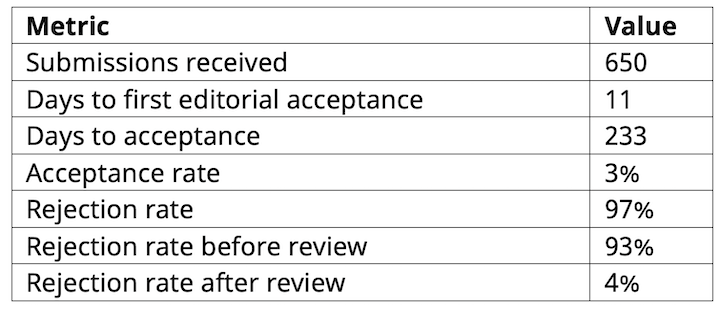
Metric statistics. Year 2025