
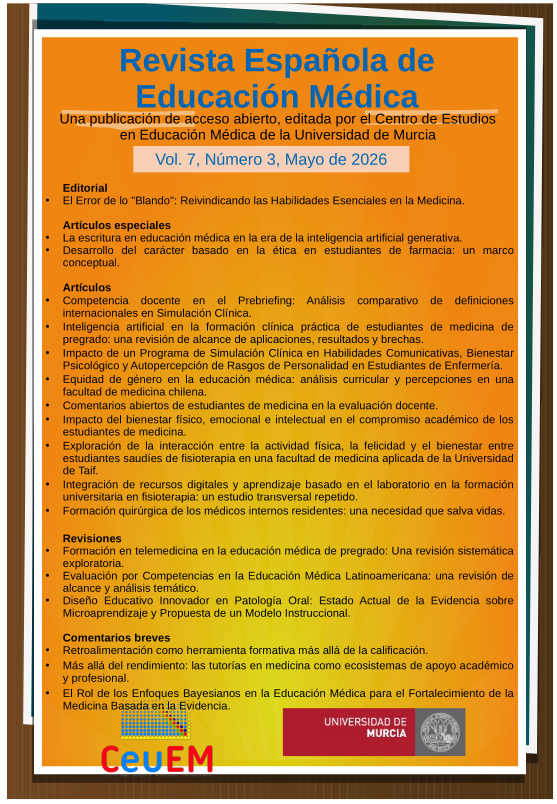
Retroalimentación como herramienta formativa más allá de la calificación.
Resumo
La retroalimentación es clave en la educación porque ayuda al estudiante a mejorar, autorregularse y aprender de forma significativa. No debe confundirse con la calificación, ya que implica explicar el desempeño y orientar cómo avanzar. Debe ser un proceso continuo, dialogado y constructivo entre docente y estudiante, promoviendo reflexión, motivación y autonomía. Su correcta aplicación favorece el desarrollo de competencias y un mejor desempeño profesional futuro.
Downloads
-
Resumo321
-
xml (Español (España))52
-
pdf (Español (España))226
-
pdf 226
Referências
1. Erazo J, Huezo V, Peña J, et al. Proceso enseñanza aprendizaje: la retroalimentación como estrategia de enseñanza en educación superior. Central Americans Journals Online. 2025, 12, 1. https://doi.org/10.5377/ce.v12i1.21921
2. Romero L. Análisis de la evaluación y la calificación. ¿Es possible una coordinación pedagógica entre ambos enfoques? European Public & Social Innovation Review. 2024, 9. https://doi.org/10.31637/epsir-2024-327
3. Muñoz P, Henríquez E, Kunakov N. Retroalimentación como evaluación formativa desde la perspectiva docente en odontología: estudio de caso. Educación Médica. 2023, 24, 2. https://doi.org/10.1016/j.edumed.2022.100785
4. Boud D, Molloy E. Rethinking models of feedback for learning: the challenge of design. Assessment & Evaluation in Higher Education. 2013, 38, 6. https://doi.org/10.1080/02602938.2012.691462
5. Nicol D, Macfarlane D. Formative Assessment and Self-Regulated Learning: A Model and Seven Principles of Good Feedback Practice. Studies in Higher Education. 2006, 31, 2. https://doi.org/10.1080/03075070600572090
6. Fuentes J, Rammsy F, Molina A, et al. Explorando la alfabetización en feedback en la formación de profesionales de la salud: un estudio cualitativo. Revista Médica Clínica Las Condes. 2024, 35. https://doi.org/10.1016/j.rmclc.2024.10.004
7. Fuentes S, Rosário P, Valdés M, et al. Autorregulación del Aprendizaje: Desafío para el Aprendizaje Universitario Autónomo. Revista Latinoamericana de Educación Inclusiva. 2023, 17, 1. http://dx.doi.org/10.4067/s0718-73782023000100021
Direitos de Autor (c) 2026 Serviço de Publicações da Universidade de Múrcia

Este trabalho encontra-se publicado com a Licença Internacional Creative Commons Atribuição-NãoComercial-SemDerivações 4.0.
Os trabalhos publicados nesta revista estão sujeitos aos seguintes termos:
1. O Serviço de Publicações da Universidade de Murcia (o editor) preserva os direitos económicos (direitos de autor) das obras publicadas e favorece e permite a sua reutilização ao abrigo da licença de utilização indicada no ponto 2.
2. Os trabalhos são publicados sob uma licença Creative Commons Atribuição-NãoComercial-NãoDerivada 4.0.
3. Condições de autoarquivamento. Os autores estão autorizados e incentivados a divulgar eletronicamente as versões pré-impressas (versão antes de ser avaliada e enviada à revista) e / ou pós-impressas (versão avaliada e aceita para publicação) de seus trabalhos antes da publicação, desde que favorece sua circulação e difusão mais precoce e com ela possível aumento de sua citação e alcance junto à comunidade acadêmica.