
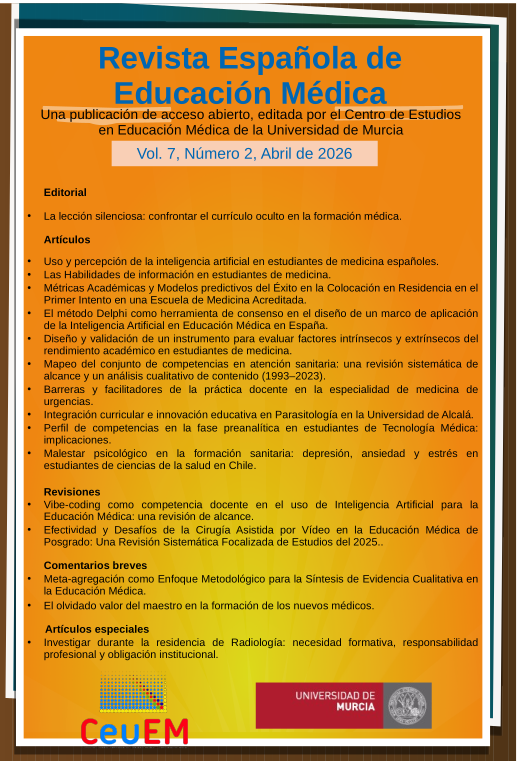
Efectividad y Desafíos de la Cirugía Asistida por Vídeo en la Educación Médica de Posgrado: Una Revisión Sistemática Focalizada de Estudios del 2025.
Resumen
Introducción: La cirugía asistida por video (CAV) se ha incorporado de manera creciente en la educación médica de posgrado (EMP), ofreciendo una visualización mejorada y oportunidades estructuradas para el desarrollo de habilidades técnicas. No obstante, los modelos recientes de implementación presentan variaciones considerables en su diseño, evaluación y resultados reportados. Objetivo: Sintetizar la evidencia proveniente de estudios publicados en 2025 acerca de la efectividad y los desafíos de la CAV en la EMP. Métodos: Se realizó una revisión sistemática focalizada conforme a las recomendaciones PRISMA-S. Se identificaron estudios revisados por pares, publicados en idioma inglés en 2025, mediante búsquedas en PubMed, Scopus y Web of Science. Fueron elegibles aquellos estudios que evaluaron intervenciones educativas asistidas por video dirigidas a residentes y/o becarios, y que reportaron al menos un desenlace educativo. Cuatro estudios cumplieron los criterios de inclusión tras un proceso de selección doble. Los datos se extrajeron mediante un marco estandarizado y se sintetizaron de forma narrativa debido a la heterogeneidad sustancial en los diseños de estudio, las intervenciones y las medidas de resultado. Resultados: Los cuatro estudios incluidos emplearon metodologías heterogéneas (diseños observacionales descriptivos, un estudio observacional multicéntrico y un ensayo clínico aleatorizado). Los resultados reportados sugieren posibles mejoras en la comprensión de los procedimientos, la adquisición de habilidades técnicas, la eficiencia del flujo de trabajo y la participación del estudiante, particularmente cuando los enfoques asistidos por video se integraron en modelos de formación estructurados. Sin embargo, la evidencia se basó con frecuencia en muestras pequeñas, medidas subjetivas (por ejemplo, satisfacción y utilidad percibida) y evaluaciones a corto plazo, con un uso limitado de métricas objetivas estandarizadas. Conclusiones: La evidencia proveniente de estudios publicados en 2025 indica que la CAV puede favorecer la formación quirúrgica en la EMP cuando se integra en marcos educativos estructurados. No obstante, el reducido número de estudios, la heterogeneidad metodológica y la limitada disponibilidad de datos longitudinales exigen una interpretación cautelosa. Se requieren investigaciones adicionales, multicéntricas y metodológicamente rigurosas, para esclarecer el impacto educativo a largo plazo y su transferencia a la práctica clínica.
Descargas
-
Resumen214
-
pdf 111
Citas
1. Ericsson KA. Deliberate practice and the acquisition and maintenance of expert performance in medicine and related domains. Acad Med. 2004, S70-81. https://doi/10.1097/00001888-200410001-00022
2. Reznick RK, MacRae H. Teaching surgical skills--changes in the wind. N Engl J Med. 2006, 355(25), 2664-9. https://doi.org/10.1056/NEJMra054785
3. Ahmet A, Gamze K, Rustem M, Sezen KA. Is Video-Based Education an Effective Method in Surgical Education? A Systematic Review. J Surg Educ. 2018, 75(5), 1150-1158. https://doi.org/10.1016/j.jsurg.2018.01.014
4. Mota P, Carvalho N, Carvalho-Dias E, João Costa M, Correia-Pinto J, Lima E. Video-Based Surgical Learning: Improving Trainee Education and Preparation for Surgery. J Surg Educ. 2018, (3), 828-835. https://doi.org/10.1016/j.jsurg.2017.09.027
5. Youssef SC, Aydin A, Canning A, Khan N, Ahmed K, Dasgupta P. Learning Surgical Skills Through Video-Based Education: A Systematic Review. Surg Innov. 2023, 30(2), 220-238. https://doi.org/10.1177/15533506221120146
6. Allori AC, Marcus JR, Daluvoy S, Bond J. Video-assisted palatopharyngeal surgery: a model for improved education and training. Cleft Palate Craniofac J. 2014, 51(5), 605-612. https://doi.org/10.1597/12-336
7. Landry EC, Yong M, Pauwels J, Chadha NK. The use of video glasses improved learning of tonsillectomy and adenoidectomy surgery: A randomized controlled trial. Int J Pediatr Otorhinolaryngol. 2019, 117, 12-16. https://doi.org/10.1016/j.ijporl.2018.10.039
8. Porto JT, Eifler LS, Steffen LP, Rabaioli GF, Tomazzoni JM. Use of simulators in video laparoscopic surgery in medical training: a prospective court study with medicine academic at a university in Southern Brazil. Rev Col Bras Cir. 2020, 47, e20202608. https://doi.org/10.1590/0100-6991e-20202608
9. Henning GM, Findlay BL, Cohen TD, Potretzke AM, Kohler TS, Helo S, Granberg CF, Boorjian SA, Khanna A, Linder BJ, Viers BR. The Film Room: Using Artificial Intelligence to Facilitate Video Review for Urology Trainees. J Surg Educ. 2024, 81(11), 1743-1747. https://doi.org/10.1016/j.jsurg.2024.08.019
10. Luo Y, Wang J, Yan Z, He J, Fu L, Wang S, Han Y, Fu Y, Wang X, Li K, Yin R, Pu D. Enhancing laparoscopic surgery training: a comparative study of traditional models and automated error detection system. BMC Med Educ. 2025, 25(1), 677. https://doi.org/10.1186/s12909-025-07242-3
11. Cherem-Kibrit M, Rolnick N, King J, Gomes-da Silva de Rosenzweig P, Saffioti A, Barron Cervantes NM, Moscovici S. Optimizing neurosurgical video formats for effective learning in the social media era, bridging global gaps: A literature review on enhancing quality in video-based education. J Clin Neurosci. 2025, 141, 111589. https://doi.org/10.1016/j.jocn.2025.111589
12. Beffa E., Lybéris P., Rosboch G., Balsamo L., Femia F., Lausi P. et al.. Device and technology helping to teach video-assisted thoracic surgery. AME Surgical Journal. 2023, 3, 45. https://doi.org/10.21037/asj-22-40
13. Farivar BS, Flannagan M, Leitman IM. General surgery residents' perception of robot-assisted procedures during surgical training. J Surg Educ. 2015, 72(2), 235-242. https://doi.org/10.1016/j.jsurg.2014.09.008
14. Mittal MK, Dumon KR, Edelson PK, Acero NM, Hashimoto D, Danzer E, Selvan B, Resnick AS, Morris JB, Williams NN. Successful implementation of the american college of surgeons/association of program directors in surgery surgical skills curriculum via a 4-week consecutive simulation rotation. Simul Healthc. 2012, 7(3), 147-54. https://doi.org/10.1097/SIH.0b013e31824120c6
15. Coco D, Leanza S, Viola MG. Single-surgeon training of 14 novice surgeons in robotic cholecystectomy: a study of 300 consecutive cases, assessing training outcomes and surgical performance. J Robot Surg. 2025 Feb 1;19(1):58. https://doi.org/10.1007/s11701-024-02166-4
16. Rethlefsen ML, Kirtley S, Waffenschmidt S, Ayala AP, Moher D, Page MJ, Koffel JB; PRISMA-SGroup. PRISMA-S: an extension to the PRISMA Statement for Reporting Literature Searches inSystematic Reviews. Syst Rev. 2021, 10(1), 39. https://doi.org/10.1186/s13643-020-01542-z
17. Mourad Ouzzani, Hossam Hammady, Zbys Fedorowicz, Ahmed Elmagarmid. Rayyan — a web and mobile app for systematic reviews. Syst Rev. 2016, 5, 210. https://doi.org/10.1186/s13643-016-0384-4
18. Haddaway NR, Page MJ, Pritchard CC, McGuinness LA. PRISMA2020: An R package and Shiny app for producing PRISMA 2020-compliant flow diagrams, with interactivity for optimised digital transparency and Open Synthesis. Campbell Syst Rev. 2022, 18(2), e1230. https://doi.org/10.1002/cl2.1230
19. Englert S, Tschukewitsch N, Wölfl A, Justinger C. Entwicklung und Implementation eines strukturierten Ausbildungsprogramms in der robotischen Chirurgie: Aller Anfang ist schwer [Development and implementation of a structured training program in robotic surgery: The first step is always the hardest]. Chirurgie (Heidelb). 2025, 96(9), 765-773. https://doi.org/10.1007/s00104-025-02304-0
20. Sagae Y, Yamanoi K, Horie A, Kaneda M, Sunada M, Miyamoto T, Mizuno R, Taki M, Murakami R, Yamaguchi K, Hamanishi J, Baba T, Terai Y, Yokoyama Y, Kondo E, Kobayashi H, Mandai M. Online Live Streaming System for Robotic Surgery With Bidirectional Discussion Through a Commentator: A Multi-Institutional Observational Study. Asian J Endosc Surg. 2025, 18(1), e70072. https://doi.org/10.1111/ases.70072
21. Ramos JP, Zinco A, Bryan MR, Bensen GP, Alty IG, Roy N, Raykar N, Ottolino P. Video education in open trauma: a program for developing trauma surgical skills. BMC Med Educ. 2025, 25(1), 325. https://doi.org/10.1186/s12909-025-06863-y
22. Wang Y, Zhang X, Tang X, Jiang R, Yang S, Shen Y, Yi P. Enhancing Pedicle Screw Fixation Training: A Novel Approach Using Head-mounted Devices for Video-assisted Debriefing. World Neurosurg. 2025, 194, 123424. https://doi.org/10.1016/j.wneu.2024.11.007
23. Krumm IR, Miles MC, Clay A, Carlos Ii WG, Adamson R. Making Effective Educational Videos for Clinical Teaching. Chest. 2022, 161(3), 764-772. https://doi.org/10.1016/j.chest.2021.09.015
24. Raison N, Harrison P, Abe T, Aydin A, Ahmed K, Dasgupta P. Procedural virtual reality simulation training for robotic surgery: a randomised controlled trial. Surg Endosc. 2021, 35(12), 6897-6902. https://doi.org/10.1007/s00464-020-08197-w
25. Grossi S, Cattoni M, Rotolo N, Imperatori A. Video-assisted thoracoscopic surgery simulation and training: a comprehensive literature review. BMC Med Educ. 2023, 23(1), 535. https://doi.org/10.1186/s12909-023-04482-z
26. Teng P., Xu Y., Qian K., Lu M., & Hu J.. Case-Based Virtual Reality Simulation for Severe Pelvic Trauma Clinical Skill Training in Medical Students: Design and Pilot Study. JMIR Medical Education. 2025, 11, e59850. https://doi.org/10.2196/59850
27. Mao BP, Teichroeb ML, Lee T, Wong G, Pang T, Pleass H. Is Online Video-Based Education an Effective Method to Teach Basic Surgical Skills to Students and Surgical Trainees? A Systematic Review and Meta-analysis. J Surg Educ. 2022, 79(6), 1536-1545. https://doi.org/10.1016/j.jsurg.2022.07.016
28. Morgado M, Botelho J, Machado V, Mendes JJ, Adesope O, Proença L. Full title: Video-based approaches in health education: a systematic review and meta-analysis. Sci Rep. 2024, 14(1), 23651. https://doi.org/10.1038/s41598-024-73671-7
29. Robbrecht M, Van Winckel M, Mulder A, Embo M. What is the learning effect of video review in postgraduate medical education: a systematic review. BMC Med Educ. 2025, 25(1), 114. https://doi.org/10.1186/s12909-024-06515-7
30. Tudor Car L, Kyaw BM, Teo A, Fox TE, Vimalesvaran S, Apfelbacher C, Kemp S, Chavannes N. Outcomes, Measurement Instruments, and Their Validity Evidence in Randomized Controlled Trials on Virtual, Augmented, and Mixed Reality in Undergraduate Medical Education: Systematic Mapping Review. JMIR Serious Games. 2022, 10(2), e29594. https://doi.org/10.2196/29594
31. Mangalindan KE, Wyatt TR, Brown KR, Shapiro M, Maggio LA. Investigating the Road to Equity: A Scoping Review of Solutions to Mitigate Implicit Bias in Assessment within Medical Education. Perspect Med Educ. 2025, 14(1), 92-106. https://doi.org/10.5334/pme.1716
32. Hsin LJ, Chao YP, Chuang HH, Kuo TBJ, Yang CCH, Huang CG, Kang CJ, Lin WN, Fang TJ, Li HY, Lee LA. Mild simulator sickness can alter heart rate variability, mental workload, and learning outcomes in a 360° virtual reality application for medical education: a post hoc analysis of a randomized controlled trial. Virtual Real. 2022, 27, 3345–3361. https://doi.org/10.1007/s10055-022-00688-6
Derechos de autor 2026 Servicio de Publicaciones de la Universidad de Murcia

Esta obra está bajo una licencia internacional Creative Commons Atribución-NoComercial-SinDerivadas 4.0.
Las obras que se publican en esta revista están sujetas a los siguientes términos:
1. El Servicio de Publicaciones de la Universidad de Murcia (la editorial) conserva los derechos patrimoniales (copyright) de las obras publicadas y favorece y permite la reutilización de las mismas bajo la licencia de uso indicada en el punto 2.
© Servicio de Publicaciones, Universidad de Murcia
2. Las obras se publican bajo una licencia Creative Commons Reconocimiento-NoComercial-SinObraDerivada 4.0.

3. Condiciones de auto-archivo. Se permite y se anima a los autores a difundir electrónicamente las versiones preprint (versión antes de ser evaluada y enviada a la revista) y/o post-print (versión evaluada y aceptada para su publicación) de sus obras antes de su publicación, ya que favorece su circulación y difusión más temprana y con ello un posible aumento en su citación y alcance entre la comunidad académica.




 This is a Diamond Journal