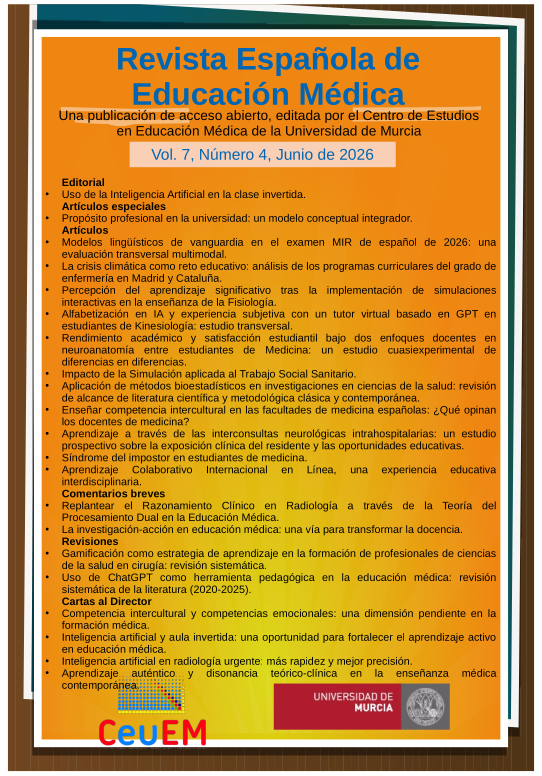
Use of Artificial Intelligence in the flipped classroom.
Abstract
A reformulation of the flipped classroom model, supported by artificial intelligence, is proposed to shift direct instruction outside the classroom and reserve in-person time for activities of greater human and cognitive value. In this approach, AI guides the student through explanations, structured practice, and immediate feedback before the in-person session, while the classroom is dedicated to discussion, resolving conceptual errors, practical application, and collaborative learning. The model is structured around three pillars: (1) the outsourcing of instruction and guided practice through AI following the sequence “I do, we do, you do”; (2) the personalized contextualization of examples and problems without altering the disciplinary content; and (3) immediate and adaptive formative feedback. Although initially developed for university algebra, the approach is transferable to other disciplines such as biology, economics, physics, or literature. Far from being an isolated innovation, the proposal integrates pedagogical approaches widely supported by research: the flipped classroom, gradual empowerment, explicit instruction, formative feedback, contextualized learning, and active learning strategies. The model's distinctive contribution lies in how AI enables these practices to be implemented more efficiently and in a more personalized way. Taken together, the proposal redefines the role of educational technology: AI does not replace the teacher, but rather takes on repetitive and scalable tasks—explanation, practice, and immediate feedback—to free up human time for meaningful interaction, interpreting difficulties, discussion, and building a community in the classroom.
Downloads
-
Abstract55
-
xml (Español (España))0
-
pdf (Español (España))56
-
pdf56
References
1. When the AI Tutor handles the lecture. 2026. Visitado el 9 de mayo de 2026. https://edunewsletter.openai.com/p/when-the-ai-tutor-handles-the-lecture?hide_intro_popup=true
2. Bergmann J, Sams A. Flip Your Classroom: Reach Every Student in Every Class Every Day. International Society for Technology in Education. 2012. https://blog.dilab.uni-passau.de/wp-content/uploads/2021/06/Bergmann-Sams-2012-Flip-your-classroom-Reach-every-student-in-every-class-ecery-day.pdf
3. Pearson P D, Gallagher MC. The instruction of reading comprehension. Contemporary Educational Psychology, 1983, 8(3), 317–344. https://doi.org/10.1016/0361-476X(83)90019-X
4. Rosenshine B. Principles of instruction: Research-based strategies that all teachers should know. American Educator, 2012, 36(1), 12–19, 39. https://www.aft.org/sites/default/files/Rosenshine.pdf
5. Hattie J. Visible learning: A synthesis of over 800 meta-analyses relating to achievement. Routledge, 2009. https://doi.org/10.4324/9780203887332
6. Lave J, Wenger E. Situated learning: Legitimate peripheral participation. Cambridge University Press, 1991. https://doi.org/10.1017/CBO9780511815355
7. Ausubel DP. Educational psychology: A cognitive view. 1968. https://psycnet.apa.org/record/1968-35017-000
8. Freeman, S., Eddy, S. L., McDonough, M., Smith, M. K., Okoroafor, N., Jordt, H., & Wenderoth, M. P. Active learning increases student performance in science, engineering, and mathematics. PNAS Proceedings of the National Academy of Sciences of the United States of America, 2014, 111(23), 8410–8415. https://doi.org/10.1073/pnas.1319030111
Copyright (c) 2026 Servicio de Publicaciones de la Universidad de Murcia

This work is licensed under a Creative Commons Attribution-NonCommercial-NoDerivatives 4.0 International License.
The works published in this magazine are subject to the following terms:
1. The Publications Service of the University of Murcia (the publisher) preserves the economic rights (copyright) of the published works and favors and allows them to be reused under the use license indicated in point 2.
2. The works are published under a Creative Commons Attribution-NonCommercial-NoDerivative 4.0 license.
3. Self-archiving conditions. Authors are allowed and encouraged to disseminate electronically the pre-print versions (version before being evaluated and sent to the journal) and / or post-print (version evaluated and accepted for publication) of their works before publication , since it favors its circulation and earlier diffusion and with it a possible increase in its citation and reach among the academic community.



