
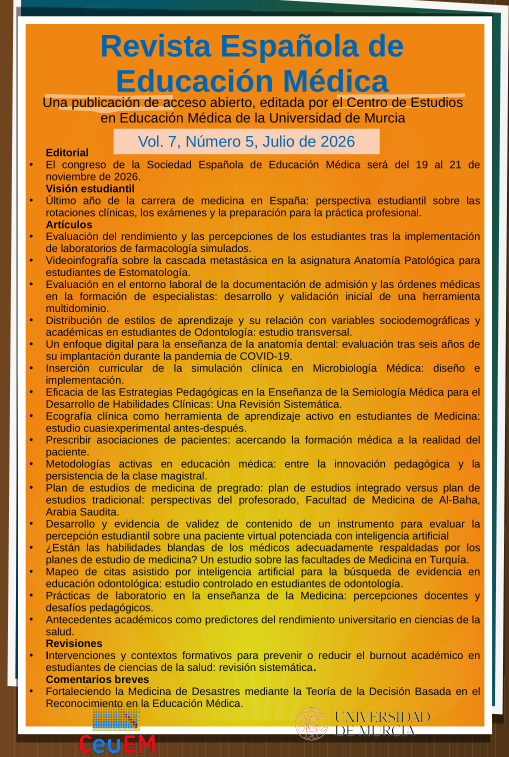
Distribuição dos estilos de aprendizagem e sua relação com variáveis sociodemográficas e acadêmicas em estudantes de Odontologia: um estudo transversal.
Resumo
Introdução: Compreender os estilos de aprendizagem em estudantes da área da saúde é uma ferramenta relevante para orientar a reflexão pedagógica e reconhecer a diversidade de abordagens de aprendizagem. Em odontologia, a formação progride de etapas teóricas para cenários clínicos cada vez mais complexos, tornando pertinente analisar como essas preferências se distribuem ao longo da trajetória educacional.
Objetivo: Analisar a distribuição dos estilos de aprendizagem entre estudantes de odontologia de uma universidade privada em Santiago, Chile, durante o ano de 2025, considerando sua relação com gênero, idade e ano acadêmico.
Métodos: Estudo transversal. Participaram 177 estudantes do primeiro ao quinto ano (taxa de resposta: 53,8%). Foi aplicado o Questionário de Estilos de Aprendizagem de Honey-Alonso (CHAEA). A consistência interna foi avaliada utilizando o alfa de Cronbach (α = 0,592–0,729). Testes não paramétricos foram utilizados para comparações por gênero e ano acadêmico, correlação de Spearman para idade e análise post-hoc com correção de Bonferroni. Os tamanhos do efeito foram estimados utilizando o eta-quadrado (η²).
Resultados: O estilo teórico foi o mais frequente (33,9%), seguido pelo reflexivo (28,8%), pragmático (19,2%) e ativo (18,1%). Não foram observadas diferenças significativas na distribuição dos estilos predominantes por gênero (p=0,051), mas diferenças foram encontradas entre os anos acadêmicos para todos os quatro estilos (p<0,001), com grandes tamanhos de efeito (η²=0,14–0,33). As maiores diferenças concentraram-se entre o terceiro e o quarto ano, coincidindo com o início do ciclo clínico. O estilo pragmático apresentou correlação positiva moderada com a idade (r=0,526; p<0,001) e o estilo teórico, correlação negativa moderada (r=-0,432; p<0,001).
Conclusão: Os estilos de aprendizagem diferem de acordo com a etapa da formação dos estudantes de odontologia, com maiores diferenças observadas entre os cursos pré-clínicos e clínicos. Embora o desenho do estudo não permita alterações ao longo do tempo, os resultados reforçam a necessidade de implementar estratégias pedagógicas diversificadas e coerentes, adaptadas às diferentes etapas da formação.
Downloads
-
Resumo125
-
pdf (Español (España))141
-
pdf 141
Referências
1. Caetano C, Luedke R, Antonello ICF. The importance of identifying learning styles in medical education. Rev Bras Educ Med. 2018, 42, (3), 189–193. https://doi.org/10.1590/1981-52712015v42n3RB20170111r1ING
2. Dalmolin AC, Mackeivicz GAO, Pochapski MT, Pilatti GL, Santos FA. Learning styles preferences and e-learning experience of undergraduate dental students. Rev Odontol UNESP. 2018, 47,(3), 175–182. https://doi.org/10.1590/1807-2577.05118
3. González Garza B, Hernández Castañón MA, Castrejón Reyes V. Estilos de aprendizaje para el desarrollo de competencias en estudiantes de la Licenciatura en Enfermería. RIDE Rev Iberoam Investig Desarro Educ. 2018, 8,(16), 351–369. https://doi.org/10.23913/ride.v8i16.345
4. Altamirano Pérez HR, Cadena Pasquel V, Anchundia Guerrero C, Larcos Pérez J. Aplicación del Cuestionario Honey-Alonso para la caracterización de los estilos de aprendizaje en estudiantes de educación básica. Univ Cienc Tecnol. 2023, 27,(121), 7–15. https://doi.org/10.47460/uct.v27i121.750
5. Baherimoghadam T, Hamedani S, Mehrabi M, Naseri N, Marzban N. The effect of learning style and general self-efficacy on satisfaction of e-Learning in dental students. BMC Med Educ. 2021, 21,(1), 463. https://doi.org/10.1186/s12909-021-02903-5
6. Eckleberry-Hunt J, Lick D, Hunt R. Is Medical Education Ready for Generation Z? J Grad Med Educ. 2018, 10,(4), 378–381. https://doi.org/10.4300/JGME-D-18-00466.1
7. Cardozo LA, Molano-Sotelo E, Moreno-Jiménez J, Vera-Rivera DA, Peña-Vega MA. Identificación de los Estilos de Aprendizaje: Estudiantes universitarios de entrenamiento deportivo de jornadas diurna y nocturna. Educ Fís Cienc. 2018, 20,(4). https://doi.org/10.24215/23142561e060
8. Hernández-Antonio A, Sosa-Velasco T, Caballero-Sánchez H. Estilos de Aprendizajes de Acuerdo a la Teoría Kolb en Estudiantes de Posgrado del Área Odontológica. Int J Odontostomatol. 2025, 19,(2), 103–108. https://dx.doi.org/10.4067/s0718-381x2025000200103
9. Alonso C, Gallego D, Honey P. Los estilos de aprendizaje. Procedimientos de diagnóstico y mejora. Bilbao: Mensajero; 1994. https://dialnet.unirioja.es/servlet/libro?codigo=158637
10. Cortés Barré M, Guillén O JF. Estilos de aprendizaje en estudiantes de medicina. Univ Med. 2018, 59(2), 4–10. https://doi.org/10.11144/javeriana.umed59-2.apre
11. Marantika JER. The relationship between learning styles, gender and learning outcomes. Cypriot J Educ Sci. 2022, 17,(1), 56–67. https://doi.org/10.18844/cjes.v17i1.6681
12. Ortega-Galarza M, Altamirano-Pérez H, Pachacama-Socasi V, Tovar-Pinzón M. Estilos de aprendizaje en estudiantes de posgrado de Odontología a través del cuestionario Honey–Alonso. Rev Innova Educ. 2023, 5,(4), 7–21. https://doi.org/10.35622/j.rie.2023.05.001
13. Parra S, García C, Navarro J. Estilos de aprendizaje según el modelo de Honey y Mumford en estudiantes de primer año de Fonoaudiología y Kinesiología. Rev Electrón Investig Educ Cienc. 2017, 14, (2). https://www.reiec.cl/index.php/reiec/article/view/99
14. Mancilla N, Backes M, Canever P. Estilos de aprendizaje: Preferencia de los estudiantes de enfermería de la Universidad de Magallanes, Chile. Texto Contexto Enferm. 2020, 29(spe), e20190265. https://www.scielo.br/j/tce/a/JbyG984M93YrdS9sPzpwVdn/?lang=es
15. Sarmiento-Cornejo J, Sarmiento-Oesterreich R, Lorca-Parraguez D, Sarmiento-Oesterreich S. Perfiles de aprendizaje y estrategias didácticas para estudiantes de pregrado de la carrera de Odontología de la Universidad de Valparaíso, Chile. FEM Rev Fund Educ Med. 2023, 26,(6), 249–254. https://dx.doi.org/10.33588/fem.2606.1310
16. Bautista Quiroz D. Caracterización de estilos de aprendizaje de estudiantes de la cohorte de ingreso 2017 de la Facultad de Odontología de la Universidad de Chile y su relación con indicadores socioeducativos. [Tesis]. Santiago: Universidad de Chile; 2017. https://repositorio.uchile.cl/handle/2250/146545
17. Venturelli Garay RE, Watt RG. Review and analysis of Chilean dental undergraduate education: curriculum composition and profiles of first year dental students. Hum Resour Health. 2018, 16,(1), 48. https://doi.org/10.1186/s12960-018-0314-8
18. Newton PM, Miah M. Evidence-Based Higher Education - Is the Learning Styles 'Myth' Important? Front Psychol. 2017, 8, 444. https://doi.org/10.3389/fpsyg.2017.00444
19. Pashler H, McDaniel M, Rohrer D, Bjork R. Learning Styles: Concepts and Evidence. Psychol Sci Public Interest. 2008, 9(3), 105–119. https://doi.org/10.1111/j.1539-6053.2009.01038.x
20. Diago Egaña ML, Martínez Abad F, Perochena González P. Preferencias de estilos de aprendizaje en el alumnado español de entre 11 y 15 años. Rev. invest. educ. 2022, 40, (2), 589-606. https://doi.org/10.6018/rie.495231
21. Almeida N, Cunha A. An integrative debate on learning styles and the learning process. Soc Sci Humanit Open. 2020, 2(1), 100017. https://doi.org/10.1016/j.ssaho.2020.100017
22. Villarreal-Fernández J. Cuestionario Honey-Alonso de estilos de aprendizaje (CHAEA). Propiedades psicométricas en estudiantes universitarios colombianos. Psicogente. 2023, 26,(50), 46–69. https://doi.org/10.17081/psico.26.50.6231
23. Ruiz Ledesma E, Chavarría Báez L, García Sánchez J. Estilos de aprendizaje del cuestionario Honey-Alonso y rendimiento académico en estudiantes universitarios. RIDE Rev Iberoam Investig Desarro Educ. 2025, 16,(31), e964. https://doi.org/10.23913/ride.v16i31.2617
24. López Muñoz J de JD, Meza Zamora MEC, Saavedra Vélez CH, Fernández Cañedo L, Lagunes Merino O, Hernández Osorio C, Ortega Planell CB. Estilos de aprendizaje en estudiantes de ciencias de la salud y universidad intercultural de la universidad veracruzana. Ciencia Latina. 2021, 5(4),4798-81. https://doi.org/10.37811/cl_rcm.v5i4.660
25. Porras Mucha CT, Quispe Paiva M, Carhuas Arzapalo IA, Ríos Cataño C. Estilos de aprendizaje en estudiantes universitarios: una revisión descriptiva de la literatura. Desafíos. 2021, 12,(2),144-151. https://doi.org/10.37711/desafios.2021.12.2.345
Direitos de Autor (c) 2026 Serviço de Publicações da Universidade de Múrcia

Este trabalho encontra-se publicado com a Licença Internacional Creative Commons Atribuição-NãoComercial-SemDerivações 4.0.
Os trabalhos publicados nesta revista estão sujeitos aos seguintes termos:
1. O Serviço de Publicações da Universidade de Murcia (o editor) preserva os direitos económicos (direitos de autor) das obras publicadas e favorece e permite a sua reutilização ao abrigo da licença de utilização indicada no ponto 2.
2. Os trabalhos são publicados sob uma licença Creative Commons Atribuição-NãoComercial-NãoDerivada 4.0.
3. Condições de autoarquivamento. Os autores estão autorizados e incentivados a divulgar eletronicamente as versões pré-impressas (versão antes de ser avaliada e enviada à revista) e / ou pós-impressas (versão avaliada e aceita para publicação) de seus trabalhos antes da publicação, desde que favorece sua circulação e difusão mais precoce e com ela possível aumento de sua citação e alcance junto à comunidade acadêmica.