
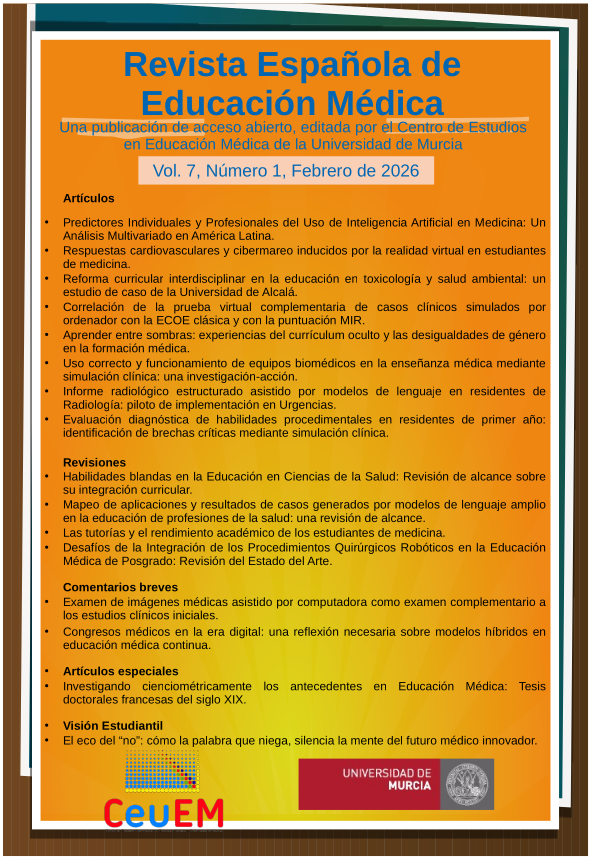
Correlation of the complementary virtual test of computer-simulated clinical cases with the classic OSCE and with the MIR score.
Abstract
Introduction. Starting in 2021, Spanish medical schools were offered a Complementary Virtual Clinical Examination (CVCE) with computer-simulated clinical cases, sponsored by the National Conference of Deans. This study analyzes the correlation between CVCE scores, the local OSCE with simulated patients and mannequins, the clinical rotation score, and the results of the MIR exam. Methods. An observational correlation study was conducted, including students evaluated between 2021 and 2025 at the University of Las Palmas de Gran Canaria. Correlations were analyzed using Pearson and Spearman coefficients. Results. 652 students were included, with MIR data available for 2022. The correlation between the local OSCE and the CVCE and the MIR was weak (Rho = 0.26; p<0.001 and Rho = 0.31; p<0.001, respectively). The correlation between the Clinical Clinical Practice Assessment (CCP) and the Medical Residency Exam (MIR) was moderate and consistent over the five years (r = 0.56; p < 0.001). No correlation was found between the clinical rotation score and the CCP, the OSCE, or the MIR. Women performed better in the local OSCE history taking and in the clinical rotation, while men performed better in the CCP and the MIR. Conclusions. The CCP correlates more consistently with the MIR than the local OSCE, suggesting greater predictive value. The results suggest that the MIR and the local OSCE assess different domains of clinical competence, highlighting the complementary and exploratory nature of the skills each test evaluates.
Downloads
-
Abstract140
-
pdf (Español (España))80
-
pdf80
References
1. Harden RM, Stevenson WM, Doynie W, Wilson GM. Assessment of Clinical Competence Using an Objective Structured Examination (OSCE). Br Med J. 1975, 1, 447. https://doi.org/10.1136/bmj.1.5955.447.
2. Regehr G, Freeman R, Robb A, Missiha N, Heisey R. OSCE performance evaluations made by standardized patients: comparing checklist and global rating scores. Acad Med. 1999, 74, S135. https://doi.org/10.1097/00001888-199910000-00064.
3. Sloan DA, Donnelly MB, Schwartz RW, Strodel WE. The Objective Structured Clinical Examination. The new gold standard for evaluating postgraduate clinical performance. Ann Surg. 1995, 222, 735. https://doi.org/10.1097/00000658-199512000-00007.
4. Orden ECI/332/2008, de 13 de Febrero, por la que se establecen los requisitos para la verificación de los títulos universitarios oficiales que habiliten para el ejercicio de la profesión de Médico. BOE, 15 de Febrero de 2008, núm. 40, pp. 8351-5.
5. García-Estañ López L. Prueba Nacional de Evaluación de Competencias Clínicas de la Conferencia Nacional de Decanos de Facultades de Medicina de España. FEM. 2013, 16, S1. https://www.um.es/documents/1935287/1936044/Garc%C3%ADa-Esta%C3%B1%20ECOE+CND.pdf/6e270f9c-83d3-4e04-946f-189119bc2248
6. García-Seoane JJ, Ramos-Rincón JM, Lara-Muñoz JP et al. Cambios en el examen clínico objetivo y estructurado (ECOE) de las facultades de Medicina durante la COVID-19. Experiencia de una ECOE de casos-clínicos computarizados simulados (ECOE-CCS) conjunta. Rev Clin Esp. 2021, 221, 456. https://doi.org/10.1016/j.rce.2021.01.004.
7. Ley 44/2003, de 21 de noviembre, de ordenación de las profesiones sanitarias. Boletín Oficial del Estado, nº 280, 22 de noviembre de 2003. p. 41442-41458. https://www.boe.es/buscar/act.php?id=BOE-A-2003-21340
8. Real Decreto 589/2022, de 19 de julio, por el que se regulan las pruebas selectivas para el acceso a plazas de formación sanitaria especializada. Boletín Oficial del Estado, nº 173, 20 de julio de 2022. p. 104456-104477. https://www.boe.es/buscar/act.php?id=BOE-A-2022-12015
9. Baillés E, Girvent M, Moyano E, Pérez Sánchez J. Relación entre expediente académico y resultado en la prueba MIR en los estudios de medicina de la UPF-UAB. FEM. 2020, 23, 205. https://doi.org/10.33588/fem.234.1069.
10. Meana JJ, Aretxaga B. Rendimiento en la prueba MIR de los licenciados en la Universidad del País Vasco (UPV/EHU): análisis de cuatro promociones. Educ Med. 2005, 8, 153. https://scielo.isciii.es/pdf/edu/v8n3/09comunicaciones1.pdf
11. Aspa-Marco FJ, Rodríguez de Castro F. Evaluación final: ¿sirve el examen MIR? Educ Med. 2010, 13, S73. https://scielo.isciii.es/scielo.php?script=sci_arttext&pid=S1575-18132010000500014
12. Palés-Argullós J. Contenidos y calidad del examen MIR. FEM. 2020, 23, S11. https://scielo.isciii.es/pdf/fem/v23s1/2014-9832-fem-23-s1-11.pdf
13. Gutiérrez J, Baillés E, Girvent M, Moyano E, Larramona P, Pérez J. Relación de las calificaciones en la prueba ECOE de la administración catalana con el expediente académico y los resultados en la prueba MIR en estudiantes de Medicina de la UPF-UAB. Rev Esp Edu Med. 2020, 1, 82. https://doi.org/10.6018/edumed.422961
14. Martin IG, Jolly B. Predictive validity and estimated cut score of an objective structured clinical examination (OSCE) used as an assessment of clinical skills at the end of the first clinical year. Med Educ. 2002, 36, 418. https://doi.org/10.1046/j.1365-2923.2002.01207.x
15. Pugh D, Bhanji F, Cole G et al. Do OSCE progress test scores predict performance in a national high-stakes examination? Med Educ. 2016, 351. https://doi.org/10.1111/medu.12942
16. Komasawa N, Terasaki F, Nakano T, Kawata R. Relationships between objective structured clinical examination, computer-based testing, and clinical clerkship performance in Japanese medical students. PLoS One. 2020, 26, 15. https://doi.org/10.1371/journal.pone.0230792
17. Cervera-Barba E, Denizon-Arranz S, Castañeda-Vozmediano R et al. Correlación de competencias evaluadas en una evaluación clínica objetiva estructurada, un test de opción múltiple y un examen de casos clínicos por ordenador en estudiantes de último curso de Medicina. Educ Med. 2026, 27. https://doi.org/10.1016/j.edumed.2025.101113
18. Díaz-Fernández M, Llorente-Marrón M, Cocina-Díaz V, Asensi V. COVID-19 and Access to Medical Professional Careers: Does Gender Matter? Int J Environ Res Public Health. 2023, 20, 6477. https://doi.org/10.3390/ijerph20156477
Copyright (c) 2026 Servicio de Publicaciones de la Universidad de Murcia

This work is licensed under a Creative Commons Attribution-NonCommercial-NoDerivatives 4.0 International License.
The works published in this magazine are subject to the following terms:
1. The Publications Service of the University of Murcia (the publisher) preserves the economic rights (copyright) of the published works and favors and allows them to be reused under the use license indicated in point 2.
2. The works are published under a Creative Commons Attribution-NonCommercial-NoDerivative 4.0 license.
3. Self-archiving conditions. Authors are allowed and encouraged to disseminate electronically the pre-print versions (version before being evaluated and sent to the journal) and / or post-print (version evaluated and accepted for publication) of their works before publication , since it favors its circulation and earlier diffusion and with it a possible increase in its citation and reach among the academic community.



