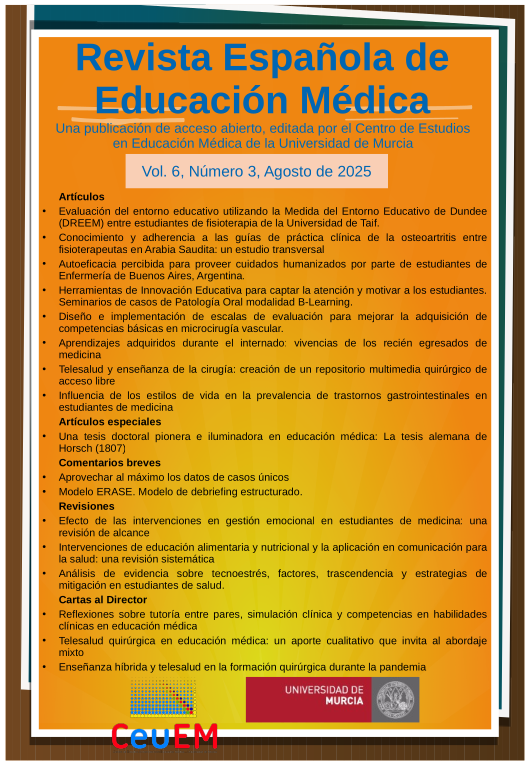
Reflections on Peer Tutoring, Clinical Simulation, and Competencies in Clinical Skills in Medical Education
Abstract
This letter to the editor offers reflections on the article by López-Brotons et al., which addresses peer tutoring in clinical simulation for the development of clinical skills among medical students. The letter emphasizes the relevance of this pedagogical approach based on current evidence, which supports its effectiveness in enhancing not only clinical competencies but also teaching skills, leadership, communication, and professional identity among peer tutors. Findings from national and international studies are incorporated, demonstrating the positive impact of peer-assisted learning combined with clinical simulation at various levels of medical education, from undergraduate to postgraduate training. The authors also acknowledge existing methodological limitations in current studies, highlighting the need for future research to assess long-term outcomes, standardize training programs, and validate measurement instruments. Finally, the letter underscores the importance of continued development and investigation of these innovative methodologies to strengthen medical education.
Downloads
-
Abstract390
-
pdf (Español (España))151
References
López-Brotons M, Javaloy-Ballestero S, Ramos Rincón JM. Análisis del Aprendizaje Adquirido, a través de la Tutoría entre Pares, en la Formación de Habilidades de Exploración Física en Simulación Clínica en Estudiantes de Medicina. Rev Esp Educ Med. 2024;6(1). https://doi.org/10.6018/edumed.639271
Rudinsky SL, Spalding C, Conley SP, Everett L, Cole R. The development, implementation, and evaluation of a medical student peer teaching training curriculum during a high-fidelity prehospital trauma simulation. AEM Educ Train. 2022;6(4):e10782. https://doi.org/10.1002/aet2.10782
Lee T, Yoon SW, Fernando S, Willey S, Kumar A. Blended (online and in-person) Women's Health Interprofessional Learning by Simulation (WHIPLS) for medical and midwifery students. Aust N Z J Obstet Gynaecol. 2022;62(4):596-604. https://doi.org/10.1111/ajo.13531
Dickman N, Barash A, Reis S, Karasik D. Students as anatomy near-peer teachers: a double-edged sword for an ancient skill. BMC Med Educ. 2017;17(1):156. https://doi.org/10.1186/s12909-017-0996-y
Jaffrelot M, Boet S, Floch Y, Garg N, Dubois D, Laparra V, et al. Learning with our peers: peer-led versus instructor-led debriefing for simulated crises, a randomized controlled trial. Korean J Anesthesiol. 2024;77(2):265-272. https://doi.org/10.4097/kja.23317
Mileder L, Wegscheider T, Dimai HP. Teaching first-year medical students in basic clinical and procedural skills--a novel course concept at a medical school in Austria. GMS Z Med Ausbild. 2014;31(1):Doc6. https://doi.org/10.3205/zma000898
Chiu PW, Chu SC, Yang CH, Lee HF, Hung HM, Hsu HC. Peer-assisted learning in critical care: a simulation-based approach for postgraduate medical training. Med Educ Online. 2025;30(1):2497333. https://doi.org/10.1080/10872981.2025.2497333
Evans CL, Bazant E, Atukunda I, Williams E, Niermeyer S, Hiner C, et al. Peer-assisted learning after onsite, low-dose, high-frequency training and practice on simulators to prevent and treat postpartum hemorrhage and neonatal asphyxia: A pragmatic trial in 12 districts in Uganda. PLoS One. 2018;13(12):e0207909. https://doi.org/10.1371/journal.pone.0207909
Ramm D, Thomson A, Jackson A. Learning clinical skills in the simulation suite: the lived experiences of student nurses involved in peer teaching and peer assessment. Nurse Educ Today. 2015;35(6):823-827. https://doi.org/10.1016/j.nedt.2015.01.023
Copyright (c) 2025 Servicio de Publicaciones de la Universidad de Murcia

This work is licensed under a Creative Commons Attribution-NonCommercial-NoDerivatives 4.0 International License.
The works published in this magazine are subject to the following terms:
1. The Publications Service of the University of Murcia (the publisher) preserves the economic rights (copyright) of the published works and favors and allows them to be reused under the use license indicated in point 2.
2. The works are published under a Creative Commons Attribution-NonCommercial-NoDerivative 4.0 license.
3. Self-archiving conditions. Authors are allowed and encouraged to disseminate electronically the pre-print versions (version before being evaluated and sent to the journal) and / or post-print (version evaluated and accepted for publication) of their works before publication , since it favors its circulation and earlier diffusion and with it a possible increase in its citation and reach among the academic community.

 This is a Diamond Journal