
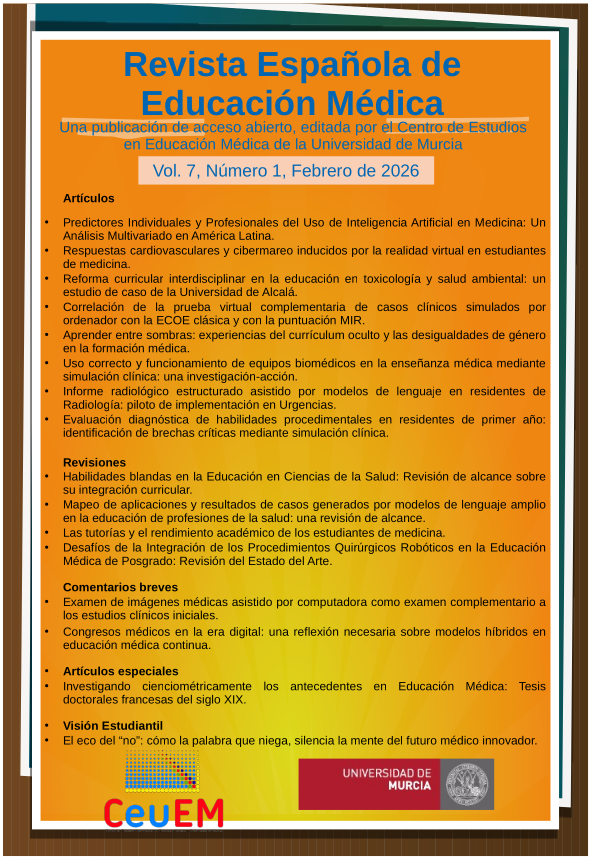
Evaluación diagnóstica de habilidades procedimentales en residentes de primer año: identificación de brechas críticas mediante simulación clínica.
Resumo
Introducción: El ingreso a un programa de especialidad médica supone que los residentes manejan procedimientos diagnósticos y terapéuticos básicos, tal como se espera en el perfil de egreso nacional para médicos generales. Sin embargo, estudios previos señalan una autopercepción de baja preparación práctica, atribuida a una limitada exposición durante el pregrado. Este estudio evaluó habilidades procedimentales en residentes de primer año mediante simulación clínica, con el fin de identificar brechas formativas desde el inicio del posgrado. Métodos: Se evaluaron 83 residentes correspondientes a dos cohortes (2024 y 2025), pertenecientes a once especialidades. Se aplicaron pruebas prácticas en cuatro procedimientos: técnica aséptica (n=83), sutura interrumpida (n=48), punción lumbar (n=35) e intubación orotraqueal (n=34). Las evaluaciones se realizaron en un entorno simulado mediante listas de cotejo basadas en estándares internacionales y criterios definidos por expertos clínicos y docentes. El desempeño individual se clasificó con fines diagnósticos como competente (≥70 %), insuficiente o puntaje máximo. Resultados: La competencia fue de 88,0% en técnica aséptica, 95,8% en sutura, 73,5% en intubación orotraqueal, y 65,7% en punción lumbar. Se observaron diferencias marcadas entre técnicas, destacando mayor dificultad en procedimientos complejos o poco frecuentes. La punción lumbar presentó el mayor porcentaje de desempeño insuficiente. Conclusión: La simulación clínica permitió evaluar objetivamente las habilidades procedimentales iniciales de los residentes, revelando discrepancias entre la percepción de preparación y el desempeño real. Esta estrategia aporta datos objetivos para diseñar intervenciones dirigidas, identificando la punción lumbar como prioridad crítica (34,3% con desempeño insuficiente). El enfoque contribuye potencialmente a fortalecer la seguridad clínica y optimiza la asignación de recursos formativos desde el ingreso a la especialidad.
Downloads
-
Resumo161
-
pdf (Español (España))123
-
pdf 123
Referências
1. Chipman JG, Schmitz CC. Using objective structured assessment of technical skills to evaluate a basic skills simulation curriculum for first-year surgical residents. J Am Coll Surg. 2009, 209, 364-370. https://doi.org/10.1016/j.jamcollsurg.2009.05.005
2. Stepaniak C, Bui A, Bertram G, Powers J, Mattingly A, Stovall J, et al. An Assessment of Basic Patient Safety Skills in Residents Entering the First Year of Clinical Training. Jt Comm J Qual Patient Saf. 2015, 41, 341-345. https://doi.org/10.1016/S1553-7250(15)41031-3
3. Martin JA, Regehr G, Reznick R, MacRae H, Murnaghan J, Hutchison C, et al. Objective structured assessment of technical skill (OSATS) for surgical residents. Br J Surg. 1997, 84, 273-278. https://doi.org/10.1046/j.1365-2168.1997.02502.x
4. Ashrafzadeh S, Dickinson KM, Goldsworthy M, Scheich B, Powell M, McAlister RP. Re-boot: Simulation Elective for Medical Students as Preparation Bootcamp for Obstetrics and Gynecology Residency. Cureus. 2018, 10, e3097. https://doi.org/10.7759/cureus.3097
5. Cook DA, Hatala R, Brydges R, Zendejas B, Szostek JH, Wang AT, et al. Technology-enhanced simulation for health professions education: a systematic review and meta-analysis. JAMA. 2011, 306, 978-988. https://doi.org/10.1001/jama.2011.1234
6. Mitchell AA, Ivimey-Cook ER. Technology-enhanced simulation for healthcare professionals: A meta-analysis. Front Med. 2023, 10, 1149048. https://doi.org/10.3389/fmed.2023.1149048
7. Saragih ID, Suarilah I, Hsiao CT, Fann WC, Lee BO. Interdisciplinary simulation-based teaching and learning for healthcare professionals: A systematic review and meta-analysis of randomized controlled trials. Nurse Educ Pract. 2024, 76, 103920. https://doi.org/10.1016/j.nepr.2024.103920
8. Barsuk JH, Cohen ER, Caprio T, McGaghie WC, Simuni T, Wayne DB. Simulation-based education with mastery learning improves residents' lumbar puncture skills. Neurology. 2012, 79, 132-137. https://doi.org/10.1212/WNL.0b013e318258f4d7
9. Alharbi NS. Evaluating competency-based medical education: a systematized review of current practices. BMC Med Educ. 2024, 24, 612. https://doi.org/10.1186/s12909-024-05609-6
10. McGaghie WC, Issenberg SB, Petrusa ER, Scalese RJ. A critical review of simulation-based medical education research: 2003-2009. Med Educ. 2010, 44, 50-63. https://doi.org/10.1111/j.1365-2923.2009.03547.x
11. Asociación de Facultades de Medicina de Chile (ASOFAMECH). Perfil de Egreso del Médico Cirujano. Santiago: ASOFAMECH; 2019. Disponible en: https://www.asofamech.cl/perfil-egreso
12. Yudkowsky R, Otaki J, Lowenstein T, Riddle J, Nishigori H, Bordage G. A hypothesis-driven physical examination learning and assessment procedure for medical students: initial validity evidence. Med Educ. 2009, 43, 729-740. https://doi.org/10.1111/j.1365-2923.2009.03379.x
13. León-Castelao E, Maestre JM. Prebriefing en simulación clínica: análisis del concepto y terminología en castellano. Educ Med. 2019, 20, 238-248. https://doi.org/10.1016/j.edumed.2018.12.011
14. Armon C, Evans RW; Therapeutics and Technology Assessment Subcommittee of the American Academy of Neurology. Addendum to assessment: Prevention of post-lumbar puncture headaches: report of the Therapeutics and Technology Assessment Subcommittee of the American Academy of Neurology. Neurology. 2005, 65, 510-512. https://doi.org/10.1212/01.wnl.0000173034.96211.1b
15. Griesdale DE, Bosma TL, Kurth T, Isac G, Chittock DR. Complications of endotracheal intubation in the critically ill. Intensive Care Med. 2008, 34, 1835-1842. https://doi.org/10.1007/s00134-008-1205-6
16. Soffler M, Maheshwari K, Tsai M, Mays JA, Elshafei A, Shah KN, et al. Perception Precedes Reality: A Simulation and Procedural Bootcamp Improves Residents' Comfort With Transitioning to Clinical Anesthesiology Training. Anesth Analg. 2022, 134, 1041-1050. https://doi.org/10.1213/ANE.0000000000005945
Direitos de Autor (c) 2026 Serviço de Publicações da Universidade de Múrcia

Este trabalho encontra-se publicado com a Licença Internacional Creative Commons Atribuição-NãoComercial-SemDerivações 4.0.
Os trabalhos publicados nesta revista estão sujeitos aos seguintes termos:
1. O Serviço de Publicações da Universidade de Murcia (o editor) preserva os direitos económicos (direitos de autor) das obras publicadas e favorece e permite a sua reutilização ao abrigo da licença de utilização indicada no ponto 2.
2. Os trabalhos são publicados sob uma licença Creative Commons Atribuição-NãoComercial-NãoDerivada 4.0.
3. Condições de autoarquivamento. Os autores estão autorizados e incentivados a divulgar eletronicamente as versões pré-impressas (versão antes de ser avaliada e enviada à revista) e / ou pós-impressas (versão avaliada e aceita para publicação) de seus trabalhos antes da publicação, desde que favorece sua circulação e difusão mais precoce e com ela possível aumento de sua citação e alcance junto à comunidade acadêmica.