
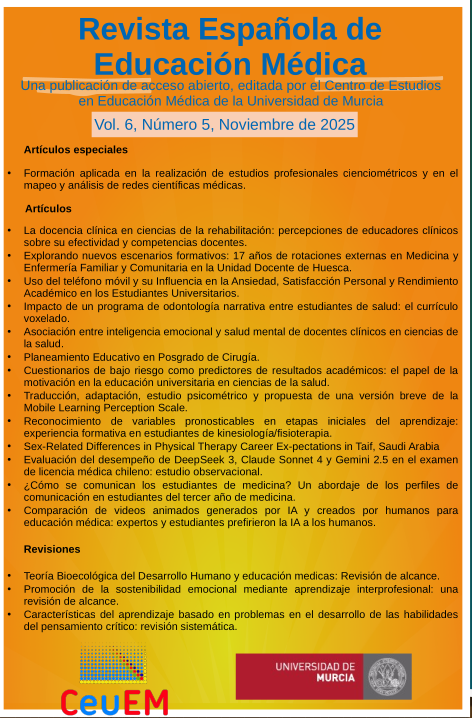
Smartphone Use and its Influence on Anxiety, Personal Satisfaction and Academic Performance in University Students
Abstract
The research examines the influence of excessive smartphone use on three key dimensions of university life: anxiety, perceived personal satisfaction, and academic performance. A quantitative approach was adopted with a non-experimental cross-sectional design and a descriptive-correlational scope. Validated psychometric instruments were used, including the Smartphone Dependence and Addiction Scale (EDAS), the Beck Anxiety Inventory (BAI), the Satisfaction with Life Scale (SWLS), and the University Academic Performance Scale (RAU), administered to a sample of 370 students. The findings revealed that students with greater smartphone dependence exhibited significantly higher levels of anxiety, lower academic performance, and higher levels of personal life satisfaction. It was concluded that constant interaction on social media and mobile applications fostered states of anxiety by generating a permanent need for connection, which affected the students' emotional well-being. Likewise, this technological distraction decreased concentration and academic organisation, negatively impacting university performance and achievement. In addition, an increase in personal satisfaction was observed, which could be related to a feeling of emotional disconnection or social isolation. These results underscore the need to promote educational strategies that favour a balanced use of technology, minimising its negative effects in the academic context.
Downloads
-
Abstract3250
-
pdf (Español (España))1586
-
pdf1586
References
United Nations. Más del 75% de la población mundial tiene un teléfono celular y más del 65% usa el internet 2023. https://news.un.org/es/story/2023/12/1526712
INEC. 2025. Los Usuarios de Teléfonos Inteligentes (Smartphone) se Incrementaron en un 60%. https://www.ecuadorencifras.gob.ec/los-usuarios-de-telefonos-inteligentes-smartphone-se-incrementaron-en-un-60/
Meyerhoff, Jonah, Tony Liu, Konrad P. Kording, Lyle H. Ungar, Susan M. Kaiser, Chris J. Karr, and David C. Mohr. Evaluation of Changes in Depression, Anxiety, and Social Anxiety Using Smartphone Sensor Features: Longitudinal Cohort Study. Journal of Medical Internet Research 2021, 23(9), e22844. https://doi.org/10.2196/22844
Lin, Y, Chih-Lin, C., Po-Hsien L., Li-Ren, C., Chih-Hung, K, Yang-Han, L, & Sheng-Hsuan L. Proposed Diagnostic Criteria for Smartphone Addiction. PloS One 2016, 11(11), e0163010. https://doi.org/10.1371/journal.pone.0163010
Alotaibi, M., Fox, M., Coman, R., Ratan, Z., & Hosseinzadeh, H. Smartphone Addiction Prevalence and Its Association on Academic Performance, Physical Health, and Mental Well-Being among University Students in Umm Al-Qura University (UQU), Saudi Arabia. International Journal of Environmental Research and Public Health, 2022, 19(6), 3710. https://doi.org/10.3390/ijerph19063710
Chinwong, D., Sukwuttichai, P., Jaiwong, N., Saenjum, C., Klinjun, N., & Chinwong, S. Smartphone Use and Addiction among Pharmacy Students in Northern Thailand: A Cross-Sectional Study. Healthcare 2023, 11(9), 1264. https://doi.org/10.3390/healthcare11091264
Alhassan, M., Al-Otaibi, E., Ofaysan, M., Alarjani, K., Alzuhairi, M., Alarfaj, N., Al-Murayt, F., Alotaibi, B., Alanazi, K., Alfawaz, A., & Musa, A.Smartphone addiction and its psychosocial correlates among university students. Cureus 2025. https://doi.org/10.7759/cureus.91165
Castillo Gonzales, M. & SEK International University. Mobile device dependence and internalizing problems in Ecuadorian university students. Rev Eugenio Espejo, 2025, 46, 1–46) https://doi.org/10.37135/ee.04.23.04.
Hidalgo-Cajo, B., & Meneses-Freire, M. Factores de Riesgo Específicos Asociados Al Síndrome de Burnout En El Profesorado de La Universidad Nacional de Chimborazo. Espacios, 2024, 45(6), 23–37. https://doi.org/10.48082/espacios-a24v45n06p03
Asamblea Médica Mundial. Declaración de Helsinki de la AMM - Principios éticos para las investigaciones médicas en seres humanos. Acta Bioeth, 2013, 1–9. https://www.wma.net/es/policies-post/declaracion-de-helsinki-de-la-amm-principios-eticos-para-las-investigaciones-medicas-en-seres-humanos/
García-Domingo M, Fuentes V, Pérez-Padilla J, Aranda M. EDAS-18: validación de la versión corta de la escala de dependencia y adicción al smartphone. Terapia Psicológica, 2020, 38(3), 339–361. https://doi.org/10.4067/S0718-48082020000300339
Beck A, Epstein N, Brown G, Steer R. An inventory for measuring clinical anxiety: Psychometric properties [Un inventario para medir la ansiedad clínica: propiedades psicométricas]. Journal of Consulting and Clinical Psychology, 1988, 56(6), 893–897. https://doi.org/10.1037/0022-006X.56.6.893
Beck A, Steer R, Sanz J, Vallar F, De La Guía E, Hernández A, Educación P. Inventario de Ansiedad de Beck (BAI). 2013, 1–14. https://www.cop.es/uploads/PDF/2013/BAI.pdf
Diener E, Emmons R, Larsen RJ, Griffin S. Escala de Satisfacción con la Vida. Journal of Personality Assessment, 1985, 49(1), 71–75. https://doi.org/10.1207/s15327752jpa4901_13
Preciado-Serrano M, González M, Colunga-Rodríguez C, Vázquez-Colunga JC, Esparza-Zamora M, Vázquez-Juárez CL, Obando-Changuán M. Construction and validation of the university academic performance RAU scale. Revista Iberoamericana de Diagnóstico y Evaluación Psicológica, 2021, 60(3), 5–14. https://doi.org/10.21865/RIDEP60.3.01
George D, Mallery P. IBM SPSS Statistics 29 Step by Step: A Simple Guide and Reference (18th ed.). Routledge, 2024. https://doi.org/10.4324/9781032622156
Andone I, Konrad B, Mark E, Trendafilov C, Alexander M. How Age and Gender Affect Smartphone Usage. Proceedings of the 2016 ACM International Joint Conference on Pervasive and Ubiquitous Computing, 2016, Adjunct 9–12. https://doi.org/10.1145/2968219.2971451
Linares R, García-Domingo M, Amezcua T, Fuentes V, Moreno-Padilla M. Cyber-Dating Abuse in Young Adult Couples: Relations with Sexist Attitudes and Violence Justification, Smartphone Usage and Impulsivity. PLoS One, 2021, 16(6), e0253180. https://doi.org/10.1371/journal.pone.0253180
Hidalgo-Cajo B, Gisbert-Cervera M. La adopción y el uso de las tecnologías digitales en el profesorado universitario: un análisis desde la perspectiva del género y la edad. Revista de Educación a Distancia (RED), 2021, 21(11), 1–19. https://doi.org/10.6018/red.481161
Edwards E, McLeod G, Khan A. Anxiety Related Distractibility Deficits: Too Much Smartphone Use Is Not Such a Smart Call. Behaviour & Information Technology, 2024, 43(13), 3253–3260. https://doi.org/10.1080/0144929X.2023.2274891
Xiao T, Mengting P, Xiao X, Yang L. The Relationship between Physical Activity and Sleep Disorders in Adolescents: A Chain-Mediated Model of Anxiety and Mobile Phone Dependence. BMC Psychology, 2024, 12(1), 751.
Daraj L, Muneera A, Yaser M, Khaled T, Haitham J. Systematic Review and Meta-Analysis of the Correlation Coefficients between Nomophobia and Anxiety, Smartphone Addiction, and Insomnia Symptoms. Healthcare, 2023, 11, 2066. https://doi.org/10.3390/healthcare11142066
Hidalgo-Cajo B. Modelo de aula Ubicua en el entorno de aprendizaje mixto con enfoque social en la educación universitaria. Espacios en Blanco. Revista de Educación, 2024. https://doi.org/10.37177/UNICEN/EB34-409
Pereira F, Guilherme G, Danilo R, Andrade A. Impact of Problematic Smartphone Use on Mental Health of Adolescent Students: Association with Mood, Symptoms of Depression, and Physical Activity. Cyberpsychology, Behavior, and Social Networking, 2020, 23(9), 619–626. https://doi.org/10.1089/cyber.2019.0257
Herring M, Lindheimer J, O’Connor P. The Effects of Exercise Training on Anxiety. American Journal of Lifestyle Medicine, 2014, 8(6), 388–403. https://doi.org/10.1177/1559827613508542
Jose S, Maneesha C, Cyriac S, Lidiyamol P, Dhandapani D. Impact of Problematic Mobile Phone Use among Nursing Students in India: Exploring Associations with Depression, Insomnia, Self‐esteem and Satisfaction with Life. International Journal of Nursing Practice, 2024, 30(5), e13247. https://doi.org/10.1111/ijn.13247
Dai C, Zixue T, Shan N. Smartphone Use and Psychological Well-Being among College Students in China: A Qualitative Assessment. Frontiers in Psychology, 2021, 12, 708970. https://doi.org/10.3389/fpsyg.2021.708970
Samaha M, Hawi N, Salameh N. Digital fatigue and subjective well-being among heavy smartphone users. Frontiers in Psychology, 2023, 14, 1123796. https://doi.org/10.3389/fpsyg.2023.1123796
Beiromvand A, Shahnaz K, Shadi T, Reza B, Hanieh A, Kianpour M, Sadeghi N. Relationship between Cellphone Overuse with Sleep Quality and Self-Efficacy in Clinical Performance of Nurse and Midwifery Students. Iranian Journal of Nursing and Midwifery Research, 2024, 29(6), 709–713. https://doi.org/10.4103/ijnmr.ijnmr_8_23
Meskini N, Zakaria F, Mouloud L, Sfendla A, Laarbi O. The Association Between Excessive Smartphone Use, Insomnia, and Academic Performance Among Middle School Adolescents in Morocco. E3S Web of Conferences, 2024, 477, 58. https://doi.org/10.1051/e3sconf/202447700058
Edeh F, Blessing F, Collins I, Mundu M, Ainebyoona C, Dayo D, Neji D, Lilian A, Najjuma A. Smartphone Usage and Academic Performance of Management Science Students in an Emerging Economy. Management, 2024, 9(3), 516–532. https://doi.org/10.32535/ijabim.v9i3.3593
Suhail T, Indiradevi E, Suresh A, Ayyappan A. Smartphone Distractions and Cognitive Performance in Adolescents: An Electroencephalography Approach. Basic & Clinical Neuroscience, 2025, 16(1). https://doi.org/10.1089/ciber.2019.0257
Copyright (c) 2025 Servicio de Publicaciones de la Universidad de Murcia

This work is licensed under a Creative Commons Attribution-NonCommercial-NoDerivatives 4.0 International License.
The works published in this magazine are subject to the following terms:
1. The Publications Service of the University of Murcia (the publisher) preserves the economic rights (copyright) of the published works and favors and allows them to be reused under the use license indicated in point 2.
2. The works are published under a Creative Commons Attribution-NonCommercial-NoDerivative 4.0 license.
3. Self-archiving conditions. Authors are allowed and encouraged to disseminate electronically the pre-print versions (version before being evaluated and sent to the journal) and / or post-print (version evaluated and accepted for publication) of their works before publication , since it favors its circulation and earlier diffusion and with it a possible increase in its citation and reach among the academic community.



