
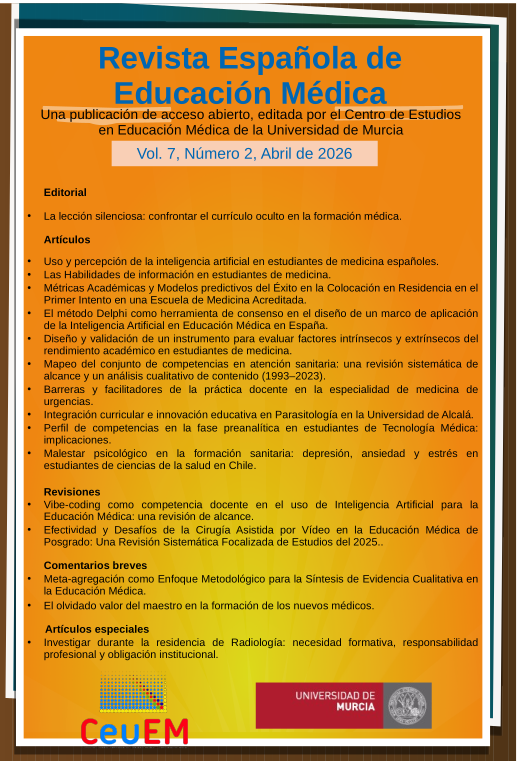
Design and validation of an instrument to evaluate intrinsic and extrinsic factors of academic performance in medical students.
Abstract
Background: Low academic performance is a significant problem in medical programs that affects students' academic trajectories and well-being. This phenomenon results from the complex interaction between intrinsic factors (cognitive and emotional) and extrinsic factors (contextual and social). However, there remains a lack of validated instruments that comprehensively assess this multiplicity of factors in the Mexican context. The systematic identification of these factors is essential for designing effective preventive interventions. Objective To design and validate an instrument to systematically identify and assess the intrinsic and extrinsic factors that influence academic performance in medical students. Method: An instrumental study with an exploratory sequential design was conducted. Phase I: literature review in six specialized databases, 57 exploratory interviews with discourse analysis, and preliminary instrument development. Phase II: two pilot tests (n₁=33, n₂=45) and two rounds of expert judgment validation (5 and 6 experts respectively). The Content Validity Coefficient (CVC) was used as a measure of reliability.Results: The first round of validation of the 42 preliminary items obtained a total CVC of 0.902. After incorporating expert recommendations, the final 38-item version achieved a total CVC of 0.974, exceeding international acceptance criteria. The final instrument integrates four dimensions that operationalize the key factors: (1) sociodemographic characteristics and academic background; (2) metacognition and self-regulation; (3) academic emotions and support networks; and (4) sleep habits and mental health. Conclusion: A validated, reliable, and comprehensive instrument was developed that operationalizes the intrinsic factors (metacognition, emotional regulation, mental health) and extrinsic factors (academic background, socioeconomic context, support networks) that determine academic performance in Mexican medical students. This tool facilitates early identification of academic risk and provides a foundation for designing contextualized and personalized educational interventions.
Downloads
-
Abstract539
-
pdf (Español (España))648
-
pdf648
References
1. Rubiano Romero SS, Martínez Huertas JC. El desempeño académico como un comportamiento en el proceso de enseñanza aprendizaje. Ciencia Latina. 2024, 8(2), 5247-61. https://doi.org/10.37811/cl_rcm.v8i2.10941
2. Navarro RE. El rendimiento académico: concepto, investigación y desarrollo. REICE. 2003, 1(2), 1-15. https://doi.org/10.15366/reice2003.1.2.007.
3. Nazir S, Khalid A, Yousaf D, et al. Potential dropout thoughts and their influencing factors among medical students. Cureus. 2024, 16(11), e74757. https://doi.org/10.7759/cureus.74757.
4. Fernández MA, Gutiérrez D, Cruz P, et al. Abandono escolar en medicina: análisis de tres promociones. FEM. 2020, 23(6), 331-333. https://dx.doi.org/10.33588/fem.236.1094.
5. Martínez González A, Herrera Penilla CJ, García Minjares M, et al. Trayectorias académicas de los estudiantes de licenciaturas de ciencias de la salud. Gac Med Mex. 2023, 159(3), 238-244. http://dx.doi.org/10.24875/GMM.22000393.
6. Bautista Rodríguez G, Fortoul T. Trayectorias académicas de tres generaciones de una licenciatura en Medicina durante la pandemia por COVID-19. RIEM. 2025, 14(53), 25-34. https://doi.org/10.22201/fm.20075057e.2025.53.24609.
7. Heffington DV, Dzay Chulim F, Fernández de Lara HR, et al. Una Aproximación Cuantitativa a la Deserción Escolar en la Educación Superior en el Sureste de México. Revista de la educación superior. 2024, 53(211), 19-40. https://doi.org/10.36857/resu.2024.211.2954.
8. Bin Abdulrahman KA, Khalaf AM, Bin Abbas FB, et al. Study habits of highly effective medical students. Adv Med Educ Pract. 2021, 12, 627–33. https://doi.org/10.2147/AMEP.S309535.
9. Bin Abdulrahman KA, Alshehri AS, Alkhalifah KM, et al. The relationship between motivation and academic performance among medical students in Riyadh. Cureus. 2023, 15(10), e46815. https://doi.org/10.7759/cureus.46815.
10. Guerrero López JB, Monterrosas AM, Reyes Carmona C, et al. Factors related to academic performance in medical students. Salud Ment. 2023, 46(4), 193–200. https://doi.org/10.17711/SM.0185-3325.2023.024.
11. Gruppen LD, Irby DM, Durning SJ, et al. Conceptualizing learning environments in the health professions. Acad Med. 2019, 94(7), 969–74. https://doi.org/10.1097/acm.0000000000002702.
12. Jaber MH, Dafallah IA, Mohammed AY, et al. Socioeconomic disparities and their effect on medical student academic attainment Sudanese Universities. BMC Med Educ. 2024, 24(1), 929. https://doi.org/10.1186/s12909-024-05867-4.
13. Rincon B, Bravo DY, Arnold E, et al. Community and family relationships across the transition to medical school: links to student adjustment. Front Psychol. 2024, 15, 1330455. https://doi.org/10.3389/fpsyg.2024.1330455.
14. Schiekirka Schwake S, Anders S, Von Steinbüchel N, et al. Facilitators of high-quality teaching in medical school: findings from a nation-wide survey among clinical teachers. BMC Med Educ. 2017, 17(1), 178. https://doi.org/10.1186/s12909-017-1000-6.
15. Rashid A, Yasmeen R, Ahmed R, et al. Factors leading to the academic failure of undergraduate medical students - Predict early to prevent. Pak J Med Sci. 2022, 38(8), 2071-75. https://doi.org/10.12669/pjms.38.8.5951.
16. Ratnapalan S, Jarvis A. How to identify medical students at risk of academic failure and help them succeed? An interview with a medical educator. MedSciEduc. 2020, 30, 989–94. https://doi.org/10.1007/s40670-020-00940-1.
17. Aguilar Bustamante JS, Cadena Durán MD, Jara Guerrero ER. Prevalencia y repercusión del estrés académico en estudiantes de la carrera de medicina de la Universidad Técnica de Machala período 2024 DI. Ciencia Latina. 2024, 8(6), 9815–29. https://doi.org/10.37811/cl_rcm.v8i6.15645.
18. Kilic R, Nasello JA, Melchior V, et al. Academic burnout among medical students: respective importance of risk and protective factors. Public Health. 2021, 198, 187–95. https://doi.org/10.1016/j.puhe.2021.07.025.
19. Ilić IM, Ilić MD. The relationship between the burnout syndrome and academic success of medical students: a cross-sectional study. Arh Hig Rada Toksikol. 2023, 74(2), 134–41. https://doi.org/10.2478/aiht-2023-74-3719.
20. Lavados Toro NA, Inzunza Carrasco S, Lillo Miranda B, et al. Evaluación de intervenciones para mitigar el estrés académico en estudiantes de medicina: una revisión sistemática. Rev Esp Edu Med. 2025, 6(1), 633961. https://doi.org/10.6018/edumed.633961.
21. Mirabal Martínez G, Román Rodríguez A, Silva Lago R, et al. Caracterización del estrés académico en los estudiantes de medicina del municipio Bahía Honda. Gac méd estud. 2025, 6, e493. https://revgacetaestudiantil.sld.cu/index.php/gme/article/view/493.
22. Salazar Flórez E, Arias Castro CE, Quintero Pinzón D, et al. Salud mental en estudiantes de medicina: un reto más allá del estrés académico. Psicol. caribe. 2024, 41(1), 83–103. https://doi.org/10.14482/psdc.41.1.919.265.
23. Venkteshwar A, Maney K. The role of mental health in the medical performance of MBBS students. Migrat. Lett. 2024, 21(S2), 638–47. https://migrationletters.com/index.php/ml/article/view/6685.
24. Reyes Seáñez MA, Ibáñez Bernal C, De La Rosa Ríos JE. Exploración sobre las estrategias de estudio efectivo de estudiantes competentes en Anatomía Humana. Exploratoris: Revista de la Realidad Global. 2019, 8(1), 8-14. https://www.academia.edu/44967588/Exploraci%C3%B3n_sobre_las_estrategias_de_estudio_efectivo_de_estudiantes_competentes_en_Anatom%C3%ADa_Humana_2019
25. Bracho Pernalete LC. Validación cualitativa y cuantitativa de un instrumento para medir la satisfacción estudiantil universitaria. Innovaciones Educativas. 2021, 23(35), 55–72. https://doi.org/10.22458/ie.v23i35.3590.
26. Homberg A, Rotter G, Thye M, et al. Instruments for evaluating undergraduate medical education in complementary and integrative medicine: a systematic review. J Integr Complement Med. 2025, 31(7), 596-610. https://doi.org/10.1089/jicm.2024.0614.
27. Jensen Doss A, Hawley KM. Understanding barriers to evidence-based assessment: clinician attitudes toward standardized assessment tools. J Clin Child Adolesc Psychol. 2010, 39(6), 885–96. https://doi.org/10.1080/15374416.2010.517169.
28. Barteit S, Guzek D, Jahn A, et al. Evaluation of e-learning for medical education in low- and middle-income countries: a systematic review. Comput Educ. 2020, 145, 103726. https://doi.org/10.1016/j.compedu.2019.103726.
29. Fajardo Dolci GE, Santacruz Varela J, Lara Padilla E, et al. Características generales de la educación médica en México. Una mirada desde las escuelas de medicina. Salud Publica Mex. 2019, 61(5), 648-56. https://doi.org/10.21149/10149.
30. León Bórquez R, Lara Vélez VM, Abreu Hernández LF. Educación médica en México. FEM. 2018, 21(3), 119-28. https://dx.doi.org/10.33588/fem.213.949.
31. Santander P. Por qué y cómo hacer análisis de discurso. Cinta Moebio. 2011, 41, 207–24. http://dx.doi.org/10.4067/S0717-554X2011000200006.
32. Van Dijk TA. El discurso como estructura y proceso. 3a ed. Barcelona: Gedisa Mexicana. 2017, 512 p. https://dialnet.unirioja.es/servlet/libro?codigo=10701
33. Urra E, Muñoz A, Peña J. El análisis del discurso como perspectiva metodológica para investigadores de salud. Enferm Univ. 2013, 10(2), 50–57. http://www.scielo.org.mx/scielo.php?script=sci_arttext&pid=S166570632013000200004&lng=es.
34. Salomón RV. Delimitación del tamaño muestral en estudios piloto. Rev Latinoam Metodol Investig Soc. 2025, 15(29), 7–21. https://relmis.com.ar/ojs/index.php/relmis/article/view/delmitacion_muestral.
35. García García JA, Reding Bernal A, López Alvarenga JC. Cálculo del tamaño de la muestra en investigación en educación médica. Investig educ médica. 2013, 2(8), 217–24. http://dx.doi.org/10.1016/s2007-5057(13)72715-7.
36. Vera Ponce VJ, Zuzunaga Montoya FE, Huaman Vega CH, et al. Cálculo de tamaño muestral y precisión para estudios epidemiológicos: desarrollo e implementación del paquete Calculadora Prevalencia en R. Rev Peru Cienc Salud. 2025, 7(2), 156–63. http://dx.doi.org/10.37711/rpcs.2025.7.2.4.
37. Mayorga Ponce RB, Virgen Quiroz AK, Martinez Alamilla A, et al. Prueba Piloto. ICSA. 2020, 9(17), 69-70. https://doi.org/10.29057/icsa.v9i17.6547.
38. Bujang MA, Omar ED, Foo DHP, et al. Sample size determination for conducting a pilot study to assess reliability of a questionnaire. Restor Dent Endod. 2024, 49(1), e3. https://doi.org/10.5395/rde.2024.49.e3.
39. Whitehead AL, Julious SA, Cooper CL, et al. Estimating the sample size for a pilot randomised trial to minimise the overall trial sample size for the external pilot and main trial for a continuous outcome variable. Stat Methods Med Res. 2016, 25(3), 1057–73. http://dx.doi.org/10.1177/0962280215588241.
40. Yusoff MSB. ABC of content validation and content validity index calculation. Educ Med J. 2019, 11(2), 49–54. http://dx.doi.org/10.21315/eimj2019.11.2.6.
41. Galicia Alarcón LA, Balderrama Trápaga JA, Edel Navarro R. Content validity by experts judgment: Proposal for a virtual tool. Apert. 2017, 9(2), 42–53. http://dx.doi.org/10.32870/ap.v9n2.993.
42. Vázquez Cancela O, Lens Perol G, Mascareñas Garcia M, et al. Assessing the Reliability and Validity of a Questionnaire Evaluating Medical Students’ Attitudes, Knowledge, and Perceptions of Antibiotic Education and Antimicrobial Resistance in University Training. Antibiotics. 2024, 13(12), 1126. https://doi.org/10.3390/antibiotics13121126.
43. Saenz Acuña AO, Parra Acosta H. Validación de instrumento que mide la educación disruptiva en la formación clínica. Rev Med Inst Mex Seguro Soc. 2023, 61(3), 274-82. https://revistamedica.imss.gob.mx/index.php/revista_medica/article/view/4776.
44. Herrera Masó JR, Calero Ricardo JL, González Rangel MA, et al. El método de consulta a expertos en tres niveles de validación. Rev haban cienc méd. 2022, 21(1), e4711. http://www.revhabanera.sld.cu/index.php/rhab/article/view/4711.
45. Escobar Pérez J, Cuervo Martínez Á. Validez de contenido y juicio de expertos: una aproximación a su utilización. Avances en medición. 2008, 6, 27-36. http://www.humanas.unal.edu.co/psicometria/files/7113/8574/5708/Articulo3_Juicio_de_expertos_27-36.pdf.
46. Carrera Farran FX, Vaquero Tió E, Balsells Bailón MÁ. Instrumento de evaluación de competencias digitales para adolescentes en riesgo social. EDUTEC. 2011, 35, a154. https://doi.org/10.21556/edutec.2011.35.410.
47. Hernández Nieto R. Instrumentos de recolección de datos en ciencias sociales y ciencias biomédicas. 1a ed. Mérida, Venezuela: Universidad de los Andes. 2012, 370 p. https://www.academia.edu/37886946/Instrumentos_de_recoleccion_de_datos_en_ciencias_sociales_y_ciencias_biomedicas_Rafael_Hernandez_Nieto_pdf
48. Maldonado Suárez N, Santoyo Telles F. Validez de contenido por juicio de expertos: integración cuantitativa y cualitativa en la construcción de instrumentos de medición. REIRE. 2024, 17(2), 1–19. https://doi.org/10.1344/reire.46238.
49. Roebianto A, Savitri SI, Aulia I, et al. Content validity: Definition and procedure of content validation in psychological research. TPM. 2023, 30(1), 5-18. https://doi.org/10.4473/TPM30.1.1.
50. Martínez González A, García Minjares M, Zapata Castilleja CA, et al. La acreditación de programas de educación médica: comparación de resultados entre equipos evaluadores. Inv Ed Med. 2024, 13(49), 65–75. https://doi.org/10.22201/fm.20075057e.2024.49.23531.
51. Cook Sather A, Bovill C, Felten P. Engaging students as partners in learning and teaching: a guide for faculty. Nashville, TN: John Wiley & Sons. 2014, 304 p. https://www.wiley.com/en-gb/Engaging+Students+as+Partners+in+Learning+and+Teaching%3A+A+Guide+for+Faculty-p-9781118434581
Copyright (c) 2026 Servicio de Publicaciones de la Universidad de Murcia

This work is licensed under a Creative Commons Attribution-NonCommercial-NoDerivatives 4.0 International License.
The works published in this magazine are subject to the following terms:
1. The Publications Service of the University of Murcia (the publisher) preserves the economic rights (copyright) of the published works and favors and allows them to be reused under the use license indicated in point 2.
2. The works are published under a Creative Commons Attribution-NonCommercial-NoDerivative 4.0 license.
3. Self-archiving conditions. Authors are allowed and encouraged to disseminate electronically the pre-print versions (version before being evaluated and sent to the journal) and / or post-print (version evaluated and accepted for publication) of their works before publication , since it favors its circulation and earlier diffusion and with it a possible increase in its citation and reach among the academic community.



