
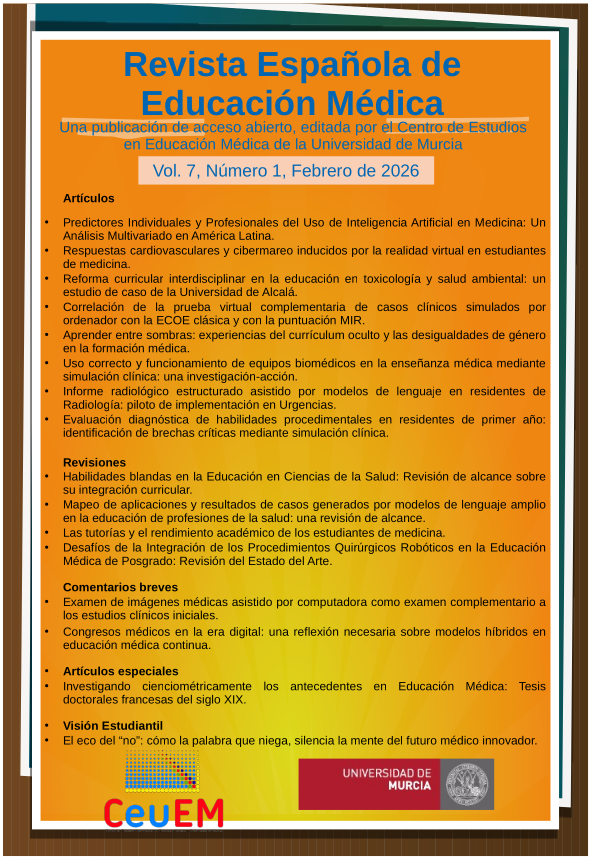
Proper Use and Functioning of Biomedical Equipment in Medical Education through Clinical Simulation: An Action Research Study.
Abstract
This investigation explores how medical students learn to use and understand the functioning of biomedical equipment in clinical simulation courses, employing an action research design. Participants were selected through purposive and opinion-based sampling, which enabled the inclusion of diverse experiences related to the phenomenon under analysis. Data were collected through two non-participant observations, two focus groups, twelve semi-structured interviews, two field notes, and a research journal that documented reflections, perceptions, and emotions throughout the process. Thematic analysis of the transcribed materials revealed that the combination of progressive pedagogies, hands-on practice, frequent equipment handling, observation of professional use, and multidisciplinary teaching approaches enhances students’ learning. Nevertheless, certain limitations were identified, particularly the persistent gap between theory and practice, which hinders the consolidation of competencies applicable in real clinical settings. Consequently, the study suggests that medical education should adopt strategies that increase interaction with biomedical equipment from early stages while simultaneously strengthening the integration between conceptual knowledge and practical experience.
Downloads
-
Abstract292
-
pdf (Español (España))245
-
pdf245
References
1. Stern G. Handled with care? Protecting medical devices from harm. Biomedical Instrumentation & Technology. 2017, 51, 489–495. https://doi.org/10.2345/0899-8205-51.6.458
2. Zamzam AH, Abdul Wahab AK, Azizan MM, Satapathy SC, Lai KW, Hasikin K. A systematic review of medical equipment reliability assessment in improving the quality of healthcare services. Front Public Health. 2021, 9, 753951. https://doi.org/10.3389/fpubh.2021.753951
3. Song W, Li J, Li H, Ming X. Human factors risk assessment: An integrated method for improving safety in clinical use of medical devices. Applied Soft Computing. 2020, 86, 105918. https://doi.org/10.1016/j.asoc.2019.105918
4. Marín SV, López Trejos JG. Gestión de riesgos orientada al uso de equipos biomédicos en las áreas de UCI y urgencias del Hospital Universitario del Valle [Internet]. Cali: Universidad Autónoma de Occidente; 2024 [cited 2026 Jan 19]. Available from: https://hdl.handle.net/10614/15649.
5. Arab-Zozani M, Imani A, Doshmangir L, Dalal K, Bahreini R. Assessment of medical equipment maintenance management: proposed checklist using Iranian experience. BioMed Eng OnLine. 2021, 20, 49. https://doi.org/10.1186/s12938-021-00887-2
6. Shamayleh A, Awad M, Farhat J. IoT-based predictive maintenance management of medical equipment. J Med Syst. 2020, 44, 72. https://doi.org/10.1007/s10916-020-1539-7
7. Flores Fiallos SL. Simulación clínica en la formación de profesionales de la salud: explorando beneficios y desafíos. Vitalia. 2024, 5(2), 116–129. https://doi.org/10.61368/r.s.d.h.v5i2.124
8. Coyne E, Calleja P, Forster E, Lin F. A review of virtual simulation for assessing healthcare students’ clinical competency. Nurse Education Today. 2021, 96, 104623. https://doi.org/10.1016/j.nedt.2020.104623
9. McKernan J. Investigación-acción y currículo. 3rd ed. Madrid: Morata; 2008. https://edmorata.es/producto/investigacion-accion-y-curriculum/
10. Bancayán-Ore CC, Vega-Denegri P. La investigación-acción en el contexto educativo. Paideia XXI. 2020, 10(1), 233–247. https://doi.org/10.31381/paideia.v10i1.3041
11. Pacheco LT. Modelo instruccional ADDIE. Revista de Educación y Desarrollo. 2020, 7(2), 45–52. https://repository.uaeh.edu.mx/revistas/index.php/prepa2/article/view/6093
12. Rosa D, Jappe ME. Concepções de Jerome Bruner para o desenvolvimento do indivíduo na área do ensino de ciências. Revista Científica Electrônica de Psicologia da FAEF. 2021, 36(1). http://faef.revista.inf.br/imagens_arquivos/arquivos_destaque/fstJKOyLeOKWdB2_2021-10-15-20-18-54.pdf
13. Carvajal-Rivera AE, Montiel-Gálvez BE, Dieck-Assad G, Lara-Prieto V. Un nuevo enfoque para el aprendizaje de diseño básico de dispositivos médicos a través de aprendizaje basado en retos y experiencial. IEEE Rev Iberoam Tecnol Aprendizaje. 2023, 18(4), 393–399. https://doi.org/10.1109/RITA.2023.3330059
14. Sánchez-Rodríguez JM, Moscoso-Loaiza LF. Uso de herramientas tecnológicas: un reto para la educación de enfermería. Rev Cuid. 2023, 14(3). https://doi.org/10.15649/cuidarte.3310
15. Carvajal Laverde LM, Cano Marín NE, Jaramillo Marín PA. La simulación como estrategia didáctica: experiencia del programa de Instrumentación Quirúrgica. Cuadernos de Educación en Salud. 2021, 29, 55–63. https://bibliotecadigital.udea.edu.co/server/api/core/ bitstreams/ea7ce76f-2f5b-4c4d-a3a1-31d48016fce4/content
Copyright (c) 2026 Servicio de Publicaciones de la Universidad de Murcia

This work is licensed under a Creative Commons Attribution-NonCommercial-NoDerivatives 4.0 International License.
The works published in this magazine are subject to the following terms:
1. The Publications Service of the University of Murcia (the publisher) preserves the economic rights (copyright) of the published works and favors and allows them to be reused under the use license indicated in point 2.
2. The works are published under a Creative Commons Attribution-NonCommercial-NoDerivative 4.0 license.
3. Self-archiving conditions. Authors are allowed and encouraged to disseminate electronically the pre-print versions (version before being evaluated and sent to the journal) and / or post-print (version evaluated and accepted for publication) of their works before publication , since it favors its circulation and earlier diffusion and with it a possible increase in its citation and reach among the academic community.



