MOIX, MOIX, MOIX. REMEMBER THIS BRAND: ROOTLESSNESS AND DESIRE IN ANA MARÍA MOIX’S POETICS
Abstract
This article proposes a rereading of Ana María Moix’s poetry in light of the recent edition of her Poesía reunida (2024). Against approaches that have reduced her work to the strictly novísimo, it demonstrates the existence of a dense and complex Moixian writing that articulates an interior exile in dialogue with historical memory, while simultaneously exploring a sapphic desire and a fluid subjectivity outside normative frameworks. The corpus of study focuses on the collected volumes of her poetic work—Poesía reunida (2024). The methodology combines textual analysis with critical perspectives of a sociological, literary, feminist, and queer orientation.
Downloads
-
Abstract263
-
PDF (Español (España))253
References
Achótegui, J. (2004). “Emigrar en situación extrema: el Síndrome del inmigrante con estrés crónico y múltiple”, Norte de Salud Mental, 21, pp. 39-52.
Anastasi, R. (Director) (2016). Ana María Moix, passió per la paraula [Documental]. PlayFiction Video y TV3.
Carrillo-Linares, A. (2015). “Universidades y transiciones políticas: el caso español en los años 60-70”, Espacio, Tiempo y Educación, 2, pp. 49-75.
Castro, E. (2014). Poesía lesbiana queer: Cuerpos y sujetos inadecuados. Barcelona: Icaria.
Chacel, R. (2017). Memorias de Leticia Valle. Barcelona: Comba.
García-Posada, M. (1996). La nueva poesía (1975-1992). Barcelona: Crítica.
Garro, E. (2019). Los recuerdos del porvenir. Barcelona: Alfaguara.
González, Á. (1985). Tratado de urbanismo. Barcelona: Lumen.
González Arce, T. (2023). “El feminismo en los artículos publicados por Ana María Moix durante la Transición Democrática”. En García, X. y Felipe Pérez, L. (coords.), Los novísimos en el ocaso del franquismo (pp. 125-147). Guanajuato: Universidad de Guanajuato.
Keefe Ugalde, S. (2006). En voz alta: las poetas de las generaciones de los 50 y 70. Madrid: Hiperión.
Martín Huertas, C. (2018). “De mares y ofrendas: la expresión del deseo lésbico en el cuento español tras la muerte de Franco”, Philobiblion: Revista de Literatura Hispánica, 7, pp. 73-90.
Moix, A. M. (2023). Detrás del telón. Barcelona: Trampa ediciones. Moix, A. M. (2024). Poesía completa. Barcelona: Lumen.
Sánchez Zapatero, J. (2008). “Memoria y literatura: escribir desde el exilio”, Lectura y signo, 3, pp. 437-453.
Torres, S. (2022). “Sara Torres: “El drama más bestial es que un cuerpo que se enfrenta al miedo a la muerte tenga que preocuparse por ser femenino y deseable”. (P. Abad, Entrevistador). Vogue España.
Wittig, M. (1992). El pensamiento heterosexual y otros ensayos. Madrid: Egales.
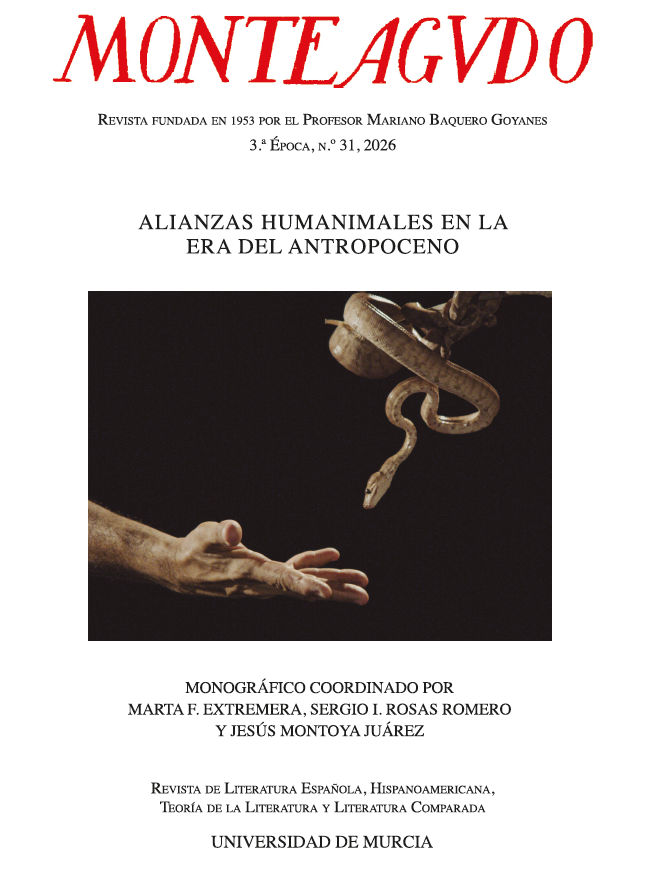
Copyright (c) 2026 Monteagudo. Revista de Literatura Española, Hispanoamericana y Teoría de la Literatura

This work is licensed under a Creative Commons Attribution-NonCommercial-NoDerivatives 3.0 Unported License.
The works published in this journal are subject to the following terms:
- The Publications Service of the University of Murcia (the publisher) retains the property rights (copyright) of the published works, and encourages and allows their reuse under the license of use indicated in point 2.
© Publications Service, University of Murcia, 2011
- The works are published in the electronic edition of the journal under a Creative Commons Attribution-NonCommercial-NoDerivatives 3.0 Spain license (legal text). They may be copied, used, distributed, transmitted and publicly displayed, provided that: i) the authorship and the original source of their publication (journal, publisher and URL of the work) are cited; ii) they are not used for commercial purposes; iii) the existence and specifications of this license of use are mentioned.