
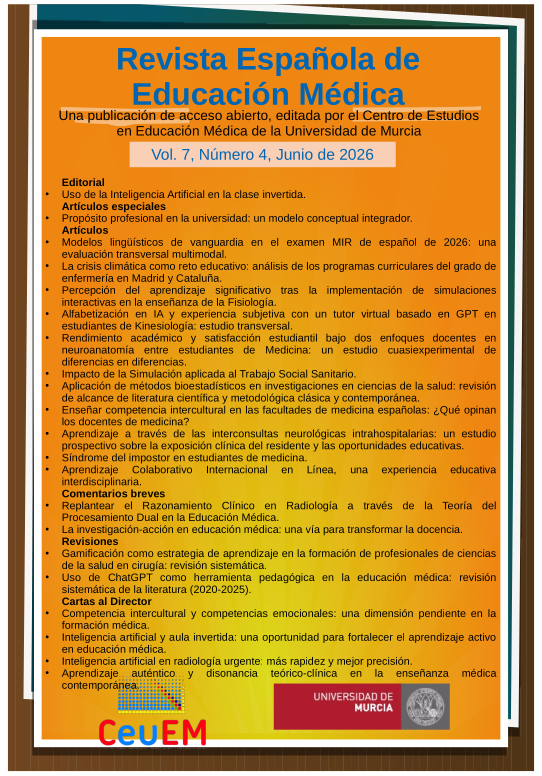
Teaching intercultural competence in Spanish faculties of medicine: What do medical educators think?
Resumo
Using anonymous online questionnaires, this exploratory cross-sectional study adopts a descriptive approach to analyse how intercultural competence (IC) is conceptualised, taught, and perceived by 125 medical educators in Spain. The findings indicate that formal IC training is limited and many educators rely on informal or experiential learning, which leads to conceptual ambiguity and raises doubts about whether IC can be systematically developed without clear pedagogical frameworks. Preparedness to teach IC is also uneven, resulting in inconsistent teaching practices and weak curricular integration. Although around half of the participants include IC-related content, it is usually addressed indirectly rather than through dedicated modules. Institutional support is perceived as insufficient, with key barriers including lack of teacher training, curriculum overload, and unclear priorities. Despite its relevance in diverse clinical contexts, collaboration with interpreters and intercultural mediators is rarely included in teaching. In sum, this paper highlights the need for clearer conceptual frameworks, more structured curricula, and stronger institutional commitment to IC in Spanish medical education to ensure culturally responsive and equitable healthcare.
Downloads
-
Resumo190
-
pdf 8
-
xml 0
Referências
1. Bagheri H, Ibrahim NA, Habil H. Analysis on opening in multilingual and multicultural clinical consultations. Procedia – Social and Behavioral Sciences. 2012, 66, 8-16. https://doi.org/10.1016/j.sbspro.2012.11.242
2. Cross T, Bazron B, Dennis K, et al. Towards a culturally competent system of care: A monograph on effective services for minority children who are severely emotionally disturbed. Georgetown University Child Development Center. 1989.
3. Singh R, Verma V. Organisation behaviour. Thakur Publication. 2023.
4. WHO. WHO recommends considering cultural factors to develop more inclusive health systems. 2020. https://www.who.int/news-room/feature-stories/detail/who-recommends-considering-cultural-factors-to-develop-more-inclusive-health-systems
5. WHO. Refugee and migrant health: Global Competency Standards for health workers. 2021a. https://www.who.int/publications/i/item/9789240030626
6. Deardorff DK. Identification and assessment of intercultural competence as a student outcome of internationalization. Journal of Studies in International Education. 2006, 10, 241-266.
7. Burdeus-Domingo N. Cultural competence development in healthcare interpreting training: A didactic proposal. In R. Lázaro Gutiérrez & C. Álvaro Aranda (Eds.), New trends in healthcare interpreting studies. An updated review of research in the field. Springer. 2023.
8. Refki D, Avery MA, Dalton A. Core competencies for healthcare interpreters. International Journal of Humanities and Social Science. 2013, 3(2), 72-83.
9. López Rubio M. Identifying communication needs found by Chinese patients and healthcare professionals in Valencian sexual and reproductive healthcare centres. In M.P. Castillo Bernal & M. Estévez Grossi (Eds.), Translation, Mediation and Accessibility for Linguistic Minorities. Frank & Timme. 2022.
10. Lee Y, Sung S, Fan X. Cultural competency education for healthcare professionals: An umbrella review. BMC Med Educ. 2025, 25(1). https://doi.org/10.1186/s12909-025-08008-7
11. Hudelson P, Dogra N, Hendrickx K, et al. The challenges of integrating cultural competence into undergraduate medical curricula across Europe. MedEdPublish. 2016, 1-7. http://dx.doi.org/10.15694/mep.2016.000010
12. Thomas K, Jacobs N, Lopez Vera A. A proposal to teach medical students how to use interpreters. Discover Education. 2024, 3(80). https://doi.org/10.1007/s44217-024-00177-9
13. Álvaro Aranda C. La competencia intercultural en los grados universitarios de medicina en España. Hikma. 2025a, 24(2), 1-28. https://doi.org/10.21071/hikma.v24i2.17471
14. Wright KB. Researching Internet-Based Populations: Advantages and Disadvantages of Online Survey Research. Journal of Computer-Mediated Communication. 2005, 10(3). https://doi.org/10.1111/j.1083-6101.2005.tb00259.x
15. Ting H, Memon MA, Thurasamy R, et al. Snowball sampling: A review and guidelines for survey research. Asian Journal of Business Research. 2025, 15(1), 1-15. https://doi.org/10.14707/ajbr.250186
16. Braun V, Clarke V. Using thematic analysis in psychology. Qualitative Research in Psychology. 2006, 3(2), 77-101. https://doi.org/10.1191/1478088706qp063oa
17. Dawadi, S. Thematic analysis approach: A step by step guide for ELT research practitioners. Journal of NELTA, 2020, 25(1-2), 62–71. https://doi.org/10.3126/nelta.v25i1-2.49731
18. Ley Orgánica 2/2023, de 22 de marzo, del Sistema Universitario. Boletín Oficial del Estado, núm. 70, de 23 de marzo de 2023. https://www.boe.es/buscar/act.php?id=BOE-A-2023-7500
19. Raga Gimeno F. La competencia cultural como enacción. Pragmalingüística. 2022, 30, 355-374. https://doi.org/10.25267/Pragmalinguistica.2022.i30.16
20. Liu J, Miles K, Li S. Cultural competence education for undergraduate medical students: An ethnographic study. Frontiers in Education. 2022, 7, 1-18. https://doi.org/10.3389/feduc.2022.980633
21. Lu PY, Tsai JC, Tseng SYH. Clinical teachers’ perspectives on cultural competence in medical education. Med Educ. 2014, 48(2), 204-214. https://doi.org/10.1111/medu.12305
22. Sorensen J, Norredam M, Suurmond J, et al. Need for ensuring cultural competence in medical programmes of European universities. BMC Med Educ. 2019, 19(1), 1-8. https://doi.org/10.1186/s12909-018-1449-y
23. Liu L, Gill G, Li S. Cultural competence in clinical education: A faculty development review. Clin Teach. 2021, 18(2), 123-130. https://doi.org/10.1111/tct.13269
24. Constantinou CS. Need for widely applicable cultural competencies in the healthcare of humans and animals. Encyclopedia. 2023, 3(3), 956-963. https://doi.org/10.3390/encyclopedia3030068
25. Constantinou CS, Ng AT, Becker CB, et al. The use of interpreters in medical education: A narrative literature review. Societies. 2021, 11(3). https://doi.org/10.3390/soc11030070
26. van Lent LGG, Yilmaz NG, Goosen S, et al. Effectiveness of interpreters and other strategies for mitigating language barriers: A systematic review. Patient Educ Couns. 2025, 136. https://doi.org/10.1016/j.pec.2025.108767
27. Forner Tejero A, Costa Abós S. Competencia cultural enfermera en España. Nure Investigación. 2023, 20(124), 1-13. https://doi.org/10.58722/nure.v20i124.2334
28. WHO. Toolkit no. 1: Migration and health: enhancing intercultural competence and diversity sensitivity. World Health Organisation. 2021b.
29. United Nations. Global Compact for Safe, Orderly and Regular Migration. 2018. https://data.unhcr.org/es/documents/details/66956
30. General Medical Council. Good medical practice (2024). 2024. https://www.gmc-uk.org/professional-standards/good-medical-practice-2024
31. Royal College of Physicians and Surgeons of Canada. CanMEDS 2015 physician competency framework. 2015.
32. Li S, Miles K, George RE, et al. A critical review of cultural competence frameworks and models in medical and health professional education. Med Teach. 2023, 45(10), 1085-1107. https://doi.org/10.1080/0142159X.2023.2174419
33. Rukadikar C, Mali S, Bajpai R, et al. A review on cultural competency in medical education. J Family Med Prim Care. 2022, 11(8), 4319-4329. https://doi.org/10.4103%2Fjfmpc.jfmpc_2503_21
34. Alharbi K, Bakarman SS, Alqahtani N, et al. Exploring cultural competence knowledge, skills, and comfort among male nursing students in Riyadh, Saudi Arabia. BMC Med Educ. 2025, 25. https://doi.org/10.1186/s12909-025-07666-x
35. Barrett MD. Intercultural competence. EWC Statement Series. 2011, 2, 22-27. European Wergeland Centre.
36. Purnell L. The Purnell model for cultural competence. J Multicult Nurs Health. 2005, 11(2), 7-15.
37. Leininger M. Culture care theory: a major contribution to advance transcultural nursing knowledge and practices. J Transcult Nurs. 2002, 13(3), 183-192. https://doi.org/10.1177/10459602013003005
38. Teal CR, Street RL. Critical elements of culturally competent communication in the medical encounter: A review and model. Soc Sci Med. 2008, 68(3), 533-543. https://doi.org/10.1016/j.socscimed.2008.10.015
39. George RE, Smith K, OʼReilly M, et al. Perspectives of patients with mental illness on how to better teach and evaluate diversity education in the National Health Service. J Contin Educ Health Prof. 2019, 39(2), 92-102. https://doi.org/10.1097/CEH.0000000000000250
40. Lekas HM, Pahl K, Fuller LC. Rethinking cultural competence: Shifting to cultural humility. Health Serv Insights. 2020, 13, 1-4. https://doi.org/10.1177/1178632920970580
41. Robaina Castillo JI. Cultural competence in medical and health education: An approach to the topic. Seminars in Medical Writing and Education. 2022, 1(13), 1-6. https://doi.org/10.56294/mw202213
42. Campinha-Bacote J. The process of cultural competemility. 1991/2018. https://transculturalcare.net/the-process-of-cultural-competence-in-the-delivery-of-healthcare-services/
43. Martínez MF, Martínez J, Calzado V. La competencia cultural como referente de la diversidad humana en la prestación de servicios y la intervención social. Psychosocial Intervention. 2006, 15(3), 331-350.
44. Betancourt JR. Cross-cultural medical education: Conceptual approaches and frameworks for evaluation. Acad Med. 2003, 78(6), 560-569. https://doi.org/10.1097/00001888-200306000-00004
45. Oikarainen A, Mikkonen K, Kenny A, et al. Educational interventions designed to develop nurses’ cultural competence: A systematic review. Int J Nurs Stud. 2019, 98, 75-86. https://doi.org/10.1016/j.ijnurstu.2019.06.005
46. Brottman MR, Char DM, Hattori RA, et al. Toward cultural competency in health care: A scoping review of the diversity and inclusion education literature. Acad Med. 2020, 95(5), 803-813. https://doi.org/10.1097/ACM.0000000000002995
47. Dogra N, Bhatti F, Ertubey C, et al. Teaching diversity to medical undergraduates: Curriculum development, delivery and assessment. Med Teach. 2015, 38(4), 323-337. https://doi.org/10.3109/0142159X.2015.1105944
48. Council of Europe. Developing intercultural competence through education. Council of Europe Publishing. 2014.
49. Kramsch C. Context and culture in language teaching. Oxford University Press. 1993.
50. Byram M. Teaching and assessing intercultural communicative competence. Multilingual Matters. 1997.
51. Borghetti C. Integrating intercultural and communicative objectives in the foreign language class. A proposal for the integration of two models. Language Learning Journal. 2013, 41(3), 254-267. https://doi.org/10.1080/09571736.2013.836344
52. Gutiérrez-Santiuste E, Ritacco-Real M. Intercultural communicative competence in higher education through telecollaboration: typology and development. Education and Information Technologies. 2023, 28, 13885-13912. https://doi.org/10.1007/s10639-023-11751-3
53. Nguyen Q, Flora J, Basaviah P, et al. Interpreter and limited-English proficiency patient training helps develop medical students’ cross-cultural communication skills. BMC Med Educ. 2024, 24. https://doi.org/10.1186/s12909-024-05173-z
54. Mishler EG. The discourse of medicine: Dialectics of medical interviews. Ablex Publishing Corporation. 1984.
55. Magaña D. Cultural competence and metaphor in mental healthcare interactions: A linguistic perspective. Patient Educ Couns. 2019, 102(12), 2192-2198. https://doi.org/10.1016/j.pec.2019.06.010
56. Grupo CRIT. Culturas y atención sanitaria. Guía para la comunicación y la mediación intercultural. Editorial Octaedro. 2009.
57. de Boe E. Synchronization of interaction in healthcare interpreting by video link and telephone. In E. de Boe, J. Vranjers & H. Salaets (Eds.), Interactional dynamics in remote interpreting. Routledge. 2023.
58. Rodríguez-Vicente R, Napier J, de Pedro Ricoy R. Dialogue interpreting and person-centred care in a clinical mental healthcare setting. Patient Education and Counseling. 2025, 136, 29-47. https://doi.org/10.4324/9781003017400-4
59. Lázaro Gutiérrez R, Tejero González JM. Challenging ideologies and fostering intercultural competence. In S. Määttä & M.K. Hall (Eds.), Mapping Ideology in Discourse Studies. De Gruyter. 2022.
60. Álvaro Aranda, C. La interpretación sanitaria en una sociedad de profesiones. Comares. 2025b.
61. Lázaro Gutiérrez R. The role of Public Service Interpreting and Translation in the accessibility of public services by migrant populations. In M.P. del Castillo Bernal & M. Estévez Grossi (Eds.), Translation, Mediation and Accessibility for Linguistic Minorities. Frank & Timme. 2022.
62. Theys L, Wermuth C, Salaets H, et al. The co-construction of empathic communication in interpreter-mediated medical consultations. Translation & Interpreting. 2023, 15(1), 45-73. https://doi.org/10.12807/ti.115201.2023.a03
63. Angelelli C. Healthcare interpreting explained. Routledge. 2019.
64. Ono N, Yang J. Communication skills of medical interpreters: A qualitative explanatory study. Healthcare. 2024, 12(20). https://doi.org/10.3390/healthcare12202073
65. Álvaro Aranda C, Lázaro Gutiérrez, R, Li S. Towards a collaborative structure of interpreter-mediated medical consultations: Complementing functions between healthcare interpreters and providers. Soc Sci Med, 2021, 269. https://doi.org/10.1016/j.socscimed.2020.113529
66. Hsieh E, Kramer E. Medical interpreters as tools: Dangers and challenges in the utilitarian approach to interpreters’ roles and functions. Patient Educ Couns. 2012, 89(1), 158-162. https://doi.org/10.1016/j.pec.2012.07.001
67. van de Geuchte S, van Vaerenbergh L. Interpreting in Flemish hospitals: Interpreters’ view and healthcare workers’ expectations. CLINA. 2017, 3(1), 117-144.
68. Valero Garcés C. Healthcare staff perceptions about interpreters during the COVID-19 pandemic. BRIDGE: Trends and Traditions in Translation and Interpreting Studies. 2022, 3(1), 3-16.
69. Nevado Llopis A. La influencia de los profesionales sanitarios en el reconocimiento y el desarrollo de la interpretación médica. MonTI. 2015, 2, 185-216. http://dx.doi.org/10.6035/MonTI.2015.ne2.7
70. Intercomsalud (2024). La competencia intercultural en la comunicación interlingüística sanitaria femenina. https://intercomsalud.es/
Direitos de Autor (c) 2026 Serviço de Publicações da Universidade de Múrcia

Este trabalho encontra-se publicado com a Licença Internacional Creative Commons Atribuição-NãoComercial-SemDerivações 4.0.
Os trabalhos publicados nesta revista estão sujeitos aos seguintes termos:
1. O Serviço de Publicações da Universidade de Murcia (o editor) preserva os direitos económicos (direitos de autor) das obras publicadas e favorece e permite a sua reutilização ao abrigo da licença de utilização indicada no ponto 2.
2. Os trabalhos são publicados sob uma licença Creative Commons Atribuição-NãoComercial-NãoDerivada 4.0.
3. Condições de autoarquivamento. Os autores estão autorizados e incentivados a divulgar eletronicamente as versões pré-impressas (versão antes de ser avaliada e enviada à revista) e / ou pós-impressas (versão avaliada e aceita para publicação) de seus trabalhos antes da publicação, desde que favorece sua circulação e difusão mais precoce e com ela possível aumento de sua citação e alcance junto à comunidade acadêmica.