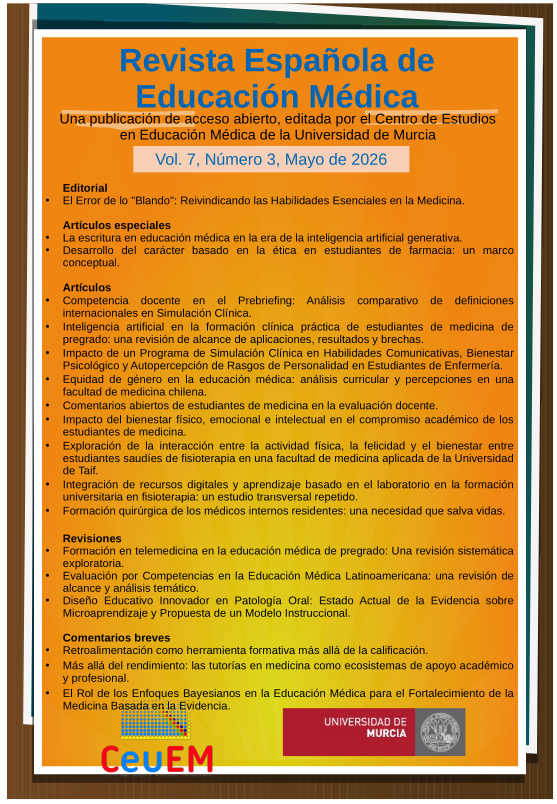
Equidad de género en la educación médica: análisis curricular y percepciones en una facultad de medicina chilena.
Resumen
Objetivo: Analizar la incorporación de la perspectiva de género en los planes curriculares de una facultad de medicina en Chile, así como identificar las barreras y facilitadores percibidos por la comunidad académica, considerando su grado de integración en los procesos formativos. Material y métodos: Se realizó un estudio cualitativo de tipo estudio de caso colectivo en siete carreras de una facultad de medicina. Se integraron dos dimensiones cualitativas complementarias: un análisis documental de perfiles de egreso y programas de curso, y un análisis interpretativo de percepciones mediante 11 entrevistas semiestructuradas y 6 grupos focales con autoridades, docentes y estudiantes. El análisis se realizó mediante análisis de contenido temático, apoyado por software NVivo, utilizando un enfoque inductivo con sensibilización teórica. Resultados: Los hallazgos se organizaron en tres ejes analíticos: (1) incorporación curricular de la perspectiva de género, (2) comprensión conceptual y formas de implementación, y (3) barreras y facilitadores. Se identificó una incorporación fragmentaria de contenidos, concentrada en áreas específicas y sin integración transversal. Las percepciones evidenciaron una comprensión heterogénea del concepto y una implementación no sistemática, frecuentemente dependiente de iniciativas individuales. Entre las principales barreras se destacaron la falta de formación docente y la ausencia de lineamientos institucionales, mientras que el compromiso de docentes motivados emergió como un facilitador relevante. Desde el marco de la transversalización de género, estos hallazgos corresponden a un nivel incipiente de integración. Conclusiones: La incorporación de la perspectiva de género en la formación en salud se caracteriza por una integración parcial, heterogénea y no sistemática. Los resultados permiten proponer una conceptualización preliminar de niveles de integración del enfoque, que abarca desde formas fragmentarias hasta una transversalización estructural. Esta aproximación puede contribuir a orientar procesos de mejora curricular, destacando la necesidad de fortalecer la formación docente, desarrollar marcos conceptuales compartidos y avanzar hacia estrategias institucionales más coherentes y sostenibles.
Descargas
-
Resumen33
-
pdf22
-
pdf 22
-
xml0
Citas
1. Organización Mundial de la Salud. Género y salud. Ginebra, OMS, 2018. https://www.who.int/es/news-room/fact-sheets/detail/gender
2. ONU Mujeres. Guía de planificación y presupuesto con enfoque de género. Ciudad de Panamá: ONU Mujeres, 2017. https://lac.unwomen.org/sites/default/files/Field%20Office%20Americas/Documentos/Publicaciones/2017/06/Guide%202%20-%20MIDEPLAN-compressed.pdf
3. ONU Mujeres. Gender Mainstreaming in Development Programming. Nueva York: ONU Mujeres, 2014. https://www.unwomen.org/sites/default/files/Headquarters/Attachments/Sections/Library/Publications/2014/GenderMainstreaming-IssuesBrief-en%20pdf.pdf
4. Yang HC. What should be taught and what is taught: integrating gender into medical and health professions education for medical and nursing students. Int J. Environ Res Public Health. 2020, 17, 18. 10.3390/ijerph17186555
5. Mattioli AV, Bucciarelli V, Gallina S. Teaching gender medicine can enhance the quality of healthcare. Am Heart J Plus. 2024, 44. 10.1016/j.ahjo.2024.100418
6. Mies C. El género como determinante social de la salud y su impacto en el desarrollo sostenible. Universitas Rev Filosofía Derecho Polít. 2022, 41, 33-47. https://doi.org/10.20318/universitas.2023.7412
7. Programa de las Naciones Unidas para el Desarrollo. Informe sobre desarrollo humano 2013: el ascenso del Sur, progreso humano en un mundo diverso. Nueva York, PNUD, 2013. https://hdr.undp.org/system/files/documents/informe-sobre-desarrollo-humano-2013-espanol.informe-sobre-desarrollo-humano-2013-espanol
8. Ruiz-Cantero MT, Tomás-Aznar C, Rodríguez-Jaume MJ, Pérez-Sedeño E, Gasch-Gallén Á. Agenda de género en la formación en ciencias de la salud: experiencias internacionales para reducir tiempos en España. Gac Sanit. 2019, 33, 5, 485-90. https://dx.doi.org/10.1016/j.gaceta.2018.03.010
9. Bradbury-Jones C, Molloy E, Clark M, Ward N. Gender, sexual diversity and professional practice learning: findings from a systematic search and review. Stud High Educ. 2020, 45, 8, 1618-36. doi:10.1080/03075079.2019.1689380
10. Rivera-Mercado ST, Garrido-Meléndez G, Espinosa-Veas P, Prado-Pizarro E, Santis-Lobos J, Bernales-Silva M. Enfoque de género y representación femenina en escuelas de medicina en Chile: ¿qué sabemos? ARS Med Rev Cienc Méd. 2024, 49, 3, 32-7. https://doi.org/10.11565/arsmed.v49i3.2067
11. Chile. Congreso Nacional. Ley N° 21.369. Regula el acoso sexual, la violencia y la discriminación de género en el ámbito de la educación superior. Diario Oficial de la República de Chile, 2021. https://www.bcn.cl/leychile/navegar?i=1165023&f=2021-09-15
12. Creswell JW. Qualitative inquiry and research design: choosing among five approaches. 3rd ed. Thousand Oaks (CA), SAGE Publications, 2013. https://www.researchgate.net/publication/283906211_Creswell_JW_2013_Qualitative_inquiry_and_research_design_Choosing_among_five_approaches_3e_ed_London_Sage_Approches_inductives_2015_Hakim_Ben_Salah_Note_de_lecture_1-4
13. Cornejo M, Salas N. Rigor y calidad metodológicos: un reto a la investigación social cualitativa. Psicoperspectivas. 2011, 10, 2, 12-34. https://doi.org/10.5027/psicoperspectivas-Vol10-Issue2-fulltext-144
14. Verdonk P, Benschop YW, de Haes HC, Lagro-Janssen TL. From gender bias to gender awareness in medical education. Adv Health Sci Educ Theory Pract. 2009, 14, 1,135-52. 10.1007/s10459-008-9100-z
15. Lagro-Janssen T. Gender and sex: issues in medical education. GMS Z Med Ausbild. 2010, 27,2, 27. 10.3205/zma000664
16. Khamisy-Farah R, Biras E, Shehadeh R, Tuma R, Atwan H, Siri A, et al. Gender and sexuality awareness in medical education and practice: mixed methods study. JMIR Med Educ. 2024, 10. 10.2196/59009
17. Beagan BL, Chiasson A, Fiske CA, Forseth SD, Hosein AC, Myers MR, et al. Working with transgender clients: learning from physicians and nurses to improve occupational therapy practice. Can J Occup Ther. 2013, 80, 2, 82-91. 10.1177/0008417413484450
18. Valenzuela A, Cartes R. Perspectiva de género en la educación médica: incorporación, intervenciones y desafíos por superar. Rev Chil Obstet Ginecol. 2019, 84, 1, 82-8. doi:10.4067/S0717-75262019000100082
19. Bonder G, et al. La institucionalización del enfoque de igualdad de género en universidades de América Latina: experiencias, reflexiones y contribuciones para el futuro de la educación superior. Buenos Aires: Cátedra Regional UNESCO Mujer, Ciencia y Tecnología en América Latina, FLACSO-Argentina, 2022. https://www.gender-sti.org/wp-content/uploads/2024/03/La-institucionalizacion-del-enfoque-de-igualdad-de-genero-en-universidades-de-America-Latina.pdf
20. Herrera T. Encuentros entre la antropología médica y la perspectiva de género en Latinoamérica, 2009–2019. Maguaré. 2021, 35, 1, 87-126. https://doi.org/10.15446/mag.v35n1.96665
21. Pavez-Lizárraga A. Perspectiva de género en la formación de profesionales de la salud. Cuad Méd Soc. 2018, 58, 2, 11-6. https://cuadernosms.cl/index.php/cms/article/view/277
22. Arcos E, Poblete J, Molina-Vega I, Miranda C, Zúñiga Y, Fecci E, et al. Gender perspective in health care teaching: a pending task. Rev Med Chil. 2007, 135, 6, 708-17. 10.4067/s0034-98872007000600004
23. Gaba MR, Gajardo-Poblete C, Murillo-Núñez N. Transversalización de la perspectiva de género(s) en el desarrollo curricular y docente de pregrado universitario (2019-2024). Estud Pedagog. 2024, 50, 3, 79-101. doi:10.4067/S0718-07052024000300079 https://www.scielo.cl/pdf/estped/v50n3/0718-0705-estped-50-03-79.pdf
Derechos de autor 2026 Servicio de Publicaciones de la Universidad de Murcia

Esta obra está bajo una licencia internacional Creative Commons Atribución-NoComercial-SinDerivadas 4.0.
Las obras que se publican en esta revista están sujetas a los siguientes términos:
1. El Servicio de Publicaciones de la Universidad de Murcia (la editorial) conserva los derechos patrimoniales (copyright) de las obras publicadas y favorece y permite la reutilización de las mismas bajo la licencia de uso indicada en el punto 2.
© Servicio de Publicaciones, Universidad de Murcia
2. Las obras se publican bajo una licencia Creative Commons Reconocimiento-NoComercial-SinObraDerivada 4.0.

3. Condiciones de auto-archivo. Se permite y se anima a los autores a difundir electrónicamente las versiones preprint (versión antes de ser evaluada y enviada a la revista) y/o post-print (versión evaluada y aceptada para su publicación) de sus obras antes de su publicación, ya que favorece su circulación y difusión más temprana y con ello un posible aumento en su citación y alcance entre la comunidad académica.



 This is a Diamond Journal