
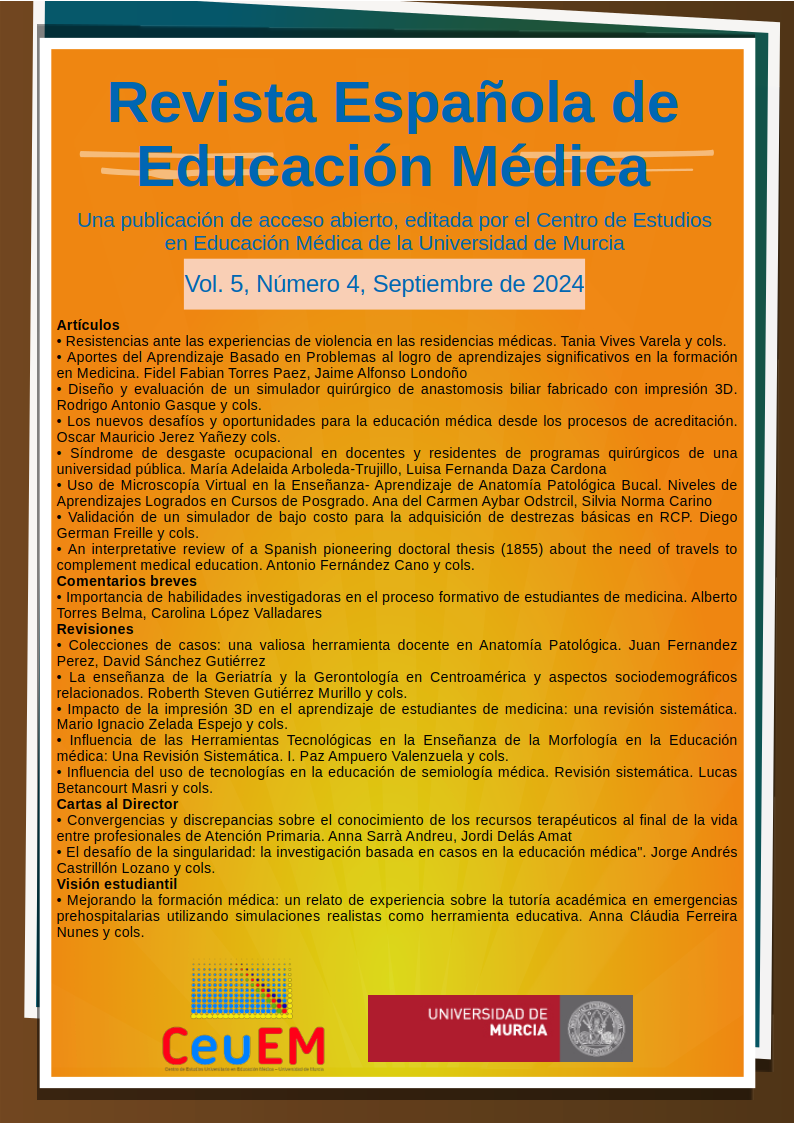
Design, manufacturing, and initial evaluation of a 3D-printed surgical simulator for biliary anastomosis
Abstract
Medical simulation has proven to enhance surgeons' skills in a safe environment. 3D printing offers a low-cost alternative for technical learning. This study describes the creation of a biliary anastomosis simulator using additive manufacturing and its initial evaluation by surgeons at various training stages. A retrospective, descriptive, observational study with non-probabilistic sampling was conducted. The biliary anastomosis simulator was created using 3D printing and liquid silicone molding. It was evaluated through a Likert-type survey, measuring fidelity, functionality, and educational quality. The total cost of the device was calculated. Descriptive statistics were applied. Twelve participants evaluated the simulator: 3 HPB surgeons, 4 HPB residents, and 5 general surgery residents. The average age was 35.33 ± 11.02 years. Of the sample, 75% had experience with inorganic simulators, and 50% had experience in biliary anastomoses. The average surgical exposure was 9.75 ± 11,01 years. The weakest points were anatomical accuracy (2.58/5) and similarity to the bile duct (2.67/5). Functionality (3.83/5) and durability (4.83/5) were highly rated. Educational quality received a score of 4.67/5. Self-efficacy varied by experience: HPB surgeons (1.11/5), residents (3.42/5), and rotating residents (5/5). The overall evaluation was 4.5/5. Our study confirmed the feasibility of a 3D biliary anastomosis simulator using additive manufacturing and silicone molding. This accessible model facilitates the learning of biliary anastomoses among surgeons in training. Future research should demonstrate its educational efficacy and validity.
Downloads
-
Abstract616
-
pdf (Español (España))543
-
pdf543
References
Cardoso SA, Suyambu J, Iqbal J, Cortes Jaimes DC, Amin A, Sikto JT. Exploring the Role of Simulation Training in Improving Surgical Skills Among Residents: A Narrative Review. Cureus. 2023 Sep 4;15(9):e44654. DOI: 10.7759/cureus.44654.
Habti M, Bénard F, Arutiunian A, Bérubé S, Cadoret D, Meloche-Dumas L. Development and Learner-Based Assessment of a Novel, Customized, 3D Printed Small Bowel Simulator for Hand-Sewn Anastomosis Training. Cureus. 2021 Dec 20;13(12):e20536. DOI: 10.7759/cureus.20536.
Goff BA. Training and assessment in gynaecologic surgery: the role of simulation. Best Pract Res Clin Obstet Gynaecol. 2010 Dec;24(6):759-66. DOI: 10.1016/j.bpobgyn.2010.03.006.
Garcia J, Yang Z, Mongrain R, Leask RL, Lachapelle K. 3D printing materials and their use in medical education: a review of current technology and trends for the future. BMJ Simul Technol Enhanc Learn. 2018 Jan;4(1):27-40. DOI: 10.1136/bmjstel-2017-000234.
Jabłonska B. End-to-end ductal anastomosis in biliary reconstruction: indications and limitations. Can J Surg. 2014 Aug;57(4):271-7. DOI: cjs.016613.
Seagull FJ, Rooney DM. Filling a void: developing a standard subjective assessment tool for surgical simulation through focused review of current practices. Surgery. 2014 Sep;156(3):718-22. DOI: 10.1016/j.surg.2014.04.048.
Norman G. Likert scales, levels of measurement and the "laws" of statistics. Adv Health Sci Educ Theory Pract. 2010 Dec;15(5):625-32. DOI: 10.1007/s10459-010-9222-y.
Jamieson S. Likert scales: how to (ab)use them. Med Educ. 2004 Dec;38(12):1217-8. DOI: 10.1111/j.1365-2929.2004.02012.x.
Fonseca AL, Evans LV, Gusberg RJ. Open surgical simulation in residency training: a review of its status and a case for its incorporation. J Surg Educ. 2013;70(1):129-137. DOI: 10.1016/j.jsurg.2012.08.007.
Tan SS, Sarker SK. Simulation in surgery: a review. Scott Med J. 2011;56(2):104-109. DOI: 10.1258/smj.2011.011098.
Bjerrum F, Thomsen ASS, Nayahangan LJ, Konge L. Surgical simulation: Current practices and future perspectives for technical skills training. Med Teach. 2018 Jul;40(7):668-675. DOI: 10.1080/0142159X.2018.1472754.
Micallef J, Sivanathan M, Clarke KM, Habti M, Bénard F, Meloche-Dumas L. Development and Initial Assessment of a Novel and Customized Bile Duct Simulator for Handsewn Anastomosis Training. Cureus. 2022 Nov 21;14(11):e31749. DOI: 10.7759/cureus.31749.
Thomas J, Patel S, Troop L, Guru R, Faist N, Bellott BJ. 3D Printed Model of Extrahepatic Biliary Ducts for Biliary Stent Testing. Materials (Basel). 2020 Oct 27;13(21):4788. DOI: 10.3390/ma13214788.
Casas-Murillo C, Zuñiga-Ruiz A, Lopez-Barron RE, Sanchez-Uresti A, Gogeascoechea-Hernandez A, Muñoz-Maldonado GE. 3D-printed anatomical models of the cystic duct and its variants, a low-cost solution for an in-house built simulator for laparoscopic surgery training. Surg Radiol Anat. 2021 Apr;43(4):537-544. DOI: 10.1007/s00276-020-02631-3.
Yoshioka R, Imamura H, Ichida H, Gyoda Y, Mizuno T, Mise Y. Simulation training in pancreatico-jejunostomy using an inanimate biotissue model improves the technical skills of hepatobiliary-pancreatic surgical fellows. PLoS One. 2021 Jan 13;16(1):e0244915. DOI: 10.1371/journal.pone.0244915.
Oshiro K, Endo K, Morishima K, Kaneda Y, Koizumi M, Sasanuma H. A structured program for teaching pancreatojejunostomy to surgical residents and fellows outside the operating room: a pilot study. BMC Surg. 2021 Feb 25;21(1):102. DOI: 10.1186/s12893-021-01101-w.
Wei F, Xu M, Lai X, Zhang J, Yiengpruksawan A, Lu Y. Three-dimensional printed dry lab training models to simulate robotic-assisted pancreaticojejunostomy. ANZ J Surg. 2019 Dec;89(12):1631-1635. DOI: 10.1111/ans.15544.
Javan R, Zeman MN. A Prototype Educational Model for Hepatobiliary Interventions: Unveiling the Role of Graphic Designers in Medical 3D Printing. J Digit Imaging. 2018 Feb;31(1):133-143. DOI: 10.1007/s10278-017-0012-4.
Larghi Laureiro Z, Novelli S, Lai Q, Mennini G, D'andrea V, Gaudenzi P. There Is a Great Future in Plastics: Personalized Approach to the Management of Hilar Cholangiocarcinoma Using a 3-D-Printed Liver Model. Dig Dis Sci. 2020 Aug;65(8):2210-2215. DOI: 10.1007/s10620-020-06326-y.
López A, Nari G, Layun J, Mariot A, López F, De Elías M. Implementation of Three-Dimensional Printed Models in Hepatic Surgery. Rev Argent Cir 2022, 114, 262-268. DOI: 10.25132/raac.v114.n3.1623.
Canbeyli İD, Çırpar M, Oktaş B, Keskinkılıç Sİ. Comparison of bench-top simulation versus traditional training models in diagnostic arthroscopic skills training. Eklem Hastalik Cerrahisi. 2018 Dec;29(3):130-8. DOI: 10.5606/ehc.2018.61213.
Martin JA, Regehr G, Reznick R, MacRae H, Murnaghan J, Hutchison C. Objective structured assessment of technical skill (OSATS) for surgical residents. Br J Surg. 1997 Feb;84(2):273-8. DOI: 10.1046/j.1365-2168.1997.02502.x.
Copyright (c) 2024 Servicio de Publicaciones de la Universidad de Murcia

This work is licensed under a Creative Commons Attribution-NonCommercial-NoDerivatives 4.0 International License.
The works published in this magazine are subject to the following terms:
1. The Publications Service of the University of Murcia (the publisher) preserves the economic rights (copyright) of the published works and favors and allows them to be reused under the use license indicated in point 2.
2. The works are published under a Creative Commons Attribution-NonCommercial-NoDerivative 4.0 license.
3. Self-archiving conditions. Authors are allowed and encouraged to disseminate electronically the pre-print versions (version before being evaluated and sent to the journal) and / or post-print (version evaluated and accepted for publication) of their works before publication , since it favors its circulation and earlier diffusion and with it a possible increase in its citation and reach among the academic community.



