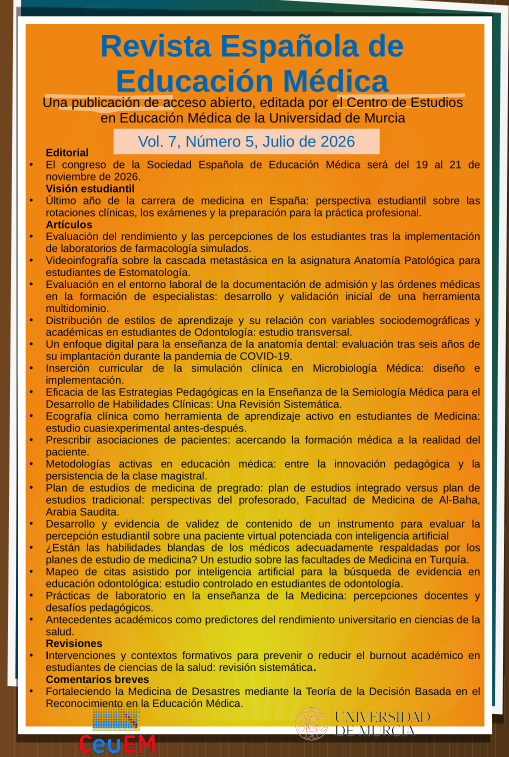
Are doctors' soft skills adequately supported by medical curricula? A study on medical schools in Turkiye.
Abstract
This study aims to investigate the extent to which soft skills, which are an important element that complements the technical skills of physicians, are included in the curricula of medical schools in Turkiye. The websites of all medical schools in Turkiye were accessed and the curricula of the 2023-2024 academic year were examined using the content analysis method. Based on the categories of soft skills identified by the Malaysian Ministry of Higher Education, it was analyzed whether these courses were included in the curricula and in which categories and medical education periods they were offered. It was found that all the medical schools under study had elective or compulsory soft skills courses. However, 12.3% of universities did not include a compulsory soft skills course in their curriculum. While 83% of the universities concentrated soft skills courses exclusively in the first three years of medical education, only 2.3% of medical schools spread these courses over the entire education period, including the last three years. Examining the distribution of courses by category revealed that courses in the field of ‘Communication’ were the most common, followed by courses in the categories of ‘Ethics’ and ‘Lifelong Learning and Information Technologies’. Courses in the categories ‘Critical Thinking and Problem Solving’, ‘Leadership’ and ‘Teamwork’ were found to be significantly underrepresented. It is recommended to design the curricula of medical faculties to include all categories of soft skills and to spread them programmatically throughout the educational process.
Downloads
-
Abstract246
-
pdf157
-
xml28
References
1. Solet DJ, Norvell JM, Rutan GH, Frankel RM. Lost in translation: challenges and opportunities in physician-to-physician communication during patient handoffs. Academic Medicine. 2005, 80 (12). 1094-1099. https://doi.org/10.1097/00001888-200512000-00005.
2. Dolev N, Naamati-Schneider L, Meirovich A. Making Soft Skills a Part of the Curriculum of Healthcare Studies. In: M. S. Firstenberg, & S. P. Stawicki (Eds.). Medical Education for the 21st Century. IntechOpen. 2021. https://doi.org/10.5772/intechopen.98671
3. Dunn SA, Markoff B. Physician-physician communiation: What is the hang-up? Journal of General Internal Medicine. 2009, 24 (3). 437-439. https://doi.org/10.1007/s11606-009-0913-0
4. Shannon D. Effective Physician-to-Physician Communication: An Essential Ingredient for Care Coordination. Physician Executive. 2012, 38 (1). 16-21.
5. Ersoy LV. Tıbbi Malpraktis. Bulletin of Thoracic Surgery/Toraks Cerrahisi Bülteni. 2014, 5 (1). 29-32. https://doi.org/10.5152/tcb.2014.004
6. Karatas M, Yakıncı C. Tıbbi Hata Nedenleri ve Çözüm Yolları . Journal of Turgut Ozal Medical Center. 2010, 17 (3). 233-236.
7. Institute of Medicine (US) Committee on Quality of Health Care in America. Kohn, L. T., Corrigan, J. M. & Donaldson, M. S. (Eds). To err is human: building a safer health system. National Academy Press. 2000. https://doi.org/10.17226/9728
8. Leape LL, Lawthers AG, Brennan TA, Johnson WG. Preventing medical injury. Quality Review Bulletin. 1993, 19 (5). 144-149. https://doi.org/10.1016/s0097-5990(16)30608-x
9. Steward MA. Effective physician-patient communication and health outcomes: a review. Canadian Medical Association Journal. 1995, 152 (9). 1423-1433.
10. Beck RS, Daughtridge R, Sloane PD. Physician-patient communication in the primary care office: a systematic review. The Journal of the American Board of Family Practice. 2002, 15 (1). 25-38.
11. Ong LM, de Haes JC, Hoos AM, Lammes FB. Doctor-patient communication: a review of the literature. Social Science and Medicine. 1995, 40 (7). 903-918. https://doi.org/10.1016/0277-9536(94)00155-m.
12. Zolnierek KBH, DiMatteo MR. Physician Communication and Patient Adherence to Treatment: A Meta-Analysis. Medical Care. 2009, 47 (8). 826–834.
13. Reader TW, Gillespie A, Roberts, J. Patient complaints in healthcare systems: a systematic review and coding taxonomy. BMJ Quality and Safety. 2014, 23 (8). 678-689. https://doi.org/10.1136/bmjqs-2013-002437
14. Mazor KM, Reed GW, Yood RA, et al. Disclosure of medical errors: what factors influence how patients respond? Journal of General Internal Medicine. 2006, 21, 704-710. https://doi.org/10.1111/j.1525-1497.2006.00465.x
15. Krakowski AJ. Doctor-doctor relationship. Psychosomatics: Journal of Consultation and Liaison Psychiatry. 1971, 12 (1). 11-15. https://doi.org/10.1016/S0033-3182(71)71560-6
16. Garelick A. Fagin L. Doctor to doctor: getting on with colleagues. Advances in Psychiatric Treatment. 2004, 10, 225–232. https://doi.org/10.1192/apt.10.3.225
17. Abraham TH, Stewart G. Solimeo S. The importance of soft skills development in a hard data world: learning from interviews with healthcare leaders. BMC Medical Education. 2021, 21 (147). 1-7. https://doi.org/10.1186/s12909-021-02567-1.
18. Murphy H. Elsevier Education. https://evolve.elsevier.com/education/expertise/faculty-development/the-importance-of-soft-skills-in-healthcare-professions-2/ . Accessed June 2024.
19. Baykan Z, Naçar M. Tip eğitiminde örtük müfredat öğrencilerin empati düzeylerini etkilemekte midir? Longitudinal bir çalişma. Hitit Üniversitesi Sosyal Bilimler Enstitüsü Dergisi. 2017, 10 (2). 775-784. https://doi.org/10.17218/hititsosbil.327003
20. Igde FA, Sahin MK. Changes in empathy during medical education: An example from Turkiye. Pakistan Journal of Medical Sciences. 2017, 33 (5). 1177-1181. https://doi.org/10.12669/pjms.335.13074
21. Shariat SV, Habibi M. Empathy in Iranian medical students: measurement model of the Jefferson scale of empathy. Medical Teacher. 2013, 35 (1). 913-918. https://doi.org/10.3109/0142159X.2012.714881
22. Chen DC, Kirshenbaum DS, Yan J, et.al. Characterizing changes in student empathy throughout medical school. Medical Teacher. 2012, 34 (4) 305-311. https://doi.org/10.3109/0142159X.2012.644600
23. Duarte MI, Branco MC, Raposo ML, Rodrigues PJ. Empathy in medical students as related to gender, year of medical school and specialty interest. South-East Asian Journal of Medical Education. 2015, 9 (1). 50-53. https://doi.org/10.4038/seajme.v9i1.97
24. Quince TA, Parker RA, Wood DF, Benson JA. Stability of empathy among undergraduate medical students: A longitudinal study at one UK medical school. BMC Medical Education. 2011, 11 (90). 1-9. https://doi.org/10.1186/1472-6920-11-90
25. Baykan Z, Naçar M, Demirel SÖ. Evaluation of empathic skills and tendencies of medical students. Academic Psychiatry. 2011, 35, 207–208. https://doi.org/10.1176/appi.ap.35.3.207
26. Van Staden CW, Joubert PM, Pickworth GE, et al. The conceptualisation of soft skills among medical students before and after curriculum reform. South African Psychiatry Review. 2006, 9, 33-37.
27. Lowther MW, McMillan WJ, Venter F. Education for actuarial quality must develop more than technical competence. South African Actuarial Journal. 2009, 9, 53–73. https://doi.org/10.4314/SAAJ.V9l1.46819
28. Abu Kasim NH, Abu Kassim NL, Razak AA, et al. Pairing as an instructional strategy to promote soft skills amongst clinical dental students. European journal of dental education: official journal of the Association for Dental Education in Europe. 2014, 18 (1) 51–57. https://doi.org/10.1111/eje.12058
29. Ministry of Higher Education. Module for development of soft skills for higher learning institutions in Malaysia, 2nd edn. Serdang Universiti Putra Malaysia; 2006.
30. TUIK. https://data.tuik.gov.tr/Bulten/Index?p=Dunya-Nufus-Gunu-2023-49688#: :text=T%C3%BCrkiye%2C%2085%20milyon%20279%20bin,1%2C1'ini%20olu%C5%9Fturdu. Accessed November 15, 2024
31. Ministry of Health. Sağlık İstatistikleri Yıllığı 2021 Haber Bülteni. 2022. https://www.saglik.gov.tr/Eklenti/44131/0/saglik-istatistikleri-yilligi-2021-haber-bultenipdf.pdf?_tag1=CEC095C58B83C4D20D904937CD3F4DD544B2DA0B. Accessed 11 May 2024.
32. Sag I, Zengul FD. Why medical tourists choose Turkiye as a medical tourism destination? Journal of Hospitality and Tourism Insights. 2019, 2 (3). 296-306. https://doi.org/10.1108/JHTI-05-2018-0031
33. https://www.ushas.com.tr/saglik-turizmi-verileri/ .Accessed 10 October 2024.
34. Bulut A, Şengül H. Dünyada ve Türkiye’de Sağlık Turizmi. Yönetim, Ekonomi ve Pazarlama Araştırmaları Dergisi. 2019. 3 (1). 45-62. https://doi.org/10.29226/TR1001.2019.104
35. TTB. Artan Tıp Fakülteleri Kontenjanı ve Önerilerimiz. 2023. https://www.ttb.org.tr/haber_goster.php?Guid=42ba715e-3ffe-11ee-889b-1b907fcd8532 Accessed 15 May 2024.
36. Joint Commission on Accreditation of Healthcare Organizations https://www.jointcommissioninternational.org/who-we-are/accredited-organizations/#sort=%40aoname%20ascending&numberOfResults=50&f:@aocountry=[Turkiye]. Accessed 2 September 2024.
37. Medical Tourism Medical tourism index 2020–2021. MedicalTourism.com. 2021. https://www.medicaltourism.com/mti/home . Accessed 15 May 2024.
38. WTO World Trade Organization & World Bank. Statistics. 2021. https://i-tip.wto.org/services/default.aspx . Accessed 29 April 2024.
39. Times Higher Education. https://www.timeshighereducation.com/world-university-rankings/2023/subject-ranking/clinical-pre-clinical-health#!/length/25/locations/TUR/sort_by/rank/sort_order/asc/cols/stats . Accessed 25 May 2024.
40. Top Universities. https://www.topuniversities.com/university-rankings/university-subject-rankings/2023/medicine?countries=tr . Accessed 25 May 2024.
41. US News. https://www.usnews.com/education/best-global-universities/Turkiye/clinical-medicine . Accessed 25 May 2024.
42. Krippendorff K. Content Analysis. In E. Barnouw, G. Gerbner, W. Schramm, T. L. Worth, & L. Gross (Eds.). InterNational Encyclopedia of Communication. Oxford University Press. 1989.
43. Suri H, Clarke D. Advancements in research systhesis methods: From a methodologically inclusive perspective. Review of Educational Research. 2009. 79 (1). 395-430. https://doi.org/10.3102/0034654308326349
44. Nagy, T., Fritúz, G., Gál, J. et al. Teaching nontechnical skills in the undergraduate education of health care professionals: a nationwide cross-sectional study in Hungary. BMC Med Educ. 2024. 174. https://doi.org/10.1186/s12909-024-05164-0
45. Evans, M. A., James, E. J., Misa M. Leadership Training in Undergraduate Medical Education: A Systematic Review. International Journal of Medical Students. 2023. 11 (1). 58–66. https://doi.org/10.5195/ijms.2023.1717
46. Nicolaou, N., Nicolaou, C., Nicolaou, P. et al. Development of a leadership and management module for the undergraduate medical curriculum. BMC Med Educ. 2024. 1310 (2024). https://doi.org/10.1186/s12909-024-06004-x
47. Griewatz, J., Yousef, A., Rothdiener, M. et al. Are we preparing for collaboration, advocacy and leadership? Targeted multi-site analysis of collaborative intrinsic roles implementation in medical undergraduate curricula. BMC Med Educ. 2020. 35. https://doi.org/10.1186/s12909-020-1940-0
48. Borowczyk, M., Stalmach-Przygoda, A., Doroszewska, A. et al. Developing an effective and comprehensive communication curriculum for undergraduate medical education in Poland – the review and recommendations. BMC Med Educ. 2023, 645. https://doi.org/10.1186/s12909-023-04533-5
49. Schmidt, C.N., Oji, N.M., Hauer, K.E. et al. Development, implementation, and evaluation of the Student Optimized Learning Environment (SOLE): a longitudinal team-based communication skills curriculum for medical students. BMC Med Educ. 2026, 663. https://doi.org/10.1186/s12909-026-08988-0
50. Bok, C., Ng, C.H., Koh, J.W.H. et al. Interprofessional communication (IPC) for medical students: a scoping review. BMC Med Educ. 2020, 372. https://doi.org/10.1186/s12909-020-02296-x
Copyright (c) 2026 Servicio de Publicaciones de la Universidad de Murcia

This work is licensed under a Creative Commons Attribution-NonCommercial-NoDerivatives 4.0 International License.
The works published in this magazine are subject to the following terms:
1. The Publications Service of the University of Murcia (the publisher) preserves the economic rights (copyright) of the published works and favors and allows them to be reused under the use license indicated in point 2.
2. The works are published under a Creative Commons Attribution-NonCommercial-NoDerivative 4.0 license.
3. Self-archiving conditions. Authors are allowed and encouraged to disseminate electronically the pre-print versions (version before being evaluated and sent to the journal) and / or post-print (version evaluated and accepted for publication) of their works before publication , since it favors its circulation and earlier diffusion and with it a possible increase in its citation and reach among the academic community.