
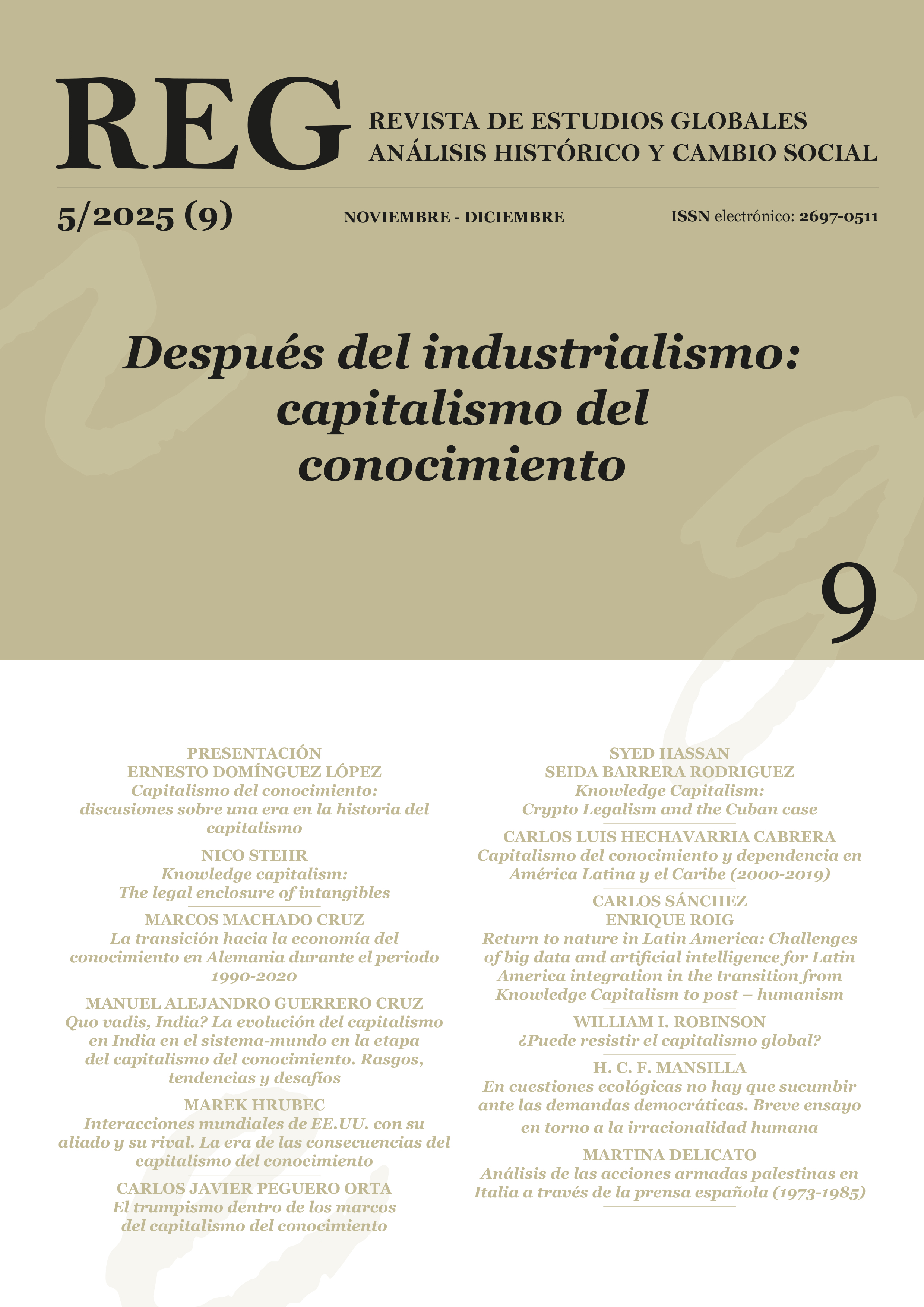
Return to nature in Latin America: Challenges of big data and artificial intelligence for Latin America integration in the transition from Knowledge Capitalism to posthumanism
Abstract
The emergence of a new technological and productive base focused on the development of the microprocessor and its articulation with organizational and work management forms linked to the valorization of the cognitive and creative capacities of the workforce allowed the unfolding of a new phase of development, or Knowledge Capitalism, enabling the overcoming of the crisis of Fordism-Keynesianism. This new economic structural base sustained the rise of the sphere of financial capital through big data and artificial intelligence, shaping a surveillance capitalism and its coercive state in the decline of its neoliberal modality. The current transition to a new global order poses serious challenges for the Latin American region, which appears to lack its own project for insertion and integration into the current landscape. The challenge takes on two dimensions of analysis: a social one linked to the absence of a historical subject of transformation; and a technological one, which is explored in this text as a transition towards posthumanism as a scenario of transcendence of the capitalist mode of production.
Downloads
Metrics
-
Abstract228
-
PDF120
References
Abbagnano, F. (2004). Diccionario de filosofía. México: Fondo de Cultura Económica.
Bolter, D. (1999). El hombre de turing. La cultura occidental en la era de la computación. México: Fondo de Cultura Económica.
Candeau, J. (2006). Antropología de la memoria. Buenos Aires: Nueva Visión.
Deleuze, G. (1999). Posdata sobre las sociedades de control. In C. Ferrer. (Comp.), El lenguaje libertario (pp. 115 – 121). Buenos Aires: Altamira.
Fernández, F. (2018, mayo). Tres pistas para intentar entender mayo del 68. El viejo topo, (364), pp. 12 – 17.
Financial Crisis Inquiry Commission. (2011). Financial Crisis Inquiry Report. Washington: U.S. Government Printing Office.
Galloway, A. (2004). Protocol, or, How Control Exists after Decentralization. Cambridge – London: MIT Press.
Gramsci, A. (2013). Socialismo y cultura. In A. Gramsci. (Aut.), Antología. Selección, traducción y notas de Manuel Sacristán (pp. 21 – 24). España: Akal.
Harari, Y. (2015). Capítulo 9: La gran desconexión. In Y. Harari. (Aut.), Homo Deus. Breve historia del mañana. (pp. 262 – 296).
Hawking, S. (2003). El universo en una cáscara de nuez. Barcelona: Crítica – Planeta.
Hawking, S. (2003). Historia del tiempo. Del Big Bang a los agujeros negros. Buenos Aires: Crítica.
Hayles, K. (1999). How we became posthuman. Virtual bodies in cybernetics, literature, and informatics. Chicago & London: The University of Chicago Press.
Jelin, E. (2004). Los trabajos de la memoria. Buenos Aires.
Lewis, M. (2014). Capítulo 5: Poniéndole cara a la alta frecuencia. In M. Lewis. (Aut.), Flash Boys. La revolución de Wall Street contra quienes manipulan el mercado (pp. 159 – 186). México: Paidós.
Maslej, N., Fattorini, L., Perrault, R., Parli, V., Reuel, A., Brynjolfsson, E., Etchemendy, J., Ligett, K., Lyons, T., Manyika, J., Niebles, J., Shoham, Y., Wald, R., & Clark, J. (2024). The AI Index 2024 Annual Report. AI Index Steering Committee, Institute for Human-Centered AI, Stanford University.
McKinsey & Company. (2023). The Great Banking Transition. The Global Banking Annual Review 2023. McKinsey Global Financial Services Marketing and Communications.
Nancy, J. (2006). El intruso. Buenos Aires: Amorrortu.
Otte, M. (2010). El crash de la información. Los mecanismos de la desinformación cotidiana. Barcelona: Ariel.
Pasquinelli, M. (2010). The Ideology of Free Culture and the Grammar of Sabotage. In D. Araya & M. Peters. (Comp.), Education in the Creative Economy: Knowledge and Learning in the Age of Innovation. New York: Peter Lang.
Roig, A. (2005). Cabalgar con Rocinante. Democracia participativa y construcción de la sociedad civil. Pensares. Quehaceres. Revista de Políticas de la Filosofía, (1), 43 – 64.
Roig, A. (2002). Ética del poder y moralidad de la protesta. La moral latinoamericana de la emergencia. Quito: Universidad Andina Simón Bolívar, Corporación Editora Nacional.
Roig, A. (1987). Nacionalidades, nacionalidad continental y cultura en nuestra América. In N. García et al. (Aut.), Temas de cultura latinoamericana (pp. 71 – 101). México: Universidad Autónoma de Estado de México.
Roig, A. (1981). Teoría y crítica del pensamiento latinoamericano. México: Fondo de Cultura Económica.
Sancho, M. & Hernández, F. (1994). La ideología de los ordenadores y la ética de los informáticos. Entrevista a Joseph Weizenbaum. Revista Telos, (38).
Schindel, E. & Ferrer, C. (2001). Entrevista a Joseph Weizenbaum. Revista Artefacto, Pensamiento sobre la técnica, (4).
Schmucler, H. (2008). Ética y Memoria, el lugar de la cultura mediática. Seminar at Centro de Estudio Avanzados, UNC.
Schmucler, H. (2001). La industria de lo humano. Revista Artefacto, Pensamiento sobre la técnica, (4).
Simondon, G. (2009). Introducción. In La individuación a la luz de las nociones de forma y de información (pp. 23 – 44). Buenos Aires: La Cebra – Cactus.
Simondon, G. (2007). Función reguladora de la cultura en la relación entre el hombre y el mundo de los objetos técnicos. In El modo de existencia de los objetos técnicos (pp. 131 – 168). Buenos Aires: Prometeo.
Sloterdijk, P. (2001). El hombre operable. Notas sobre el estado ético de la tecnología genética. Revista Artefacto, Pensamiento sobre la técnica, (4).
Sloterdijk, P. & Heinrichs, H. (2003). El sol y la Muerte. Investigaciones dialógicas. Madrid: Siruela.
Snowden, E. (2019). Permanent Record. New York: Metropolitan Books.
Terranova, T. (2006). The concept of information. In Theory, culture, society (pp. 286 – 288).
Tiqqun. (2015). La hipótesis cibernética. Madrid: Acuarela Libros.
Todorov, T. (2000). Los abusos de la memoria. Barcelona.
Varela, F. (2002). Conocer. Las ciencias cognitivas: tendencias y perspectivas. Cartografías de las ideas actuales. Barcelona: Gedisa.
Vernant, J. (2008). Los orígenes del pensamiento griego. Buenos Aires: Paidós Studio.
Weizenbaum, J. La frontera entre el ordenador y la mente. Pirámide.
Wiener, N. (2016). L’ homme et la machine. In Barthélémy, J. H., Iliadis, A., Mellamphy, N. B., de Vries, M., & Simondon, N. Book Symposium on Le concept d’information dans la science contemporaine. Cahiers de Royaumont, Les Éditions de Minuit/Gauthier-Villars 1965. Philosophy & Technology, 29(3), 99 - 132. https://doi.org/10.1007/s13347-015-0205-z
Yerushalmi, J. (2009). Zajor. México.
Zuboff, S. (2020). Capítulo 3: El descubrimiento del excedente conductual. In S. Zuboff. (Aut.), La era del capitalismo de vigilancia. La lucha por un futuro humano frente a las nuevas fronteras del poder. México: Paidós.
Copyright (c) 2025 Journal of Global Studies: Historical Analysis and Social Change

This work is licensed under a Creative Commons Attribution-NonCommercial-NoDerivatives 4.0 International License.