
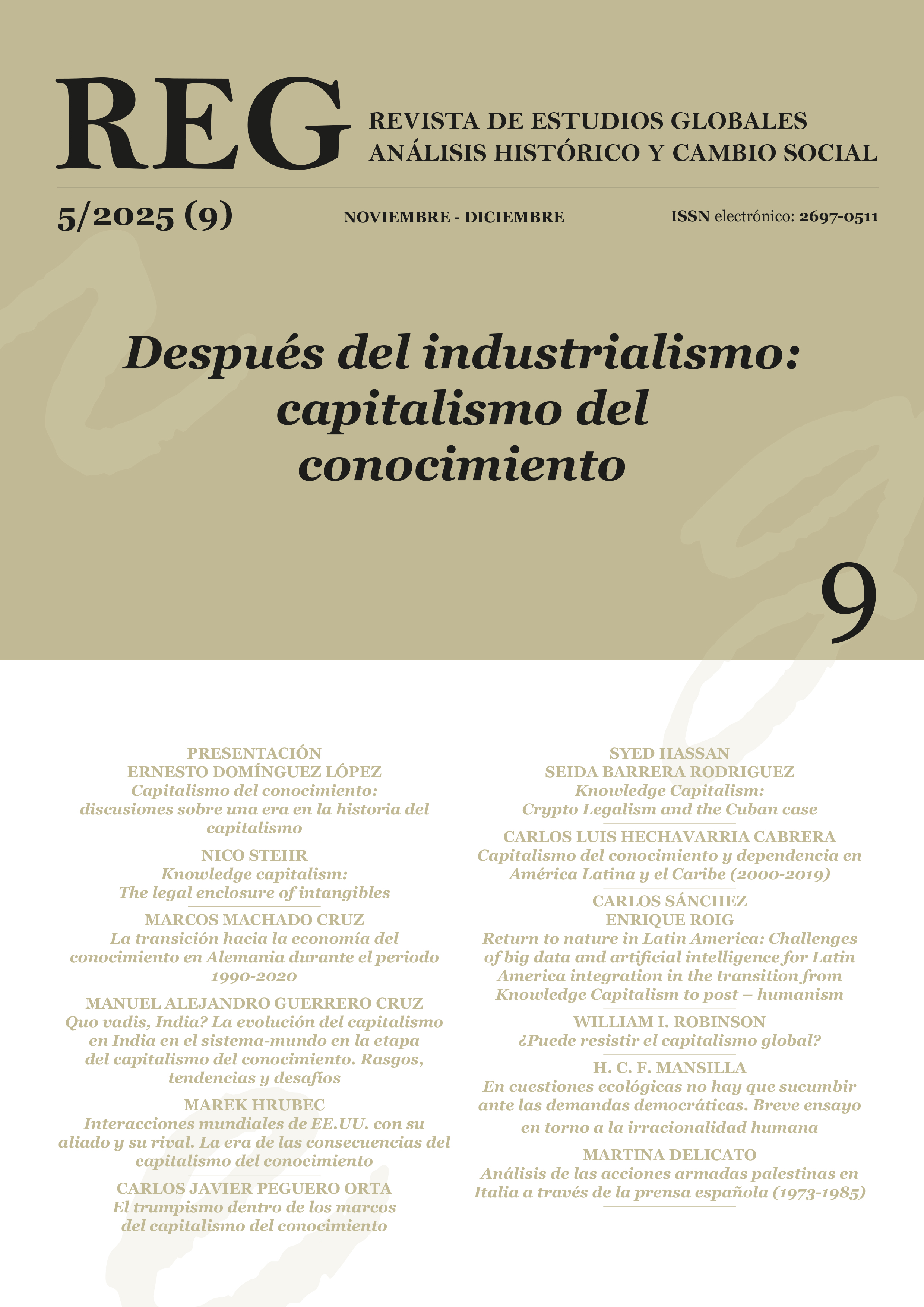
Trumpism within the framework of knowledge capitalism
Abstract
A study about how trumpism, as an expression of right-wing populism, arose and strengthened as a result of the formation and evolution of knowledge capitalism in the United States. The apogee of this political phenomenon is understood as a manifestation of the political contradictions and crises that took place in that country, which were a direct consequence of the transition process toward a new era of capitalist development as a result of the main structural capitalist transformations accumulated since the final years of the twentieth century and its crisis during the twenty first century.
Downloads
Metrics
-
Abstract185
-
PDF (Español (España))149
References
Albert, M. (1993). Capitalism against capitalism. Londres: Whurr Publishers Ltd.
Arrighi, G. (1994). El largo siglo XX: dinero, poder y los orígenes de nuestra época. Londres: Verso.
Arrighi, G. y Silver, B. (1999). Chaos and Governance in the Modern World System. Minnesota: University of Minnesota Press.
Autor, D. H., y Dorn, D. (2013). The Growth of Low Skills Service Jobs and the Polarization of the US Labor Market. American Economic Review. 103(5),1553-1597
Bacevich, A. (2009). The Limits of Power. The End of American Exceptionalism. American Empire Project.
Barnett, T. (2020). Great Powers: America and the World After Bush. Nueva York: Berkley
Bar-On, T. (2013). Rethinking the French New Right. Alternatives to modernity. Nueva York: Routledge.
Barry, J. (2011). Knowledge as Power, Knowledge as Capital: A Political Economy Critique of Modern Academic Capitalism. Irish Review, N°43
Bartee, S. (2019). Paul Gottfried and Paleoconservatism. M. Sedgwick (ed.) Key Thinkers of the Radical Right: Behind the New Threat to Liberal Democracy (pp. 102- 121). Oxford: Oxford University Press.
Beckert, S. y Desan, C. (2018). American Capitalism: New Histories. Nueva York: Columbia University Press.
Behling, F., Ciccia, R., Ó Riain, S. y Flaherty, E. (2015): The Changing Worlds and Workplaces of Capitalism. Londres: Palgrave Macmillan.
Bell, D. (1999). The Coming of Post-industrial Society. A Venture in Social Forecasting. Nueva York: Basic Books.
Berlet, Ch. (2019). Trumping Democracy from Reagan to the Alt-Right. Nueva York: Routledge.
Brands, H.W. (2010). American Dreams: The United States Since 1945. Nueva York: Penguin Press.
Burton-Jones, A. (2003). Knowledge Capitalism: the new learning economy. Policy Futures in Education, N°1, Vol. 1.
Coles, T.J. (2017). President Trump, Inc. How Big Business and Neoliberalism Empower Populism and the Far-Right. Reino Unido: Clairview Books Ltd.
Davis, G. F. (2016). The Vanishing American Corporation. Navigating the Hazards of a New Economy. Oakland: Berrett-Koehler Publishers, Inc.
Domínguez López, E. (2022): Capitalismo del conocimiento. Transición y contradicciones políticas en los Estados Unidos del siglo XXI. Revista Universidad de La Habana, N°294.
Domínguez López, E. (2025). Cultural Complexus and Evolution: Conceptual Contributions to a General Theory of Historical Evolution. Evolution Yearbook: Demographic and Political Risks, pp. 170-189.
Domínguez López, E. y Barrera Rodríguez, S. (2024). Políticas públicas, capitalismo del conocimiento y empresa en Estados Unidos: el declive de la corporación clásica. Revista de Gestión Pública, Volumen XIII, N°1, pp. 79-110.
Drolet, J.F. y Williams, M. (2019). America First: Paleoconservatism and the Ideological Struggle for the American Right. Journal of Political Ideologies, 25(1), 1-29.
Drucker, P. F. (1969). The Age of Discontinuity. Guidelines to our Changing Society. Londres: William Heinemann Ltd.
Fabelo Concepción, S. y Rodríguez Soler, A. (2021). El populismo como estilo comunicativo. El caso de Estados Unidos de América durante la administración de Donald Trump (2016-2020). Cuadernos de Nuestra América, Nueva Época, N°1.
Gascón Muro, P. (2008). La economía del conocimiento o la reinvención del capitalismo. Veredas. Revista del pensamiento sociológico, N°17.
Gerstle, G. (2022). The Rise and Fall of the Neoliberal Order. America and the World in the Free Market Era. Oxford: Oxford University Press.
Hawley, G. (2018). Making Sense of the Alt-Right. Nueva York: Columbia University Press.
Hodgson, G. M. (2015). Conceptualizing Capitalism. Institutions, Evolution, Future. Chicago: University of Chicago Press.
Isoglio, A. (2021). La economía basada en el conocimiento: discusiones conceptuales sobre los cambios ocurridos a escala global desde la década de 1970. Investigación y desarrollo, N°2, Vol. 19.
Laclau, E. (2004). La Razón Populista. México: Fondo de Cultura Económica.
Main, Thomas (2018). The Rise of the Alt-Right. Brookings Institution Press.
Mudde, C. (2018). The Far Right in America. Nueva York: Routledge.
Mudde, C. y Rovira Kaltwasser, C. (2017). Populism: A Very Short Introduction. Oxford: Oxford University Press.
Murphy, P. (2005). Knowledge Capitalism. Thesis Eleven, N°81.
Nieli, Russell (2019). Jared Taylor and White Identity. M. Sedgwick (ed.), Key Thinkers of the Radical Right: Behind the New Threat to Liberal Democracy (pp. 137- 155). Oxford: Oxford University Press.
Ordóñez, S. (2006). Capitalismo del conocimiento: elementos teóricos-históricos. Economía Informa, N°338.
Pierobon, M. L. (2021). Populismos de Derecha en Europa y Estados Unidos, la construcción de una derecha antiestablishment. Argentina: Universidad Nacional de Cuyo.
Piketty, T. (2014). Capital in the Twenty-First Century. Londres: The Belknap Press of Harvard University Press.
Rueda, D. (2021). Los fundamentos ideológicos de la Alt-Right: del paleoconservadurismo a la fascistización. Encrucijadas. Revista Crítica de Ciencias Sociales, N°21, Vol. 2.
Sanabria Gómez, S. A. (2011). Capitalismo del conocimiento y desigualdad económica entre países. Revista Logos, Ciencia & Tecnología, N°2, Vol. 2.
Sánchez Ramírez, C. M. (2013). La dimensión temporal cíclica del capitalismo y los determinantes del capitalismo del conocimiento marxista-gramsciano y neoshumpeteriano. Eseconomía Revista de estudios económicos, N°38, Vol. 8.
Skocpol, T. y Williamson, V. (2013). The Tea Party and the Remaking of Republican Conservatism. Oxford: Oxford University Press.
Stehr, N. (2022). Knowledge Capitalism. Nueva York: Routledge.
Touraine, A. (1971). The Post-Industrial Society. Tomorrow's Social History: Classes, Conflicts and Culture in the Programmed Society. New York: Random House.
Vasapollo, L. y Arriola, J. (2010). ¿Crisis o Big Bang? La crisis sistémica del capital ¿qué, cómo y para quién? La Habana: Ciencias Sociales.
Copyright (c) 2025 Journal of Global Studies: Historical Analysis and Social Change

This work is licensed under a Creative Commons Attribution-NonCommercial-NoDerivatives 4.0 International License.