
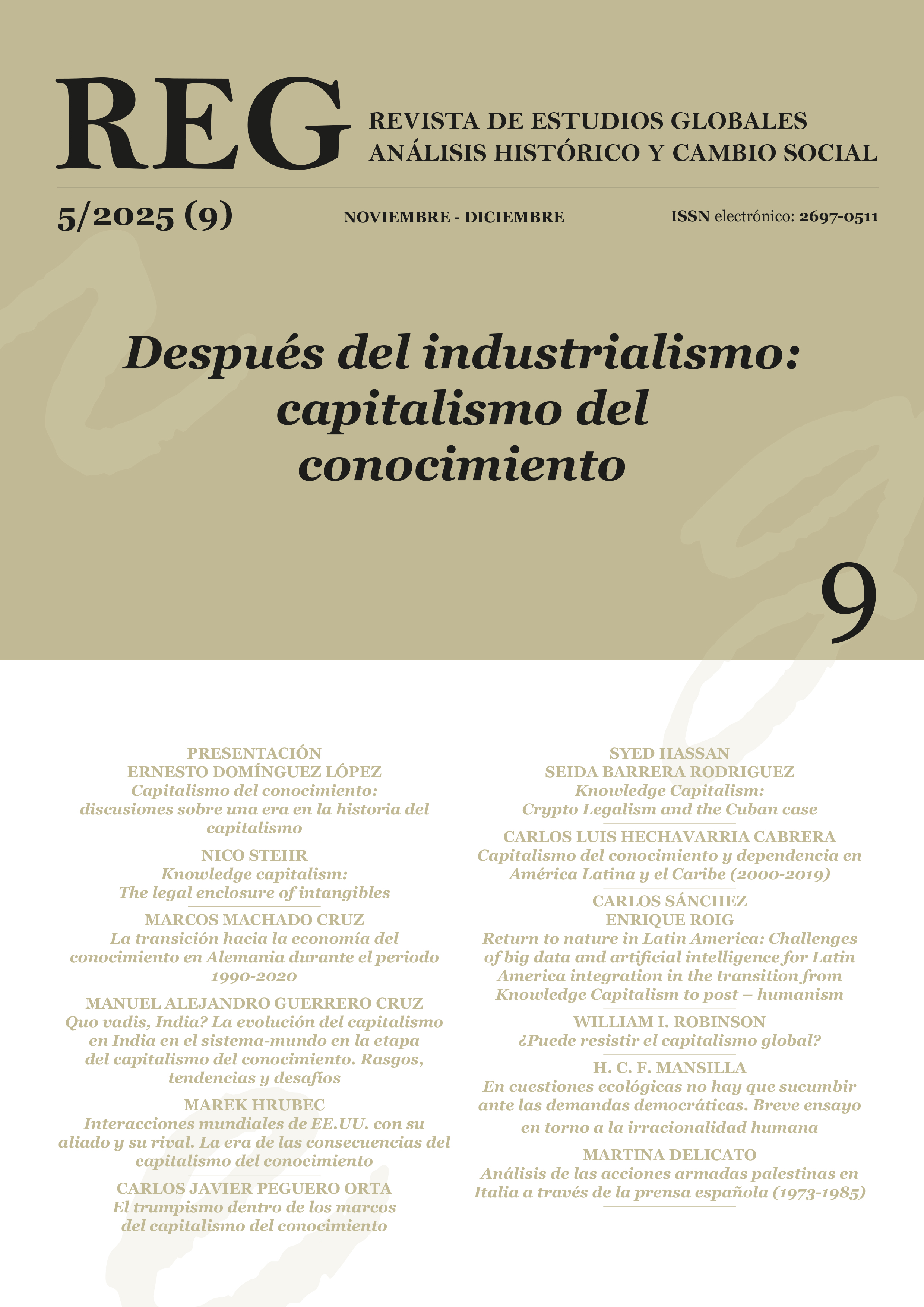
Quo Vadis, India? La evolución del capitalismo en India en el sistema-mundo en la etapa de capitalismo del conocimiento. Rasgos, tendencias y desafíos
Abstract
India possesses significant strengths within the global knowledge capitalism, such as its massive young population, its leadership in the information technology and telecommunications sectors and outsources services, and an emerging startup ecosystem driven by government policies. However, it also faces critical structural weaknesses: low investment in R&D, extreme socioeconomic inequality, and an education system that does not guarantee equitable access to training in advanced skills. Within the theoretical framework of Wallerstein and Chase-Dunn’s world-systems analysis, India oscillates between a semi-peripheral role and the aspiration to integrate into the center of the world-system. Its recent capitalist evolution (since the neoliberal reforms of 1991) prioritizes low-knowledge manufacturing and tertiary services, but it depends on foreign technological inputs and reproduces global hierarchies of exploitation. The transition to a central model of knowledge capitalism will require profound institutional reforms and a strategic, rather than subordinate, integration into the global economy.
Downloads
Metrics
-
Abstract260
-
PDF (Español (España))128
References
AD (Alper-Döger) Scientific Index. (20 de agosto de 2025). AD (Alper-Döger) Scientific Index. Obtenido de AD (Alper-Döger) Scientific Index: https://www.adscientificindex.com/university-ranking/?funding=All+Universities
Burton-Jones, A. (1999). Knowledge Capitalism: Business, Work, and Learning in the New Economy. Oxford: Oxford University Press.
Chase-Dunn, C. (1998). Global Formation: Structures of the World-Economy. Oxford: Rowman & Littlefield Publishers.
Chatterjee, P. (2008). La nación en tiempo heterogéneo y otros estudios subalternos. Buenos Aires: Siglo XXI Editores.
Cheema, G. (4 de abril de 2021). BJP Rule and Its Impact on Indian Society. Obtenido de Strategic Foresight for Asia: https://strafasia.com/bjp-rule-and-its-impact-on-indian-society/
Dahlman, C. (2007). India's Knowledge Economy in the Global Context. En N. R. Council, India's Changing Innovation System: Achievements, Challenges, and Opportunities for Cooperation: Report of A Symposium (págs. 137-164). Washington D.C.: National Academy of Sciences.
Dahlman, C., & Utz, A. (2005). India and the Knowledge Economy: Leveraging Strengths and Opportunities. Washington D.C.: World Bank.
Dasgupta, B., Ghosh, A., & Gosh, B. (2021). Neoliberalism in the Emerging Economy of India: The Political Economy of International Trade, Investment and Finance. Nueva York: Routledge.
Domínguez López, E. (mayo-agosto de 2022). Capitalismo del conocimiento. Transición y contradicciones políticas en los Estados Unidos del siglo XXI. Revista Universidad de La Habana(294). Recuperado el 30 de julio de 2025, de http://scielo.sld.cu/scielo.php?script=sci_arttext&pid=S0253-92762022000200004&lng=es&tlng=es.
Government of India. (15 de mayo de 2024). Make In India: About Us. Obtenido de Make In India: makeinindia.com/about
Halder, B. K. (noviembre de 2024). Intellectual Property Rights in India: Challenges and Opportunities. International Education and Research Journal, 10(11), 147-154.
Hansen, T. B., & Roy, S. (2022). Saffron Republic. Hindu Nationalism and State Power in India. Cambridge: Cambridge University Press.
Hope, N., Kochar, A., Noll, R., & Srinivasan, T. N. (2013). Economic Reform in India. Challenges, Prospects, and Lessons. Cambridge: Cambridge University Press.
International Monetary Fund (IMF). (2025). India: 2024 Article IV Consultation-Press Release; Staff Report; and Statement by the Executive Director for India. Recuperado el 30 de julio de 2025, de https://www.imf.org/en/Publications/CR/Issues/2025/02/27/India-2024-Article-IV-Consultation-Press-Release-Staff-Report-and-Statement-by-the-562726
International Trade Administration. (30 de julio de 2025). India Country Commercial Guide. Obtenido de United States International Trade Administration: https://trade.gov/country-commercial-guides/india-protecting-intellectual-property
Jaffrelot, C., Kohli, A., & Murali, K. (2019). Business and Politics in India. Oxford: Oxford University Press.
Kohli, A. (2004). State-Directed Development: Political Power and Industrialization in the Global Periphery. Cambridge: Cambridge University Press.
Mann Deshi Foundation. (20 de agosto de 2025). Mann Deshi Foundation Annual Report for the Year 2020-21. Obtenido de Mann Deshi Foundation: https://manndeshifoundation.org/annual-reports/MDF_AR_2020-21.pdf.
Ministry of Law and Justice of the Republic of India. (30 de julio de 2025). The Constitution of India (As of May 1 2024). Obtenido de Ministry of Law and Justice of the Republic of India: https://cdnbbsr.s3waas.gov.in/s380537a945c7aaa788ccfcdf1b99b5d8f/uploads/2024/07/20240716890312078.pdf
Ordóñez, S. (2006). Capitalismo del conocimiento: elementos teórico-históricos. Economía Informa, 338, 4-17.
Ordóñez, S., & Sánchez Ramírez, C. M. (2016). Knowledge Capitalism, Globalization, and Hegemony: Towards a Socio-Spatial Approach. World Review of Political Economy, 7(1), 4-28.
QS Rankings. (20 de agosto de 2025). QS World University Ranking 2025. Obtenido de QS University Rankings: https://www.topuniversities.com/world-university-rankings
Ramesh, A. (13 de mayo de 2025). "Make in India" relies on "Made in China". Obtenido de Hinrich Foundation: https://www.hinrichfoundation.com/research/wp/trade-and-geopolitics/make-in-india-relies-on-made-in-china/
Sánchez Ramírez, C. M. (2021). Knowledge Capitalism and State Theory. A “Space-Time” Approach Explaining Development Outcomes in the Global Economy. Nueva York: Palgrave Macmillan.
SinghaRoy, D. K. (2014). Towards a Knowledge Society. New Identities in Emerging India. New Delhi: Cambridge University Press.
Stehr, N. (1994). Knowledge Societies. New York: Sage Publications.
Stehr, N. (2022). Knowledge Capitalism. New York: Routledge.
Wallerstein, I. (2004). World-Systems Analysis: An Introduction. Durham: Duke University Press.
World Bank. (30 de julio de 2025). Data360: India. Obtenido de World Bank Group: https://data360.worldbank.org/en/economy/IND
World Intellectual Property Organization (WIPO). (2024). Global Innovation Index 2024. Recuperado el 30 de julio de 2025, de https://www.wipo.int/edocs/gii-ranking/2024/in.pdf
World Intellectual Property Organization (WIPO). (30 de julio de 2025a). An International Guide to Patent Case Management for Judges (India). Obtenido de World Intellectual Property Organization (WIPO): https://www.wipo.int/patent-judicial-guide/es/full-guide/india
World Intellectual Property Organization (WIPO). (30 de julio de 2025b). WIPO Patent Database (Patentscope). Obtenido de World Intellectual Property Organization (WIPO): https://patentscope.wipo.int
Copyright (c) 2025 Journal of Global Studies: Historical Analysis and Social Change

This work is licensed under a Creative Commons Attribution-NonCommercial-NoDerivatives 4.0 International License.