
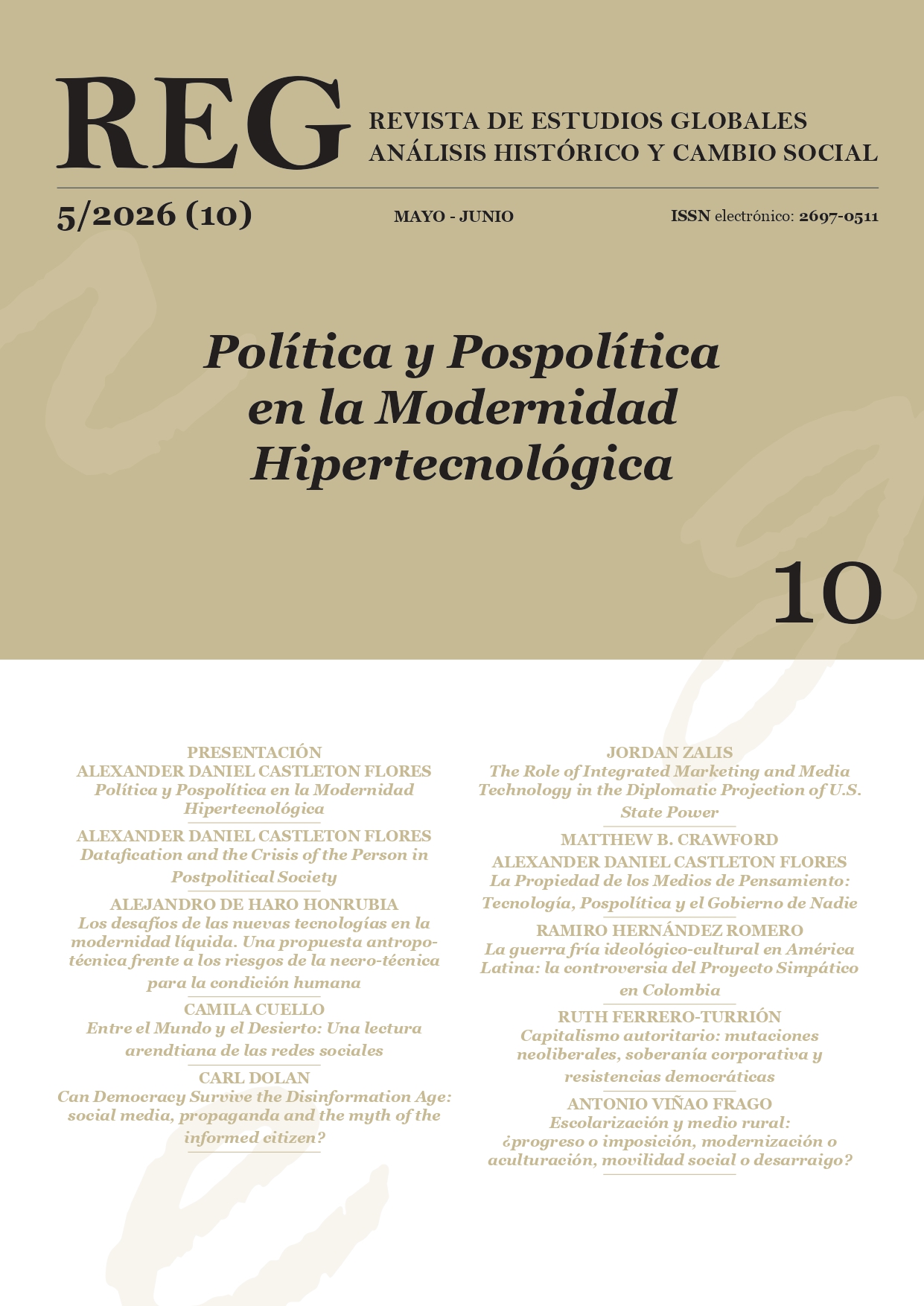
The ideological-cultural cold war in Latin America: the controversy of the Simpatía Project in Colombia
Abstract
This article studies the controversy surrounding the Simpatía Project in Colombia, which is part of a series of projects that were implemented in Latin America in the 1960s. The ruling class and the American power elites were trying to predict the causes of the insurgency in the region, and so the Camelot Project in Chile, the Colonia Project in Peru, and the Marginalidad Project in Argentina, among others, were formulated for these purposes. Shortly before, the studies related to these investigations came from a long process of transformation in the United States. There was a correlation between the social sciences and politics. In the Colombian case, a group of anthropologists and psychologists participated in carrying out the research, however, when it was carried out, it gave rise to a social and political controversy, with repercussions at the national and international level. Three groups are distinguished: 1) Social scientists: anthropologists and psychologists; 2) The deputies of the Congress of the Republic of Colombia and 3) The political-media press: El Tiempo, El Espectador and La Nación.
Downloads
Metrics
-
Abstract117
-
PDF (Español (España))52
References
Bowers, R. V. (1971). “La institución militar”. En Paul F. L., et. al. La sociología en las instituciones. Buenos Aires: Paidós.
Calvo Ospina, H. (2018). El terrorismo de Estado en Colombia. Caracas: Ediciones El perro y la rana.
Corti, B. (2015). Jazz argentino. La música “negra” del país “blanco”. Buenos Aires: Gourmet.
Davison, W. P. (1971). "La política exterior". En Paul F. L., et. al. La sociología en las instituciones. Buenos Aires: Paidós.
Domhoff, G. W. (2003). ¿Quién gobierna Estados Unidos? México: Siglo XXI.
Esteve Martí, Javier (2021). El papel de la CIA en la institucionalización de las Annales braudelianos y su impacto en la historiografía marxista europea durante la Guerra Fría cultural. Santiago de Chile: Universidad de Chile. Informe para optar el grado de Licenciatura en Historia.
Garretón, M. A. (2014). Las ciencias sociales en la trama de Chile y América Latina. Estudios sobre transformaciones sociopolíticas y movimiento social. Santiago de Chile: Lom.
Gilman, C. (2012). Entre la pluma y el fusil. Debates y dilemas del escritor revolucionario en América Latina. Buenos Aires: Siglo XXI.
Graziano, Walter (2013). Hitler ganó la guerra. México: Debolsillo.
Hernández R. R. (2020a). “La polémica del Proyecto Camelot en Chile”. En Revista De raíz diversa. Revista especializada en Estadios Latinoamericanos, 7 (13), 111-136. https://doi.org/10.22201/ppela.24487988e.2020.13.72349
Hernández R. R. (2020b). “El jazz en México a mediados del siglo XX”. En Revista Musical Chilena, 233, 28-48.
Hopen, D. (2015). “Sobre el Proyecto Marginalidad”. En Néstor Kohan (Compilador). Ciencias sociales y marxismo latinoamericano. Buenos Aires: La llamarada.
Horowitz, I. L. (1966). “Vida y muerte del Proyecto Camelot”. http://rcsdigital.homestead.com/files/Vol_X_Nm_2_1966/Horowitz.pdf, 145-165.
López y Rivas, G. (2013). Estudiando la contrainsurgencia de Estados Unidos. Manuales, mentalidades y uso de la antropología. México: Ocean Sur.
Nación, La (agosto, 1965-febrero, 1966). Bogotá, Colombia.
Maechling, Charles Jr. (1990). “Contrainsurgencia: la primera prueba de fuego”. En Klare, M. T. y P. Kornbluh. Contrainsurgencia y antiterrorismo en los 80. El arte de la guerra de baja intensidad. México: Conaculta, Grijalbo.
Mills, C. W. (2013). La élite del poder. México: FCE.
Palacios, M. (2012). Violencia pública en Colombia, 1958-2010. Bogotá: FCE.
“Presentación”. Imperialismo y ciencias sociales (1970). En Referencias. Revista del Partido Comunista de Cuba. Universidad de La Habana, 1 (2), 3-6.
Rouquié, A. (1984). El estado militar en América Latina. México, Siglo XXI.
Selser, G. (1966). Espionaje en América Latina. El pentágono y las técnicas sociológicas. Argentina: Ediciones Iguazú.
Selser, G. (2010). Cronología de las intervenciones extranjeras en América Latina. Tomo IV. México: CEIICH-UNAM. UACM.
Suárez, L. (2006). Un siglo de terror en América Latina. Crónica de crímenes de Estados Unidos contra la humanidad. La Habana: Ocean Sur.
Tiempo, El (agosto, 1965-febrero, 1966). Bogotá, Colombia.
Vidal, E. (1966). El “plan simpático” en colombia. Bogotá: Ediciones MRB.
Zinn, H. (2010). La otra historia de los Estados Unidos. México: Siglo XXI.
Zuckermann, A. (2022). El jazz en la Ciudad de México. México: FCE.
Copyright (c) 2026 Journal of Global Studies: Historical Analysis and Social Change

This work is licensed under a Creative Commons Attribution-NonCommercial-NoDerivatives 4.0 International License.