
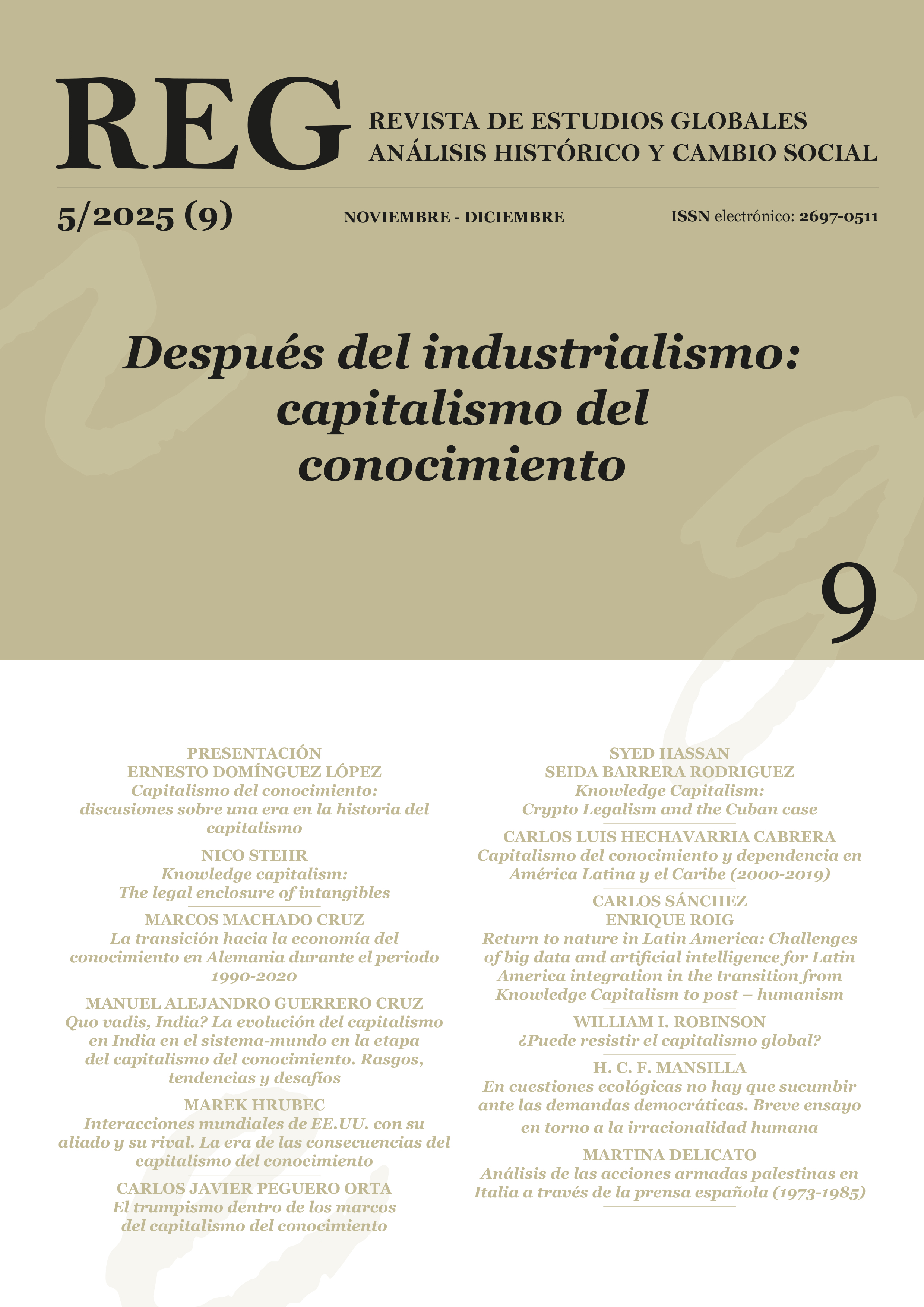
La transición hacia la economía del conocimiento en Alemania durante el periodo 1990-2020
Resumen
: La transformación de las economías de los países centrales del sistema-mundo capitalista desde la posguerra formó parte de un proceso más profundo de transición del capitalismo industrial al del conocimiento. Arribada la década de los noventa, estas economías habían incorporado profundas transformaciones en lo que respecta a una creciente presencia del conocimiento en los procesos productivos y la generación de valor. El artículo aborda la transición hacia la economía del conocimiento en el periodo 1990-2020 en Alemania, una de las economías centrales, con un modelo particular de capitalismo. Su transición también presentó peculiaridades ya que estuvo centrada en mantener el rol de la manufactura como actividad económica principal, a diferencia de la mayoría del resto de las economías centrales. La evolución de los componentes tecnológico, innovativo y formativo en efecto estuvo enfocada en fortalecer y profundizar la actividad manufacturera en la economía del conocimiento alemana en el periodo.
Descargas
-
Resumen7
-
PDF7
Citas
Abelshauser, W. (2005). The Dynamics of German Industry: Germany’s Path toward the New Economy and the American Challenge. Nueva York: Berghahn Books.
Adams, M. y Oleksak, M. (2010). Intangible Capital: Putting Knowledge to Work in the 21st-Century Organization. Nueva York: Bloomsbury Publishing.
Ayan, T. Y. y Pabuçcu, H. (2018). The assessment of knowledge economy efficiency: Comparing Turkey with the European Union countries. Zbornik radova Ekonomskog fakulteta u Rijeci, 36(2), 443–464. https://doi.org/10.18045/zbefri.2018.2.443.
Banco Mundial. (2025). Crecimiento del PIB (% anual) – Alemania. Indicadores. https://datos.bancomundial.org/indicador/NY.GDP.MKTP.KD.ZG?locations=DE.
Balestro, M., De Toni, J. y Botelho, A. J. J. (2021). Germany’s Innovation Manufacturing: A Path to Knowledge-Intensive Economy. Revista Pós Ciências Sociais, 18(2), 333–354. https://doi.org/10.18764/2236-9473.v18n2p333-354.
Becker, G. S. (1964). Human Capital: A Theoretical and Empirical Analysis with Special Reference to Education. Chicago: University of Chicago Press.
Bell, D. (1973). The Coming of Post-Industrial Society: A Venture in Social Forecasting. Nueva York: Basic Books.
Bernhard, M., Buckl, C., Döricht, V., Fehling, M., Fiege, L., Grolman, H. V., ... y Stanek, C. (2011). The Software Car: Information and Communication Technology (ICT) as an Engine for the Electromobility of the Future, Summary of results of the “eCar ICT System Architecture for Electromobility” research project sponsored by the Federal Ministry of Economics and Technology.
Bloch, M. (1986). La sociedad feudal. Madrid: Akal.
Braudel, F. (1984). Civilización material, economía y capitalismo (Tomos I, II y III). Madrid: Alianza Editorial.
Buisán, M. (2024). Alemania, en la encrucijada: el cambio de modelo económico. Boletín Económico de ICE, Información Comercial Española, 3168, 21–34. https://dialnet.unirioja.es/servlet/articulo?codigo=9393827.
Buró de Análisis Económico, (BEA). (2025). https://www.bea.gov/.
Burton-Jones, A. (2001). Knowledge Capitalism: Business, Work, and Learning in the New Economy. Oxford: Oxford University Press
Castillo, J. M. (2021). Alemania y la austeridad: de la crisis del euro a la COVID-19. Revista de Economía Mundial, 59, 9–28. https://www.redalyc.org/journal/4755/475571195009/html/.
Comisión de Expertos para la Investigación y la Innovación (EFI). (2012). Investigación, innovación y desempeño tecnológico en Alemania – Informe EFI 2012. EFI.
Corrado, C., Hulten, C., y Sichel, D. (2005). Measuring capital and technology: An expanded framework. En C. Corrado, J. Haltiwanger, y D. Sichel (Eds.), Measuring capital in the new economy (pp. 11–46). Chicago: University of Chicago Press.
Chen, D. H. C., y Dahlman, C. J. (2006). The knowledge economy, the KAM methodology and World Bank operations. Washington, D.C.: World Bank Institute.
Chisholm, R. M. (1989). Theory of Knowledge. Nueva Jersey: Prentice-Hall.
Crass, D., Licht, G., y Peters, B. (2010). Intangible assets and investments at the sector level: Empirical evidence for Germany. ZEW – Leibniz Centre for European Economic Research. https://doi.org/10.1007/978-3-319-07533-4_4
Dauth, W., Findeisen, S., Südekum, J., y Woessner, N. (2021). The adjustment of labor markets to robots. Journal of the European Economic Association, 19(6), 3104–3153. https://doi.org/10.1093/jeea/jvab012.
____________________________________________. (2017). German robots: The impact of industrial robots on workers. IAB-discussion paper. No. 30. https://www.econstor.eu/handle/10419/172894.
Diessner, S., Durazzi, N., y Hope, D. (2021). Skill-biased liberalization: Germany’s transition to the knowledge economy. Politics & Society, 50(1), 117–155. https://doi.org/10.1177/00323292211006563.
Diessner, S., Durazzi, N., Filetti, F., Hope, D., Kleider, H., y Tonelli, S. (2025). The transition to the knowledge economy in advanced capitalist democracies: a new index for comparative research. Socio-Economic Review. https://doi.org/10.1093/ser/mwaf018.
Dobb, M., Sweezy, P. M., Hill, C., Lefebvre, G., Merrington, J., Procacci, G., Takahashi, K. y Hobsbawm, E. (Eds.). (1985). The Transition from Feudalism to Capitalism. Londres: Verso.
Dohse, D. (2007). Cluster‐Based Technology Policy. The German Experience. Industry and Innovation, 14(1), 69-94. https://doi.org/10.1080/13662710601130848.
Domínguez López, E. (2017). Europa en el ocaso del milenio: Un estudio sobre el capitalismo europeo en el cambio de época. La Habana: Editorial de Ciencias Sociales.
_________________. (2022). Capitalismo del conocimiento. Transición y contradicciones políticas en los Estados Unidos del siglo XXI. Revista Universidad de La Habana, 294. http://www.revuh.uh.cu/index.php/UH/index.
Dudová, I. (2011). Ekonómia vzdelávania [Economics of Education]. Bratislava: Vydavateľstvo EKONÓM.
Dustmann, C., Fitzenberger, B., Schönberg, U. y Spitz-Oener, A. (2014). From Sick Man of Europe to Economic Superstar: Germany’s Resurgent Economy. Journal of Economic Perspectives, 28(1), 167–188. https://doi.org/10.1257/jep.28.1.167.
Drucker, P. F. (1969). The Age of Discontinuity: Guidelines to Our Changing Society. Londres: Butterworth-Heinemann Ltd.
___________. (1992). Managing for the Future: The 1990s and Beyond. Nueva York: Truman Talley Books/Dutton.
Emmenegger, P., Bajka, S. M. e Ivardi, C. (2023). How Coordinated Capitalism Adapts to the Knowledge Economy: Different Upskilling Strategies in Germany and Switzerland. Swiss Political Science Review, 29(4), 355–378. https://doi.org/10.1111/spsr.12569.
Escalante Gonzalbo, Fernando. (2015). Historia mínima del neoliberalismo. México, D.F.: El Colegio de México.
Federal Ministry for Economic Affairs and Energy. (2019). Facts about German foreign trade. Federal Ministry for Economic Affairs and Energy. https://www.bmwk.de/Redaktion/EN/Publikationen/facts-about-german-foreign-trade.pdf.
Federal Statistical Office (Destatis). (2021). Sustainable Development in Germany — Indicator Report 2021. Wiesbaden, Alemania: Federal Statistical Office. https://www.destatis.de/EN/Themes/Society-Environment/Sustainable-Development-Indicators/Publications/Downloads/indicator-report-0230002219004.html.
Gros, C. (2008). Complex and Adaptive Dynamical Systems: A Primer. Berlín: Springer.
Grundgesetz für die Bundesrepublik Deutschland [GG] [Ley Fundamental de la República Federal de Alemania], 23 de mayo de 1949, BGBl. I. https://www.gesetze-im-internet.de/gg/.
Hall, P. A. y Soskice, D. (Eds.). (2001). Varieties of Capitalism: The Institutional Foundations of Comparative Advantage. Oxford: Oxford University Press.
Haskel, J. y Westlake, S. (2018). Capitalism without Capital: The Rise of the Intangible Economy. Nueva Jersey: Princeton University Press.
Hassel, A. (1999). The Erosion of the German System of Industrial Relations. British Journal of Industrial Relations, 37(3), 483–505. https://doi.org/10.1111/1467-8543.00138.
Hayek, F. A. (1937). Economics and Knowledge. Economica, 4(13), 33-54. https://doi.org/10.2307/2548786.
_____________. (1945). The Use of Knowledge in Society. The American Economic Review, 35(4), 519-530. https://www.jstor.org/stable/1809376.
Heidinger, M., Wenner, F., Sager, S., Sussmann, P. y Thierstein, A. (2023). Where do knowledge-intensive firms locate in Germany?—An explanatory framework using exponential random graph modeling. Jahrbuch für Regionalwissenschaft, 43(1), 101–124. https://doi.org/10.1007/s10037-023-00183-8.
Heider, A., Gerken, M., van Dinther, N. y Hülsbeck, M. (2021). Business model innovation through dynamic capabilities in small and medium enterprises – Evidence from the German Mittelstand. Journal of Business Research, 130, 635–645. https://doi.org/10.1016/j.jbusres.2020.04.051.
Hein, E. y Truger, A. (2005). Macroeconomic Policies, Wage Developments, and Germany’s Stagnation. IMK Working Paper 01-2005. Düsseldorf: Macroeconomic Policy Institute (IMK) at the Hans Böckler Foundation.
Heisenberg, D. (1999). The Mark of the Bundesbank: Germany’s Role in European Monetary Cooperation. Boulder: Lynne Rienner Publishers.
Hobsbawm, E. J. (1994). Historia del Siglo XX. Buenos Aires: Crítica (Grijalbo Mondadori).
Judt, Tony. (2006). Postguerra: Una historia de Europa desde 1945. Madrid: Taurus.
Katuščáková, M., Capková, E. y Grečnár, J. (2023). How to measure knowledge economy. Electronic Journal of Knowledge Management, 21(2), 87–102. https://doi.org/10.34190/ejkm.21.2.3025.
Katzenstein, P. J. (1989). Industry in a changing West Germany. En P. J. Katzenstein (Ed.), Industry and politics in West Germany: Toward the third republic (pp. 3–29). Estados Unidos: Cornell University Press.
Körner, F. M. y Trautwein, H.-M. (2017). German economic models, transnationalization and European imbalances. En I. Cardinale, D’Maris Coffman, y R.
Leaman, J. (2009). The Political Economy of Germany under Chancellors Kohl and Schröder: Decline of the German Model? Nueva York y Oxford: Berghahn Books.
Little, A. D. (1977). New technology-based firms in the United Kingdom and the Federal Republic of Germany. Londres: Wilton House Publications.
Lüthi, S., Thierstein, A. y Bentlage, M. (2011). Interlocking firm networks in the German knowledge economy: On local networks and global connectivity. Raumforschung und Raumordnung, 69(3), 161–174. https://doi.org/10.1007/s13147-011-0088-0.
Machlup, F. (1962). The Production and Distribution of Knowledge in the United States. New Jersey: Princeton University Press.
_________. (1980). Knowledge: Its Creation, Distribution and Economic Significance, Volume I: Knowledge and Knowledge Production. New Jersey: Princeton University Press.
Markovits, A. S. (Ed.). (1982). The Political Economy of West Germany: Modell Deutschland. Nueva York: Praeger Publishers.
Marin, Radu. (2023). Knowledge Economy: An Intangible Assets Based Economy. Journal of Eastern Europe Research in Business and Economics. https://doi.org/10.5171/2023.906396.
Marx, K. (2008). El Capital. Crítica de la Economía Política. Tomo I, El proceso de producción del capital. Ciudad de México: Siglo XXI Editores.
Matuschewski, A. (2006). Regional clusters of the information economy in Germany. Regional Studies, 40(3), 409–422. https://doi.org/10.1080/00343400600632861.
Mroczkowski, Tomasz. (2014). From Breakthrough to Incremental Innovation Leadership: Lessons from Germany. Journal of the Knowledge Economy, 2(5), 409-426. http://doi.org/10.1007/s13132-014-0184-9.
National Science Foundation, NSB. (2024, Mayo). Research and Development: U.S. Trends and International Comparisons, Cross-National Comparisons of R&D Performance. https://ncses.nsf.gov/pubs/nsb20246/table/RD-5#utm.
Naudé, W. y Nagler, P. (2021). The rise and fall of German innovation. IZA Discussion Papers, No. 14154. Institute of Labor Economics (IZA). https://doi.org/10.2139/ssrn.3798907.
North, D. C. (1990). Institutions, Institutional Change and Economic Performance. Cambridge: Cambridge University Press.
Oberfichtner, M. y Schnabel, C. (2019). The German model of industrial relations: (Where) does it still exist? Journal of Economics and Statistics (Jahrbücher für Nationalökonomie und Statistik), 239(1), 5–37. https://doi.org/10.1515/jbnst-2018-0158.
Oficina Federal de Estadísticas de Alemania (Destatis). (2025). Economic sectors and enterprises. https://www.destatis.de/EN/Themes/_node.html#themaHeadline_1426886_3.
Organización para la Cooperación y el Desarrollo Económico (OCDE). (1995). The implications of the knowledge-based economy for future science and technology policies. París: OCDE.
____________________________________________________________. (1996). The knowledge-based economy. París: OCDE.
____________________________________________________________. (2019). Measuring the Digital Transformation: A Roadmap for the Future. Paris: OECD Publishing. https://doi.org/10.1787/9789264311992-en.
____________________________________________________________. (2022). OECD Reviews of Innovation Policy: Germany 2022: Building Agility for Successful Transitions. OECD Reviews of Innovation Policy. Paris: OECD Publishing. https://doi.org/10.1787/50b32331-en.
____________________________________________________________. (2024). OECD Digital Economy Outlook 2024 (Volume 1): Embracing the Technology Frontier. Paris: OECD Publishing. https://doi.org/10.1787/a1689dc5-en.
Our World in Data. (2025). Share of manufacturing in gross domestic product (GDP). https://ourworldindata.org/grapher/manufacturing-value-added-to-gdp.
Owen-Smith, E. (1994). The German Economy. Londres: Routledge.
Pérez, Carlota. (2009). Technological revolutions and techno-economic paradigms. Cambridge Journal of Economics, 1(34), 185-202. http://doi.org/10.1093/cje/bep051.
Pirenne, H. (1974). Historia económica y social de la Edad Media. Ciudad de México: Fondo de Cultura Económica.
Porat, M. U. (1977). The Information Economy: Definition and Measurement. Washington, D.C.: U.S. Department of Commerce, Office of Telecommunications.
Powell, W. W. y Snellman, K. (2004). The knowledge economy. Annual Review of Sociology, 30, 199–220. https://doi.org/10.1146/annurev.soc.29.010202.100037.
Programa de las Naciones Unidas para el Desarrollo (PNUD) y Fundación Mohammed bin Rashid Al Maktoum para el Conocimiento (MBRF). (2019). Informe de Prospectiva del Futuro del Conocimiento 2019. Dubái: PNUD & MBRF.
Racy, J. C., Vartanian, P. R. y Vendruscolo, B. D. P. (2019). German exports, economic growth and foreign demand: An analysis of the period 2000–2017. International Journal of Business, Economics and Management, 6(6), 335-354. https://doi.org/10.18488/journal.62.2019.66.335.354.
Roșca, I. G. (2006). About Knowledge Society Pillars in Romania. Theoretical and Applied Economics, 6(6), 9–12. https://ideas.repec.org/a/agr/journl/v6(501)y2006i6(501)p9-12.html.
Sachs, J. D. (1993). Poland's Jump to the Market Economy. Cambridge: MIT Press.
Sánchez Ramírez, Carlos Manuel. (2021). Knowledge Capitalism and State Theory. A “Space-Time” Approach Explaining Development Outcomes in the Global Economy. Suiza: Palgrave Macmillan.
Sanchis i Marco, M. (2014). The Economics of the Monetary Union and the Eurozone Crisis. Cham: Springer.
Schultz, T. W. (1963). The Economic Value of Education. Nueva York: Columbia University Press.
Schumpeter, Joseph. (1934). The Theory of Economic Development. An Inquiry into Profits, Capital, Credit, Interest and the Business Cycle. Oxford: Oxford University Press.
________________. (1942). Capitalism, Socialism and Democracy. Nueva York: Harper & Brothers.
Schwab, K. (2016). The Fourth Industrial Revolution. World Economic Forum.
Siebert, H. y Stolpe, M. (2001). Technology and Economic Performance in the German Economy. Kieler Arbeitspapiere, (1035). Kiel, Alemania: Kiel Institute for the World Economy. http://kielinstitute.org.
Soskice, D. (1997). German technology policy, innovation, and national institutional frameworks. Industry and Innovation, 4(1), 75-96. https://doi.org/10.1080/13662719700000005.
Stephen, D., Stahlschmidt, S. y Hinze, S. (2020). Performance and structures of the German science system 2020. Studien zum deutschen Innovationssystem, 5. https://hdl.handle.net/10419/214723.
Stewart, T. A. (1997). Intellectual Capital: The New Wealth of Organizations. Nueva York: Doubleday.
Stehr, N. (2022). Knowledge capitalism. Nueva York: Routledge.
Stiglitz, J. E. (1994). Whither Socialism? Cambridge: MIT Press.
Streeck, W. (2015). The German Political Economy Today. In B. Unger (Ed.), The German Model: Seen by Its Neighbours (pp. 81-86). Londres: SE Publishing.
Sundać, D. y Fatur Krmpotić, I. (2011). Factores de la economía del conocimiento y el desarrollo de la economía basada en el conocimiento. Croatian Economic Survey, 13(1), 105–141. https://hrcak.srce.hr/67344.
Thelen, K. (2014). Varieties of Liberalization and the New Politics of Social Solidarity. Cambridge: Cambridge University Press.
________. (2019). Transitions to the Knowledge Economy in Germany, Sweden, and the Netherlands. Comparative Politics, 51(2), 233–255. https://doi.org/10.5129/001041519X15647434969821.
Toffler, A. (1980). The Third Wave. Nueva York: William Morrow and Company.
Torella, Ilaria. (2022). The Capitalism of Knowledge: Different Trajectories of Economic Evolution in China and Germany [Master’s Degree in International Relations]. Departamento de Ciencias Políticas LUISS. ID No. 645702.
Trampusch, C. (2024). Regulating the digital economy: Explaining heterogenous business preferences in data governance. Journal of European Public Policy, 31(7), 1902-1926. https://doi.org/10.1080/13501763.2023.2181853.
Tratado de la Unión Europea, firmado en Maastricht el 7 de febrero de 1992, DO C 191 de 29.7.1992. https://web.archive.org/web/20060710025300/http://europa.eu/eur-lex/es/treaties/dat/C_2002325ES.003301.html.
Veile, J. W., Kiel, D., Müller, J. M. y Voigt, K. I. (2020). Lessons learned from Industry 4.0 implementation in the German manufacturing industry. Journal of manufacturing technology management, 31(5), 977-997. https://doi.org/10.1108/JMTM-08-2018-0270.
Volk, Christine. (2022, October 5). Expenditure on research and development (R&D) in Germany has grown considerably since 2005. https://www.kfw.de/About-KfW/Newsroom/Latest-News/Pressemitteilungen-Details_729344.html#:~:text=The%20five%20sectors%20with%20the,the%20chemical%20industry%20(5.9%25).
Williamson, T. (2000). Knowledge and its limits. Oxford: Oxford University Press.
World Intellectual Property Organization (WIPO). (2015). World intellectual property report 2015: Breakthrough innovation and economic growth. Geneva, Suiza: WIPO. https://www.wipo.int/edocs/pubdocs/en/wipo_pub_944_2015.pdf.
_________________________________________. (2025). Centro de datos estadísticos de la OMPI sobre propiedad intelectual. https://www3.wipo.int/ipstats/ips-search/search-result?type=IPS&selectedTab=patent&indicator=13&reportType=11&fromYear=1990&toYear=2020&ipsOffSelValues=DE,US,CN,GB,FR,JP,IT&ipsOriSelValues=&ipsTechSelValues=900
Young, B. (2019). From Sick Man of Europe to the German Economic Power House: Two Narratives: Ordoliberalism versus Euro-Currency Regime. German Politics, 29(3), 464–478. https://doi.org/10.1080/09644008.2018.1559832.
Derechos de autor 2025 Revista de Estudios Globales. Análisis Histórico y Cambio Social

Esta obra está bajo una licencia internacional Creative Commons Atribución-NoComercial-SinDerivadas 4.0.