
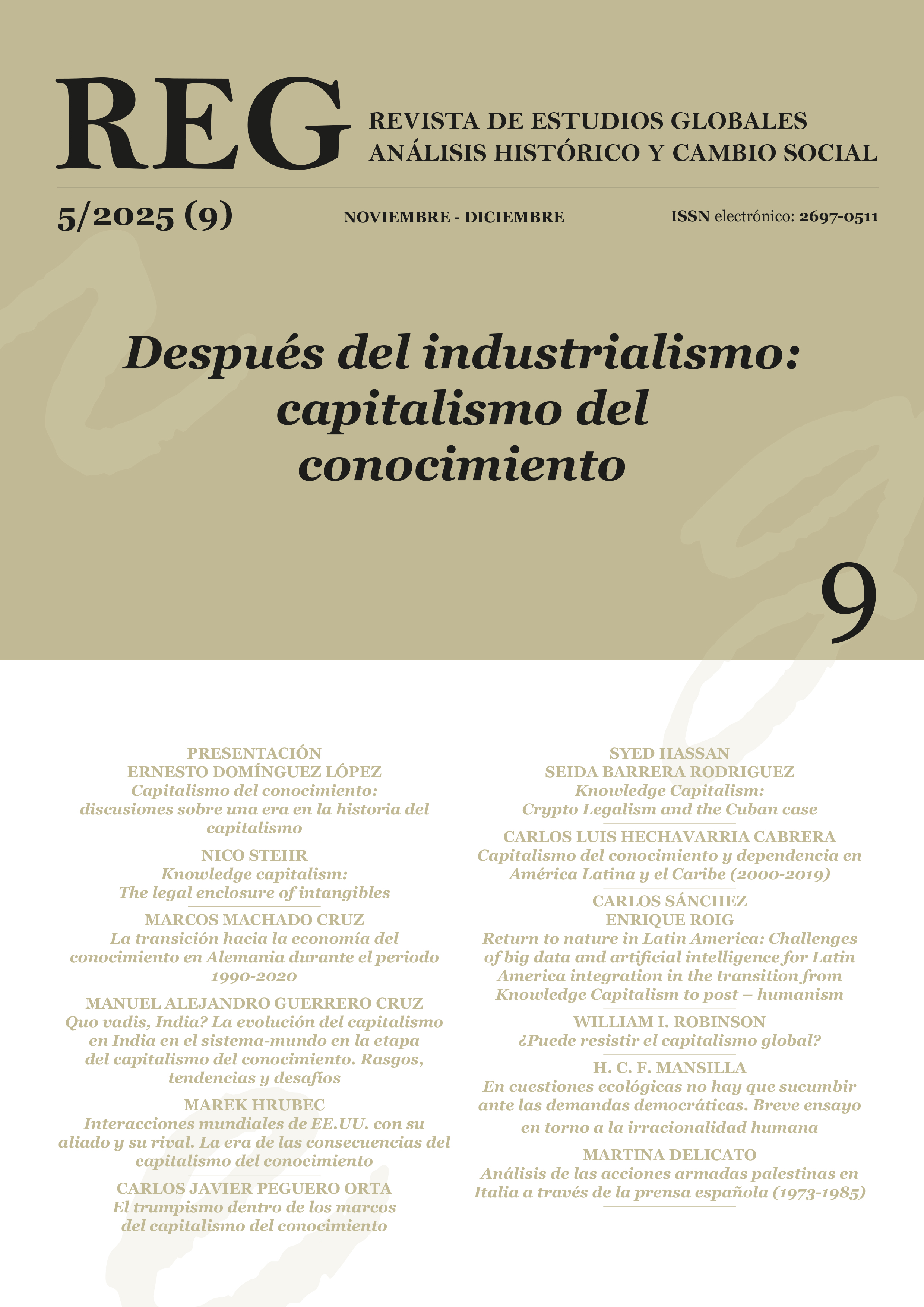
Knowledge capitalism: The legal enclosure of intangibles
Resumen
Este artículo examina el surgimiento del capitalismo del conocimiento, un sistema económico en el que los activos intangibles —como el conocimiento, las ideas y la información— constituyen el principal medio de producción y la fuente de valor corporativo. Argumenta que la protección legal del conocimiento mediante los derechos de propiedad intelectual (DPI), en particular las patentes, ha impulsado este cambio. Si bien estos derechos incentivan la innovación, también generan poder monopolístico, refuerzan las desigualdades globales y reconfiguran la competencia al favorecer a las corporaciones que poseen numerosos DPI, especialmente en el sector tecnológico. El análisis revela que las patentes sirven como instrumentos de control económico, configurando los mercados, las relaciones laborales y el comercio global, además de simplemente brindar protección legal. El Acuerdo sobre los ADPIC es un ejemplo de la globalización de este régimen, que ha institucionalizado las disparidades entre las economías avanzadas y en desarrollo. Además, el crecimiento de la inteligencia artificial y las infraestructuras en la nube exacerba estas tendencias monopolísticas. En última instancia, el capitalismo del conocimiento perpetúa la lógica capitalista tradicional de acumulación, exacerbando la desigualdad y planteando preguntas urgentes sobre la gobernanza del conocimiento y la distribución equitativa de sus beneficios.
Descargas
Métricas
-
Resumen407
-
PDF 268
Citas
Akcigit, Ufuk, John Grigsby, and Tom Nicholas (2017), “The Rise of American Ingenuity: Innovation and Inventors of the Golden Age,” NBER Working Paper No. 23047.
Autor, David, David Dorn, Lawrence F. Katz, Christina Patterson und John van Reenen (2020), “The fall of the labor share and the rise of superstar firms,” The Quarterly Journal of Economics, 135: 645–709.
Barkai, Simcha (2020), “Declining labor and capital shares,” Journal of Finance 75:2421–2463.
Beck, Ulrich (2011), “Herrschaft in der zweiten Moderne: Das Meta-Machtspiel,“ S. 284-303 in Wolfgang Bonß and Christoph Lau (eds.), Macht und Herrschaft in der
Belloc, Filippo and Ugo Pagano (2012), “Knowledge Enclosures, forced specializations and investment crisis,” European Journal of Comparative Economics 9: 445–483.
Berman, Elizabeth Popp (2008), “Why did universities start patenting?” Social Studies of Science 38:835–871.
Blaug, Mark (2005), "Why Did Schumpeter Neglect Intellectual Property Rights?" Review of Economic Research on Copyright Issues 2: 69-74.
Boldrin, Michele and David K. Levine (2013), “The case against patents,” Journal of Economic Perspectives, 27: 3-22.
Burton-Jones, Alan (1999), Knowledge Capitalism: Business, Work, and Learning in the New Economy. Oxford: Oxford University Press.
Cockburn, Iain M., Jean O. Lanjouw, and Mark Schankerman (2014), “Patents and the global diffusion of new drugs,” NBER Working Paper No. 20492 September 2014, Revised October 2014 w20492.
Contreras, Jorge L. (2021), The Genome Defense: Inside the Epic Legal Battle to Determine Who Owns Your DNA. Chapel Hill, NC: Algonquin.
Coriat, Benjamin and Fabienne Ors (2002), “Establishing a new intellectual property rights regime in the United States: Origins, content and problems,” Research Policy, vol. 31: 1491–507.
Cowgill, Bo, Andrea Prat and Tommaso Valletti (2024), “political power and market power,” National Bureau Working Paper 33255 http://www.nber.org/papers/w33255
David, Paul A. (2000), “A tragedy of the public knowledge ‘commons’? Global science, intellectual property and the digital technology boomerang,” SIEPR Discussion Paper No. 00-02. Stanford Institute for Economic Policy Research.
Deaton, Angus (2024), “In economics, do we know what we are doing?” Chronicle of Higher Education March 24, 2024. https://www-chronicle-com.login.ezproxy.library.ualberta.ca/article/in-economics-do-we-know-what-were-doing
Diessner, Sebastian, Niccolo Durazzi, Hanna Kleider, Federico Filetti, and Simone Tonelli (2025), “The Transition to the knowledge economy in advanced capitalist democracies: A new index for comparative research, Forthcoming in Socio-Economic Review.
Drahos, Peter (2010), The Global Governance of Knowledge: Patent Offices and their Clients. Cambridge: Cambridge University Press.
Drahos, Peter John Braithwaite (2002), Information Feudalism. Who Owns the Knowledge Economy? London: Earthscan.
Durand, Cédric and William Milberg (2020), “Intellectual monopoly in global value chains,” Review of International Political Economy 27: 404–429.
Funk, Jeffrey (2018), “Beyond patents,” Issues in Science and Technology 34: 48-54.
Galbraith, James K. and Jing Chen (2025), Entrophy Economics. The Living Basis of Value and Production. Chicago: University of Chicago Press.
Gereffi, Gary (2014), “Global value chains in a post-Washington Consensus world,” Review of International Political Economy, 21: 9–37.
Gorz, André (2002), "Welches Wissen? Welche Gesellschaft, " pp. 2-24 on Heinrich-Böll-Stiftung (ed.): Gut zu wissen. Links zur Wissensgesellschaft. Münster: Dampfboot Verlag.
Grassmuck, Volker (2002), „Wissenskommunismus und Wissenskapitalismus, pp. 149-160 in Karsten Weher, Michael Nagenborg and Helmut F. Spinner (eds.), Wissensarten, Wissensordnungen, Wissensregime. Beiträge zum Karlsruher Ansatz der integrierten Wissensforschung. Wiesbaden: Springer.
Heer, Christopher, Malcolm Harvey, Ephraim Stulberg, Annaette Latoszwewska and Daryna Kutsyna (2024), “Determining the value of your intellectual property,” Christopher Heer Professional Corporation operating as Heer Law, Toronto, Ontario, Canada; https://www.heerlaw.com/determining-value-intellectual-property
Hoffmann, Florian, David S. Lee and Thomas Lemieux (2020), “Growing Income Inequality in the United States and Other Advanced Economies,” Journal of Economic Perspectives 34: 52–78.
Kalsi, Priti and Zachary Ward (2025), “The Gilded Age and Beyond: The Persistence of Elite Wealth in American History, NBER Working Paper No. 33355; http://www.nber.org/papers/w33355
Kay, John (2003), The Truth about Markets. Their Genius, their Limits, their Follies. London: Allen Lane.
Korinek, Anton and Joseph E. Stiglitz (2021), »Artificial Intelligence, Globalization, and Strategies for Economic Development«, NBER Working Paper No. 28453.
Korinek, Anton, and Ding Xuan Ng (2017), “The macroeconomics of superstars,” Mimeo. http://www.korinek.com/download/Superstars.pdf
Kuznets, Simon (1955), “Economic growth and income inequality,“ American Economic Review 65: 1-28.
Lessig, Lawrence (1999), Code and other Laws of Cyberspace. New York: Basic Books.
Lindblom, Charles E. (1973), Politics and Markets. New York: Basic Books.
Lindblom, Charles E. (1995), “Market and democracy – obliquely,” PS: Political Science & Politics 28: 684-688.
Lindblom, Charles E. (2001), The Market System. What It Is, How It Works, and What To Make of It. New Haven, Connecticut: Yale University Press.
Machlup, Fritz (1958), An Economic Review of the Patent System. Study of the Subcommittee on Patents, Trademarks, and Copyrights of the Committee on the Judiciary, United States Senate, Study No. 15. Washington, D.C.: Government Printing Office.
Maggi, Giovanni and Ralph Ossa (2020), “The political economy of deep integration,” NBER Working Paper http://www.nber.org/papers/ w28190.
Mannheim, Karl. (1930), "Über das Wesen und die Bedeutung des wirtschaftlichen Erfolgsstrebens. Ein Beitrag zur Wirtschaftssoziologie," Archiv für Sozialwissenschaft und Sozialpolitik 63: 440-512.
Marx, Karl ([1939–1941] 1953), Grundrisse der Kritik der politischen Ökonomie. Frankfurt am Main: Europäische Verlagsanstalt.
May, Christopher (2000), The Global Political Economy of Intellectual Property Rights: The New Enclosures. London: Routledge.
May, Christopher (2006), "Social limits to the commodification of knowledge: ten years of TRIPs," Journal of Institutional Economics 2: 91-108.
Milanovic, Branko (2016), Global Inequality. A New Approach for the Age of Globalization. Cambridge, Massachusetts: Harvard University Press.
Moerland, Anke (2024), “Intellectual Property Law and AI,” pp. 362-383 in Ernest Lim and Phillip Morgan (eds.), The Cambridge Handbook of Private Law and Artificial Intelligence, Cambridge: Cambridge University Press, 2024.
Morozov, Evgeny (2022), “Critique of techno-feudal reason, New Left Review 133/134: 89-126.
Pagano, Udo (2018), “Knowledge as a global common and the crisis of the learning economy,” pp. 353–373 in Martin Guzman (ed.), Joseph Stiglitz and the Twenty-First Century Economics. New York: Columbia University Press.
Pagano, Ugo (2014), »The crisis of intellectual monopoly capitalism«, Cambridge Journal of Economics 38:1409–1429.
Page, Benjamin I. and Martin Gilens (2017), Democracy in America? What Has Gone Wrong and What We Can Do About It. Chicago: University of Chicago Press.
Piketty, Thomas ([2013] 2014), Capital in the Twentieth Century. Cambridge, Massachusetts: Harvard University Press.
Piketty, Thomas (2006), “The Kuznets Curve yesterday and Tomorrow,” pp. 63–72 in Abhijit Vinayak Banerjee, Roland Benabou and Dilip Mookherjee (eds.), Understanding Poverty. Oxford: Oxford University Press.
Piketty, Thomas, Emmanuel Saez, and Gabriel Zucman (2018), “Distributional National Accounts: Methods and Estimates for the United States,” Quarterly Journal of Economics 133: 553–609.
Polanyi, Karl ([1944] 2001), The Great Transformation: The Political and Economic Origins of Our Time. Foreword by Joseph E. Stiglitz. With a New Introduction by Fred Block. Boston: Beacon Press.
Richards, Donald G. (2004), Intellectual Property Rights. Armonk, New York: M.E. Sharpe.
Rikap, Cecilia (2023), “Capitalism as usual,” New Left Review 139, January February.
Robinson, Keith W. and Joshua T. Smith (2018), “Emerging technologies challenging current legal paradigms,” Minnesota Journal of Law of Science and Technology 19: 355-372.
Saez, Emmanuel, and Gabriel Zucman (2016), “Wealth Inequality in the United States since 1913: Evidence from Capitalized Income Tax Data,” Quarterly Journal of Economics 131:519–78.
Schaake, Marietje (2024), The Tech Coup. How to Save Democracy from Silicon Valley. Princeton, New Jersey: Princeton University Press.
Schwartz, Herman Mark (2019), “American hegemony: intellectual property rights, dollar centrality, and infrastructural power,” Review of International Political Economy, 26: 490–519.
Schwartz, Herman Mark (2021b), “Manufacturing stagnation,“ Phenomenal World November 4, 2021; https://www.phenomenalworld.org/analysis/manufacturing-stagnation/
Sell, Susan K. (2003), Private Power, Public Law: The Globalisation of Intellectual Property Rights.
Sell, Susan K. (2010), “The rise and rule of a trade-based strategy: Historical institutionalism and the international regulation of intellectual property,” Review of International Political Economy 17:762–790.
Shiva, Vandana (2001), Protect or Plunder? Understanding Intellectual Property Rights. London: Zed Books.
Siegrist, Hannes (2019), “Intellectual property rights and the dynamics of propertisation, nationalization, and globalization in modern cultures and economies,” pp.. 19–47 in Hannes Siegrist and Augusta Dimou (eds.), Expanding Intellectual Property. Budapest: Central European University Press.
Sinnreich, Aram (2019), The Essential Guide to Intellectual Property. New Haven, Connecticut: Yale University Press.
Soskice, David (2022), “The United States as radical innovation driver: the politics of declining dominance? pp. 321-350 in Jacob S. Hacker, Alexander Hertel-Fernandez, Paul Pierson, and Kathleen Thelen (eds), American Political Economy. Oxford: Oxford University Press.
Spinner, Helmut F. (2002), "Wissenskommunismus für Wissenskapitalisten – Anachronismus oder Futurismus des Informationszeitalters,“ pp. 295-324 in Klaus Peter Dencker (ed.), Die Politik der Maschine 5. Hamburg: Kulturbehörde Hamburg.
Stehr, Nico (1994), Knowledge Societies. London: Sage.
Stehr, Nico (2022), Knowledge Capitalism. New York: Routledge.
Stehr, Nico and Marian Adolf (2017), Knowledge. Second Edition. London: Routledge.
Stiglitz, Joseph E. (2006), Making Globalization Work. London: Penguin Books.
Stiglitz, Joseph E. (2002), Globalisation and its Discontents, London: Allen Lane, The Penguin Press.
Stiglitz, Joseph and Bruce C. Greenwald (2014), Creating a Learning Society. A New Approach to Growth, Development, and Social Progress. New York: Columbia University Press.
Veblen, Thorstein (1908), “On the nature of capital: Investment, intangible assets, and the pecuniary magnate,” The Quarterly Journal of Economics 23:104–136.
Weber, Max ([1922] 1978), Economy and Society. An Outline of an Interpretive Sociology. Edited by Guenther Roth and Claus Wittich. Berkeley. California: University of California Press.
Winseck, Dwayne (2019), “Internet infrastructure and the persistent myth of U.S. hegemony,” S.93–120 in Blanye Haggart et al. (eds.), Information, Technology and Control in a Changing World. London: Palgrave.
World Bank (2024), The Middle-Income Trap. World Development Report 2024. Washington, DC: International Bank for Reconstruction and Development / The World Bank
World Intellectual Property Organization (WIPO) (2020), World Intellectual Property Report. Geneva: World Intellectual Property Organization.
Derechos de autor 2025 Revista de Estudios Globales. Análisis Histórico y Cambio Social

Esta obra está bajo una licencia internacional Creative Commons Atribución-NoComercial-SinDerivadas 4.0.