
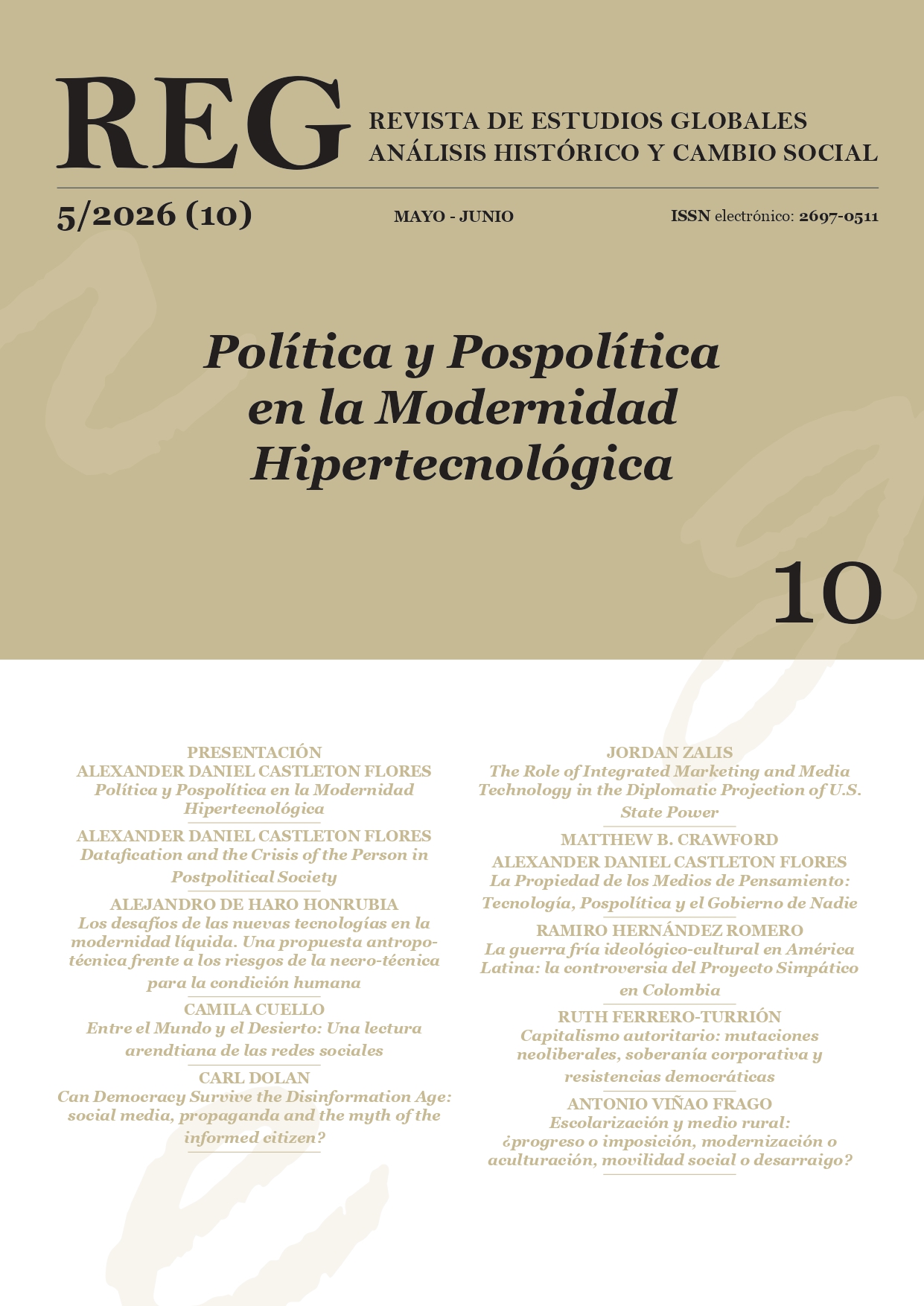
Capitalismo autoritario: mutaciones neoliberales, soberanía corporativa y resistencias democráticas
Resumen
Este artículo analiza el concepto de capitalismo autoritario como mutación del neoliberalismo en el siglo XXI, caracterizada por la subordinación de la democracia a los intereses corporativos. A partir de una revisión crítica de autores como Fraser, Brown, Streeck, Han, Sassen y Zuboff, se examinan cinco dinámicas interdependientes: concentración económica y soberanía corporativa, capitalismo de plataformas y control digital, precarización laboral, captura regulatoria y hegemonía cultural. El texto muestra cómo estas tendencias se refuerzan en contextos de crisis financieras, sanitarias y ecológicas, erosionando la legitimidad democrática a escala global. Asimismo, se destacan experiencias de resistencia social y alternativas democráticas, con especial atención a América Latina, donde confluyen luchas contra el extractivismo, la precarización y el autoritarismo neoliberal. Se concluye que comprender el capitalismo autoritario es indispensable para imaginar instituciones capaces de subordinar el capital a la democracia.
Descargas
Métricas
-
Resumen287
-
PDF76
Citas
Alianza por la Transparencia y la Justicia Social. (2019). Informe regional sobre captura institucional en América Latina. ATJS.
[arXiv]. (2024). Economic growth, inequality, and poverty in contemporary China. arXiv preprint. https://arxiv.org/abs/2412.20176
Baldoni, R., & Di Luna, G. (2025). Sovereignty in the digital era: The quest for continuous access to dependable technological capabilities. arXiv. https://arxiv.org/abs/2503.10140
Banerjee, S. B. (2008). Corporate social responsibility: The good, the bad and the ugly. Critical Sociology, 34(1), 51–79. https://doi.org/10.1177/0896920507084623
Benkler, Y., Faris, R., & Roberts, H. (2018). Network propaganda: Manipulation, disinformation, and radicalization in American politics. Oxford University Press.
Blowfield, M. (2013). Business and sustainability. Oxford University Press.
Bollerman, M. (2025). Digital sovereignty and nation-state influence: Big Tech as digital sovereigns. arXiv. https://arxiv.org/abs/2507.21066
Boltanski, L., & Chiapello, È. (2002). El nuevo espíritu del capitalismo. Akal.
Bourdieu, P. (1996). Sur la télévision. Liber-Raisons d’agir.
Bradshaw, S., & Howard, P. N. (2019). The global disinformation order: 2019 global inventory of organised social media manipulation. Oxford Internet Institute.
Brown, W. (2015). Undoing the demos: Neoliberalism’s stealth revolution. Zone Books.
Carpenter, D., & Moss, D. A. (Eds.). (2014). Preventing regulatory capture: Special interest influence and how to limit it. Cambridge University Press.
Citton, Y. (2017). The ecology of attention. Polity Press.
Comisión Económica para América Latina y el Caribe (CEPAL). (2021). Balance preliminar de las economías de América Latina y el Caribe. Naciones Unidas. https://www.cepal.org/es/publicaciones
Corporate Europe Observatory. (2019). Captured states: When EU governments are a channel for corporate interests. Corporate Europe Observatory.
Couldry, N., & Hepp, A. (2017). The mediated construction of reality. Polity Press.
Couldry, N., & Mejias, U. A. (2019). The costs of connection: How data is colonizing human life and appropriating it for capitalism. Stanford University Press.
Creemers, R. (2018). China’s social credit system: An evolving practice of control. SSRN Electronic Journal. https://doi.org/10.2139/ssrn.3175792
Crouch, C. (2004). Post-democracy. Polity Press.
De Stefano, V. (2016). The rise of the “just-in-time workforce”: On-demand work, crowdwork and labour protection in the “gig-economy.” Conditions of Work and Employment Series, 71. International Labour Office.
de Sousa Santos, B. (2014). Epistemologies of the South: Justice against epistemicide. Routledge.
European Commission. (2020). The EU response to the COVID-19 pandemic. Publications Office of the European Union. https://ec.europa.eu
Fleming, P. (2019). The worst is yet to come: A post-capitalist survival guide. Verso.
Fraser, N. (2019). The old is dying and the new cannot be born: From progressive neoliberalism to Trump and beyond. Verso.
Freedom House. (2024). Freedom in the world 2024: Marking 50 years. Freedom House. https://freedomhouse.org/report/freedom-world/2023/marking-50-years
Fuchs, C. (2021). Social media: A critical introduction (3rd ed.). Sage.
Gillespie, T. (2018). Custodians of the internet: Platforms, content moderation, and the hidden decisions that shape social media. Yale University Press.
Gramsci, A. (1971). Selections from the prison notebooks. International Publishers.
Gudynas, E. (2018). Extractivisms: Politics, economy and ecology. Fernwood Publishing.
Hall, S. (1997). Representation: Cultural representations and signifying practices. Sage.
Heinrich, C. (2024). Beyond formal politics: The epistemic facet of business power. Business and Politics, 27(1), 69–94. https://doi.org/10.1017/bap.2024.1
Hochschild, A. R. (1983). The managed heart: Commercialization of human feeling. University of California Press.
IDEA (International Institute for Democracy and Electoral Assistance). (2023). Global state of democracy report. International IDEA. https://www.idea.int
Illouz, E. (2018). Las emociones capitalistas: El presente ambivalente de la cultura emocional. Katz Editores.
Johnson, S., & Kwak, J. (2010). 13 bankers: The Wall Street takeover and the next financial meltdown. Pantheon.
Klein, N. (2000). No logo. Knopf.
Klein, N. (2014). This changes everything: Capitalism vs. the climate. Simon & Schuster.
Laclau, E., & Mouffe, C. (2001). Hegemony and socialist strategy: Towards a radical democratic politics. Verso.
Laffont, J. J., & Tirole, J. (1991). The politics of government decision-making: A theory of regulatory capture. Quarterly Journal of Economics, 106(4), 1089–1127. https://doi.org/10.2307/2937958
Lexchin, J. (2012). Regulating pharmaceutical innovation: Balancing the interests of patients and industry. Palgrave Macmillan.
Light, D. W., & Lexchin, J. (2021). COVID-19: Lessons from vaccine procurement and production. Health Policy, 125(5), 577–581. https://doi.org/10.1016/j.healthpol.2021.03.001
Morozov, E. (2019). Digital socialism? The calculation debate in the age of big data. New Left Review, 116/117, 33–67.
Ortino, F. (2023). ISDS and its transformations. Journal of International Economic Law, 26(1), 177–187. https://doi.org/10.1093/jiel/jgac037
Paine, J. (2025). Beyond investment protection and ISDS: Towards an investment law research agenda focusing on investment facilitation and liberalization commitments. World Trade Review. https://doi.org/10.1017/S1474745625000053
Pasquale, F. (2015). The black box society: The secret algorithms that control money and information. Harvard University Press.
Pew Research Center. (2021). How the coronavirus outbreak has – and hasn’t – changed the way Americans work. Pew Research Center. https://www.pewresearch.org
Reuters. (2024, September 17). Global index on free and fair elections suffers biggest decline on record in 2023. Reuters. https://www.reuters.com/world/global-index-free-fair-elections-suffers-biggest-decline-record-2023-democracy-2024-09-17
Reuters. (2025, September 15). China’s August factory output, retail sales miss expectations. Reuters. https://www.reuters.com/world/china/chinas-august-factory-output-retail-sales-miss-expectations-2025-09-15
Review of Evolutionary Political Economy. (2024). Corporate power and global value chains: Current approaches for conceptualizing the power of multinationals. Review of Evolutionary Political Economy, 5(2), 145–167. https://doi.org/10.1007/s43253-024-00121-5
Rodríguez, C., & Barranquero, A. (2012). Periodismo ciudadano y medios alternativos en América Latina. Gedisa.
Rodríguez-Piñero, M., & Valdés Dal-Ré, F. (2022). Trabajo en plataformas digitales y derechos laborales en Europa. Tirant lo Blanch.
Sadowski, J. (2020). Too smart: How digital capitalism is extracting data, controlling our lives, and taking over the world. MIT Press.
Sassen, S. (2014). Expulsions: Brutality and complexity in the global economy. Harvard University Press.
Segura, M. S., & Waisbord, S. (2019). Media movements: Civil society and media policy reform in Latin America. Zed Books.
Srnicek, N. (2017). Platform capitalism. Polity Press.
Stigler, G. J. (1971). The theory of economic regulation. The Bell Journal of Economics and Management Science, 2(1), 3–21. https://doi.org/10.2307/3003160
Streeck, W. (2016). Buying time: The delayed crisis of democratic capitalism. Verso.
Svampa, M. (2019). Neo-extractivism in Latin America: Socio-environmental conflicts, the territorial turn, and new political narratives. Cambridge University Press.
The Guardian. (2025, September 11). Global press freedom suffers sharpest fall in 50 years, report finds. The Guardian. https://www.theguardian.com/media/2025/sep/11/global-press-freedom-suffers-sharpest-fall-in-50-years-report-finds
The rule of law and corporate actors: Measuring influence. (2024). Hague Journal on the Rule of Law, 16(3), 411–430. https://doi.org/10.1007/s40803-024-00242-3
Transparency International. (2020). The role of consultancies in Europe’s COVID-19 response. Transparency International.
Van Harten, G. (2007). Investment treaty arbitration and public law. Oxford University Press.
Sovereignty in the digital era: Rethinking territoriality and governance in cyberspace. (2025). Digital Society, 2(1), 45–63. https://doi.org/10.1007/s44206-025-00189-4
Zuboff, S. (2019). The age of surveillance capitalism: The fight for a human future at the new frontier of power. PublicAffairs.
Derechos de autor 2026 Revista de Estudios Globales. Análisis Histórico y Cambio Social

Esta obra está bajo una licencia internacional Creative Commons Atribución-NoComercial-SinDerivadas 4.0.