Mary at the Foot of the Cross: Doctrine, Liturgy, Emotion and Image in Byzantium through the Vatican Reliquary of the True Cross
Abstract
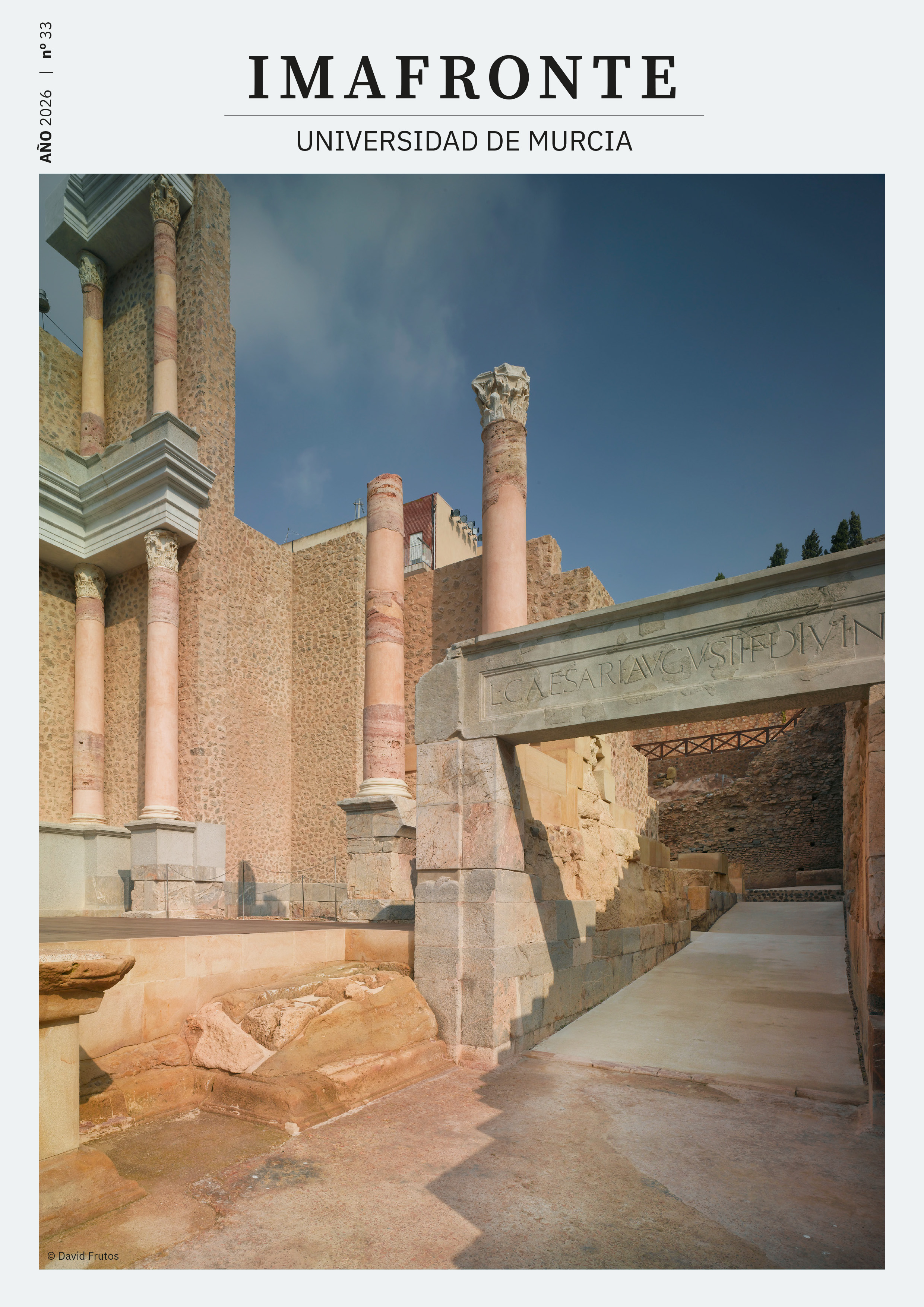
In the middle of the cloister of Santo Domingo de Silos there was a Romanesque pantheon wich we know for descriptions and archaeological finds. This small building was an aedicule without examples in the contemporary Romanesque context, but which referred to the Islamic typologies of funerary qubbas and gardens with central aedicules. In this work we value the relationships between the two cultural spaces (Islamic and Christian) as the way for transmission of this typology.
Downloads
-
Abstract0
-
PDF (Español (España))0
-
EPUB (Español (España))0
References
Alexiou, M. (1975). The lament of the Virgin in Byzantine literature and modern Greek folk-song. Byzantine and Modern Greek Studies, 1, 111–140.
Alexiou, M., Yatromanolakis, D., & Roilos, P. (2002). The ritual lament in Greek tradition. Lanham: Rowman & Littlefield.
Arentzen, T. (2017). The Virgin in song: Mary and the poetry of Romanos the Melodist. Philadelphia: University of Pennsylvania Press.
Bakker, W. F., & Philippides, D. M. L. (2000). The lament of the Virgin by Ephraem the Syrian. En Enthymēsis Nikolaou M. Panagiotakē. Atenas: Centre for Byzantine Studies, 9-56.
Belting, H. (1998). L’image et son public au Moyen Âge. Paris: Gérard Monfort.
Belting, H. (2009). Imagen y culto: Una historia de la imagen anterior a la era del arte. Madrid: Akal.
Benko, S. (1993). The Virgin Goddess: Studies in the pagan and Christian roots of Mariology. Leiden: Brill.
Bernabò, M. (2014). The miniatures in the Rabbula Gospels: Postscripta to a recent book. Dumbarton Oaks Papers, 68, 342–358.
Bernabò, M., & Arduini, F. (Eds.). (2008). Il tetravangelo di Rabbula: Firenze, Biblioteca Medicea Laurenziana, cod. Plut. 1.56. L’illustrazione del Nuovo Testamento nella Siria del VI secolo. Roma: Eidizioni di Storia e Letteratura.
Booth, P. (2015). On the Life of the Virgin Attributed to Maximus Confessor. Journal of Theological Studies, 66, 149-203.
Cameron, A. (1978). The Theotokos in sixth-century Constantinople: A city finds its symbol. The Journal of Theological Studies, 29(1), 79–108.
Constas, N. (2016). Poetry and painting in the Middle Byzantine period: A bilateral icon from Kastoria and the Stavrotheotokia of Joseph the Hymnographer. En L. Brubaker & M. B. Cunningham (Eds.), The cult of the Mother of God in Byzantium: Texts and images. Nueva York: Routledge, 14-36.
Cormack, R. (1977). Painting after iconoclasm. En A. Bryer & J. Herrin (Eds.), Iconoclasm: Papers given at the Ninth Spring Symposium of Byzantine Studies. Birmingham: University of Birmingham, 1-15.
Christos, S. (2022). Two lifes of the Virgin: John Geometres, Euthymos the Athonite and Maximos the Confessor. Dumbarton Oaks Papers, 74, 125-160.
Cunningham, M. B. (2021). The Virgin Mary in Byzantium, c. 400–1000: Hymns, homilies and hagiography. Cambridge: Cambridge University Press.
De Martino, E. (1958). Morte e pianto rituale nel mondo antico: Dal lamento funebre antico al pianto di Maria. Turín: Einaudi.
De Nicomedia, J. (1865). Oratio in sepulturam Jesu Christi. En J. P. Migne (ed.), Patrologiae Cursus Completus. Series Graeca, vol. 100. París: Apud Garnier Fratres et J.P- Migne Sucessores, 1458-1490.
Evans, H. C., & Wixom, W. D. (Eds.). (1997). The glory of Byzantium: Art and culture of the Middle Byzantine era, A.D. 843–1261. Nueva York: The Metropolitan Museum of Art.
Graef, H. (1963–1965). María. La mariología y el culto mariano a través de la historia. Barcelona: Herder.
Grabar, A. (1998). La iconoclasia bizantina. Madrid: Akal.
Han, C. (2015). The Reliquary Effect: Enshrining the Sacred Object. Chicago: University of Chicago Press.
Hyslop, F. E., Jr. (1934). A Byzantine reliquary of the True Cross from the Sancta Sanctorum. The Art Bulletin, 16(4), 333–340.
Kessler, H. L. (1990). Le statut de l’image religieuse au Moyen Âge: Entre Orient et Occident. En A. Vauchez & C. Walter (Eds.), L’image: Fonctions et usages des images dans l’Occident médiéval. Turnhout: Brepols, 21-42.
Kitzinger, E. (1954). The cult of images in the age before iconoclasm. Dumbarton Oaks Papers, 8, 83–150.
Klein, H.A. (2004). Eastern Objects and Western Desires: Relics and Reliquaries between Byzantium and the West. Dumbarton Oaks Papers, 58, 283-314.
Maguire, H. (1974). Truth and convention in Byzantine descriptions of works of art. Dumbarton Oaks Papers, 28, 113–140.
Maguire, H. (1977). The depiction of sorrow in Middle Byzantine art. Dumbarton Oaks Papers, 31, 129–160.
Mathews, T. (2006). Icons and the religious experience. En S. T. Brooks (Ed.), Byzantium: Faith and power (1261–1557). Perspectives on late Byzantine art (pp. 1–15). New Haven: Yale University Press.
Pentcheva, B. (2006). Icons and power: The Mother of God in Byzantium. Philadelphia: Pennsylvania State University Press.
San Juan Damasceno. (2011). Contra los que atacan las imágenes sagradas. Discurso apologético (J. B. Torres-Guerra, Trad.). Revisiones, 7, 21-57.
Shoemaker, S. J. (2011). Mary at the cross east and west: Maternal compassion and affective piety in the earliest Life of the Virgin and the High Middle Ages. The Journal of Theological Studies, 62(2), 569–604.
Shoemaker, S. J. (2012). The Life of the Virgin. Yale: Yale University Press.
Sticca, S. (2000). Il Planctus Mariae Nella TRadizione Drammatica del Medio Evo. Nueva York: Global Publications, Binghamton University,
Tsironis, N. (1998). The lament of the Virgin Mary from Romanos the Melode to George of Nicomedia: An aspect of the development of the Marian cult (Tesis doctoral).
Tsironis, N. (2011). Emotion and the senses in Marian homilies of the Middle Byzantine period. En L. Brubaker & M. B. Cunningham (Eds.), The cult of the Mother of God in Byzantium: Texts and images. Londres: Routledge, 179-196.
Vassilaki, M., & Tsironis, N. (2002). Representations of the Virgin and their association with the Passion of Christ. En M. Vassilaki, Representations of de Virgin in Byzantine Art. Turín: 453-463.
Ware, K. (Ed. & Trans.). (1977). The Lenten Triodion: The service books of the Orthodox Church. Londres: Faber & Faber.
Wilson, J. (2019). A Gift No More: A Byzantine Reliquary of the Holy Cross. Res: Anthropology and Aesthetics, 71-72, 131-144.
Copyright (c) 2026 Julia María García Morales

This work is licensed under a Creative Commons Attribution-ShareAlike 4.0 International License.
1. The authors non-exclusively assign the exploitation rights (reproduction, distribution, communication and transformation) to the magazine.
2. The works published in this magazine are subject to the Attribution-ShareAlike 4.0 International license (CC By SA 4.0). Therefore, they can be copied, used, disseminated, transmitted and publicly displayed, provided that:
i) the authorship and the original source of its publication (journal, editorial and URL of the work) are cited, thus allowing its recognition.
ii) it is allowed to remix, transform or create from the material while maintaining the same license as the original.

3. Self-archiving conditions. Authors are allowed and encouraged to electronically disseminate the pre-print (version before being evaluated) and/or post-print (version evaluated and accepted for publication) versions of their works before publication, as it favors their publication. Earlier circulation and diffusion and with it a possible increase in its citation and reach among the academic community. Color RoMEO: verde.