
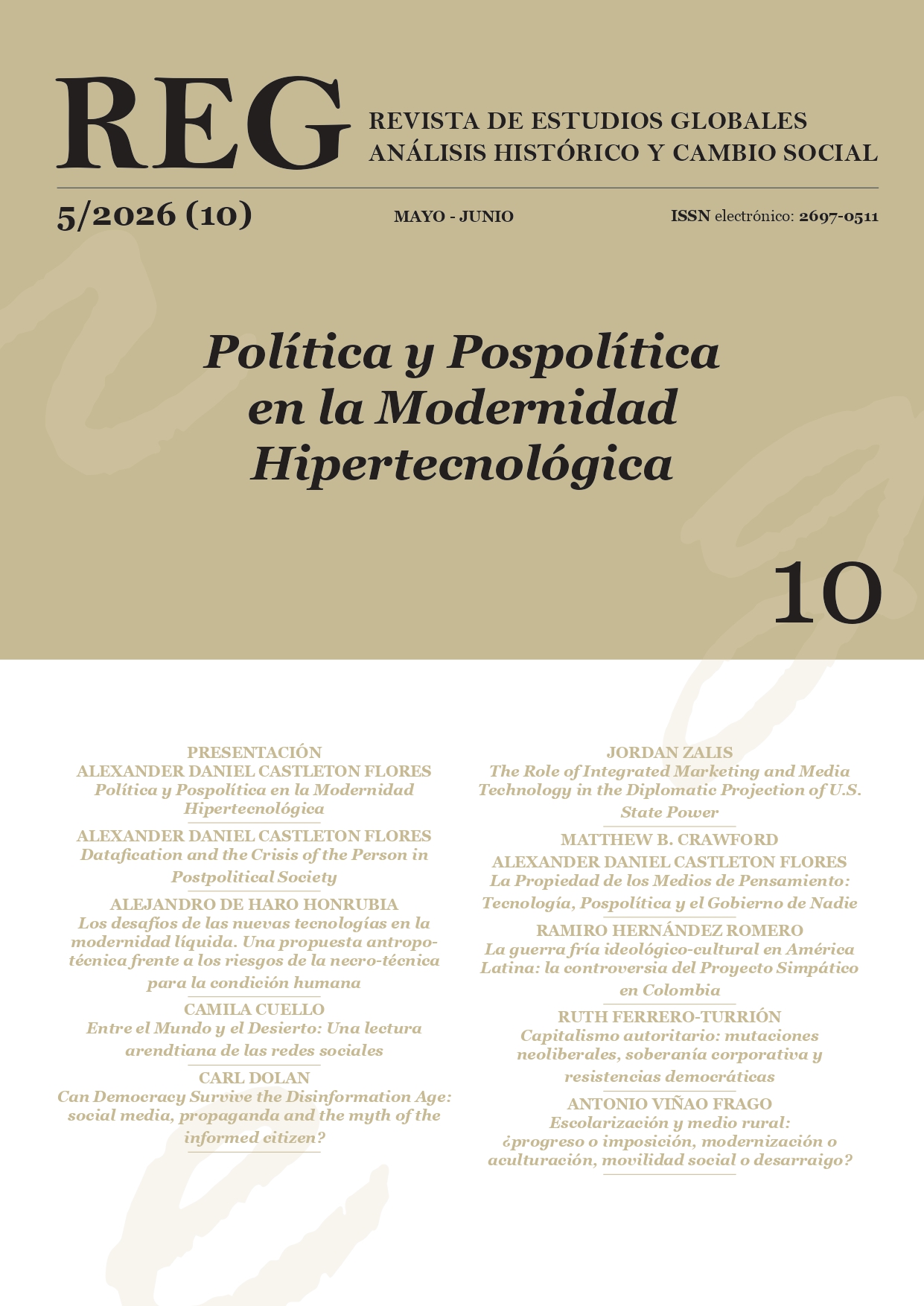
Datafication and the Crisis of the Person in Postpolitical Society
Resumen
El artículo examina cómo el big data —conjuntos extremadamente grandes y complejos de información digital que son analizados computacionalmente para identificar patrones, comportamientos y relaciones— contribuye al surgimiento de una sociedad pospolítica en la que los individuos son crecientemente transformados en objetos de cuantificación y clasificación algorítmica. A partir de las perspectivas de Hannah Arendt, José Ortega y Gasset, Julián Marías y Roger Scruton, el análisis explora cómo la dataficación reduce a la persona a perfiles de datos fragmentados y predecibles, debilitando las capacidades de acción, pensamiento, juicio y participación democrática. En este contexto, las cuestiones políticas y éticas quedan crecientemente subordinadas a formas tecnocráticas de gobierno y toma de decisiones algorítmicas, contribuyendo a una crisis de la persona y de la agencia política. Si bien se reconoce la naturaleza híbrida del ser humano como realidad personal y técnica, el artículo enfatiza la importancia de desarrollar una alfabetización crítica respecto de la dataficación para preservar la dignidad humana, la autonomía y formas significativas de vida colectiva en sociedades crecientemente automatizadas.
Descargas
Métricas
-
Resumen237
-
PDF 98
Citas
Aagaard, J. (2021). The care of our hybrid selves: Towards a concept of Bildung for digital times. Journal of Philosophy of Education, 55(1), 41–54. https://doi.org/10.1111/1467-9752.12456
Agamben, G. (2011). Identity without the person. En Nudities (pp. 46–54). Stanford University Press.
Arendt, H. (1978). The life of the mind. Harcourt Brace Jovanovich.
Arendt, H. (1993). Between past and future: Eight exercises in political thought. Penguin Books.
Arendt, H. (2003). Some questions of moral philosophy. En J. Kohn (Ed.), Responsibility and judgment (pp. 49–147). Schocken Books.
Arendt, H. (2006). Eichmann in Jerusalem: A report on the banality of evil. Penguin Books.
Arendt, H. (2017). The origins of totalitarianism. Penguin Books.
Arendt, H. (2018). The human condition (2nd ed.). University of Chicago Press.
Beer, D. (2017). The social power of algorithms. Information, Communication & Society, 20(1), 1–13. https://doi.org/10.1080/1369118X.2016.1216147
Bono, J. L. C. (2015). Constantes personalistas de la naturaleza humana en José Ortega y Gasset. Quién. Revista de Filosofía Personalista, 1, 117–132.
Boyd, D., & Crawford, K. (2012). Critical questions for big data: Provocations for a cultural, technological, and scholarly phenomenon. Information, Communication & Society, 15(5), 662–679. https://doi.org/10.1080/1369118X.2012.678878
Burgos, J. M. (2009). ¿Es Julián Marías personalista? En J. L. Cañas & J. M. Burgos (Eds.), El vuelo del Alción: El pensamiento de Julián Marías (pp. 147–164). Páginas de Espuma.
Castleton, A. (2024). Pensar y ensimismarse: José Ortega y Gasset y Hannah Arendt frente al problema de juzgar un mundo tecnológico. Anales del Seminario de Historia de la Filosofía, 41(2), 381–392. https://doi.org/10.5209/ashf.85165
Crawford, M. (2019). Algorithmic governance and political legitimacy. American Affairs, 3(2). https://americanaffairsjournal.org/2019/05/algorithmic-governance-and-political-legitimacy/
Crawford, M. (2020). Why we drive: On freedom, risk and taking back control. Random House.
Crawford, M.(2024). Big tech and the challenge of self-government. The Heritage Foundation. https://www.heritage.org/conservatism/report/big-tech-and-the-challenge-self-government
Cullen, D. (2016). The personal and the political in Roger Scruton’s conservatism. Perspectives on Political Science, 45(4), 261–271. https://doi.org/10.1080/10457097.2016.1222220
Danaher, J. (2020). Freedom in an age of algocracy. En S. Vallor (Ed.), The Oxford handbook of philosophy of technology (pp. 250–272). Oxford University Press. https://doi.org/10.1093/oxfordhb/9780190851187.013.16
Dorresteijn, S. (2017). The care of our hybrid selves: Ethics in times of technical mediation. Foundations of Science, 22(2), 311–321. https://doi.org/10.1007/s10699-015-9440-0
Gertz, N. (2023). More than machines? Jacques Ellul on AI’s real threat to humanity. Commonweal, 150(8), 24–28. https://www.commonwealmagazine.org/jacques-ellul-gertz-artificial-intelligence-AI-WGA-technology
Gillespie, T. (2016). Algorithm. En B. Peters (Ed.), Digital keywords: A vocabulary of information society and culture (pp. 18–30). Princeton University Press.
Gran, A., Booth, P., & Bucher, T. (2021). To be or not to be algorithm aware: A question of a new digital divide? Information, Communication & Society, 24(12), 1779–1796. https://doi.org/10.1080/1369118X.2020.1736124
Haggerty, K. D., & Ericson, R. V. (2000). The surveillant assemblage. British Journal of Sociology, 51(4), 605–622. https://doi.org/10.1080/00071310020015280
Kehlenbach, E. S. (2022). The subatomic person: A new ontology of big data. Theory & Event, 25(4), 851–872. https://doi.org/10.1353/tae.2022.0052
Koopman, C. (2019). How we became our data: A genealogy of the informational person. University of Chicago Press.
Kotliar, D. M. (2020). Data orientalism: On the algorithmic construction of the non-western other. Theory and Society, 49(5–6), 919–939. https://doi.org/10.1007/s11186-020-09404-2
Lake, R. W. (2017). Big data, urban governance, and the ontological politics of hyperindividualism. Big Data & Society, 4(1), 1–10. https://doi.org/10.1177/2053951716682537
Latour, B. (2012). Love your monsters: Why we must care for our technologies as we do our children. Breakthrough Institute. https://thebreakthrough.org/journal/issue-2/love-your-monsters
Loidolt, S. (2018). Phenomenology of plurality: Hannah Arendt on political intersubjectivity. Routledge.
Loidolt, S. (2020). Who one is—A political issue? Hannah Arendt on personhood, maximal self, and bare life. En T. Bedorf & S. Herrmann (Eds.), Political phenomenology (pp. 165–192). Routledge. https://doi.org/10.4324/9780429259852-9
Loidolt, S. (2024). Hannah Arendt: Plurality, worldliness, and action: Inverting the image of totalitarianism. En The Routledge handbook of political phenomenology. Routledge.
Lyon, D. (2018). The culture of surveillance. Polity Press.
Lyon, D. (2020). Christians in a surveillance culture. Zadok Perspectives, 149, 5–7.
Marías, J. (1984). Breve tratado de la ilusión. Alianza Editorial.
Marías, J. (1995). Antropología metafísica. Alianza.
Marías, J. (1997). Persona. Alianza.
Mau, S. (2019). The metric society: On the quantification of the social. Polity Press.
Mejías, U. A., & Couldry, N. (2019). Datafication. Internet Policy Review, 8(4). https://doi.org/10.14763/2019.4.1427
Mejías, U. A., & Couldry, N. (2024). Data grab: The new colonialism of big tech and how to fight back. University of Chicago Press.
Ortega y Gasset, J. (2004–2010). Obras completas (Vols. I–X). Taurus/Fundación José Ortega y Gasset.
Pangrazio, L., & Selwyn, N. (2023). Critical data literacies: Rethinking data and everyday life. MIT Press.
Pasquale, F. (2015). The black box society: The secret algorithms that control money and information. Harvard University Press.
Puzio, A. (2025). AI and the disruption of personhood. En P. Hacker (Ed.), Oxford intersections: AI in society. Oxford Academic. https://doi.org/10.1093/9780198945215.001.0001
Rausch, Z., Haidt, J., & Torres, L. (2024). Social-media companies’ worst argument: Why are tech leaders so adamant about pushing their creations on other people’s kids, while protecting their own? The Atlantic. https://www.theatlantic.com/ideas/archive/2024/09/social-media-lgbtq-teens-harms/679798/
Sander, I. (2020a). Critical big data literacy tools—Engaging citizens and promoting empowered internet usage. Data & Policy, 2. https://doi.org/10.1017/dap.2020.5
Sander, I. (2020b). What is critical big data literacy and how can it be implemented? Internet Policy Review, 9(2), 1–22. https://doi.org/10.14763/2020.2.1479
Scruton, R. (1986). Sexual desire. Continuum.
Scruton, R. (2007). The trouble with knowledge. Technology Review, 110(3), 78–86.
Scruton, R. (2011). Neurononsense and the soul. En J. Wentzel van Huyssteen & E. Wiebe (Eds.), In search of self: Interdisciplinary perspectives on personhood (pp. 338–356). Eerdmans.
Scruton, R. (2012). The face of God. Continuum.
Scruton, R. (2014). The soul of the world. Princeton University Press.
Shuster, M. (2018). Hannah Arendt on the evil of not being a person. Philosophy Compass, 13(7). https://doi.org/10.1111/phc3.12504
Tabachnick, D. E. (2013). The great reversal: How we let technology take control of the planet. University of Toronto Press.
Turró Ortega, G. (2019). El compromiso por la vida auténtica en Ortega y Gasset. Anuario Filosófico, 52(3), 539–552. https://doi.org/10.15581/009.52.3.004
Vallor, S. (2011). Knowing what to wish for: Human enhancement technology, dignity and virtue. Techné: Research in Philosophy and Technology, 15(2), 137–155. https://doi.org/10.5840/techne201115213
Vallor, S. (2024). The AI mirror: How to reclaim our humanity in the age of machine thinking. Oxford University Press. https://doi.org/10.1093/oso/9780197759066.001.0001
Van der Meulen, M., & Bruinsma, M. (2019). What computers shouldn’t do, as ‘aggregate of data’: A critique of algorithmic decision-making. AI & Society, 34(2), 343–354. https://doi.org/10.1007/s00146-018-0852-6
Vargas, J. (2012). La persona: su función política y su responsabilidad moral en el pensamiento de Hannah Arendt. En L. Quintana & J. Vargas (Eds.), Hannah Arendt: Política, violencia, memoria, Universidad de los Andes (pp. 67–82). Universidad de los Andes.
Walsh, P. (2017). Hannah Arendt on thinking, personhood and meaning. En P. Baehr & P. Walsh (Eds.), The Anthem companion to Hannah Arendt (pp. 155–174). Anthem Press.
Walsh, P. (2021). Emotions, personhood and social ontology: A critical realist approach. Journal for the Theory of Social Behaviour, 51(3), 371–390. https://doi.org/10.1111/jtsb.12276
Wilson, M. (2017). Algorithms (and the) everyday. Information, Communication & Society, 20(1), 137–150. https://doi.org/10.1080/1369118X.2016.1200645
Wong, W.-H., Duncan, J., & Lake, D. A. (2025). Why data about people are so hard to govern. Regulation & Governance, 19(1), 236–252. https://doi.org/10.1111/rego.12591
Zimmerman, J. (2023). Personhood and technology. En J. Zimmerman (Ed.), Human flourishing in a technological world: A theological perspective (pp. 72–93). Oxford University Press.
Derechos de autor 2026 Revista de Estudios Globales. Análisis Histórico y Cambio Social

Esta obra está bajo una licencia internacional Creative Commons Atribución-NoComercial-SinDerivadas 4.0.