A scent of talcum powder. The remastering of the animated short Portrait of D
Abstract
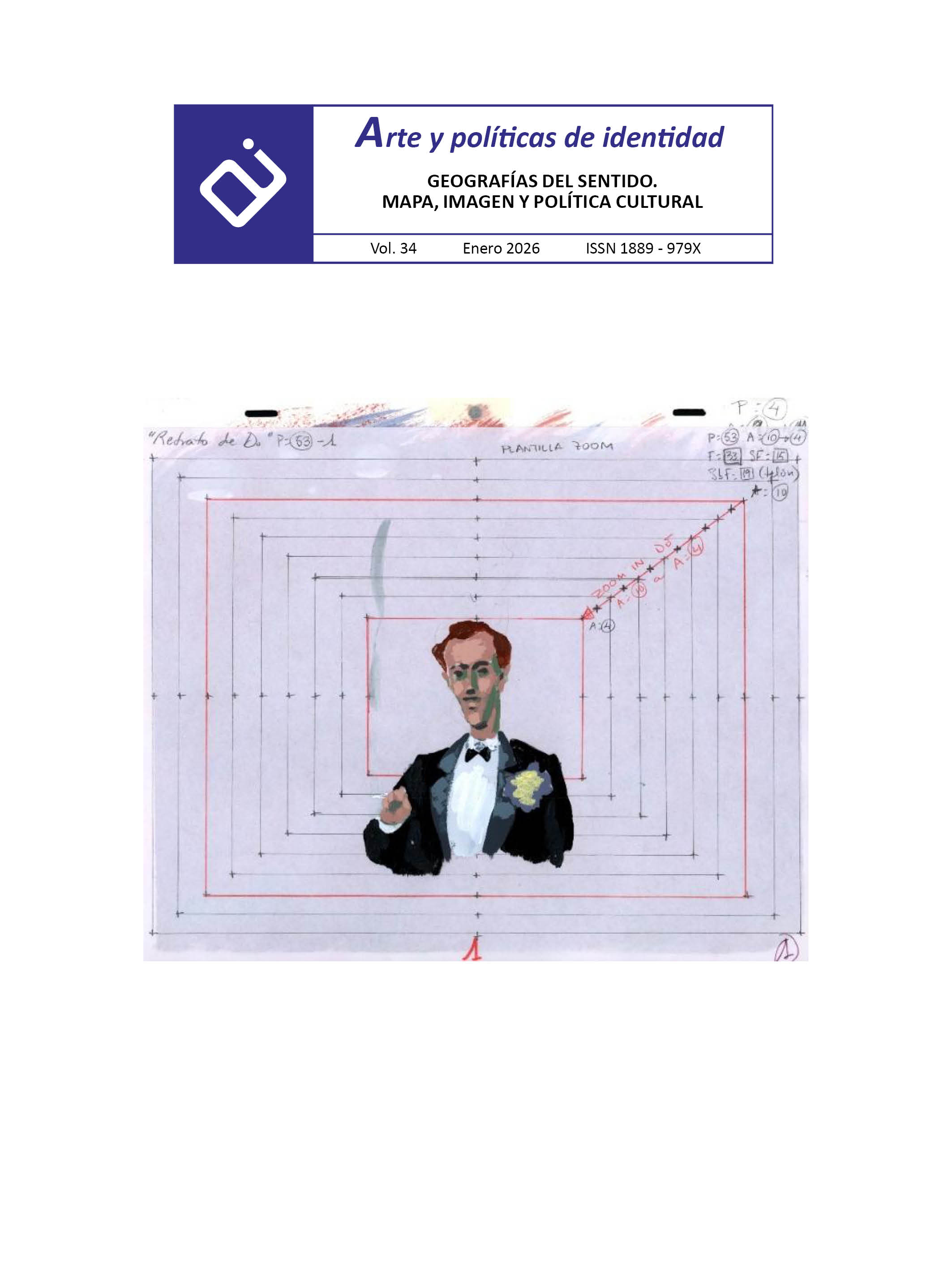
This article details the process of remastering the short film Retrato de D. (2003), directed by María Lorenzo. This work is fundamental as it is the last Spanish production made using the traditional animation technique of painting on cels (acetate sheets). With an aesthetic inspired by 19th Century academic painting and narratives from authors such as Oscar Wilde and Bram Stoker, the story explores the artist’s obsession with their creation: an unfinished portrait that consumes its author. Despite being part of the official selection at festivals like Annecy and Animafest Zagreb (2004), the short film was inaccessible for public screening due to the lack of a high-resolution or 35mm master copy.
The recovery of Retrato de D. is an example of author-led remastering that opens an exceptional path for the preservation of animation heritage. To carry it out, the original artistic materials, which were preserved in their entirety, were digitized. A deep review of the original art, digital cleanup of the initial audio, and new dialogue recording were performed, completing an exhaustive composition and editing process. This remastering, led by the director María Lorenzo herself and producer Enrique Millán, has allowed this key work of Spanish animation heritage to return to the big screen.
Downloads
-
Abstract270
-
pdf (Español (España))122
References
BERRATÚA, Luciano, y BENAVIDES, Isabel (2023). “La recreación del color de Érase una vez”, Con A de animación, n. 16, pp. 14-21. Recuperado de: https://polipapers.upv.es/index.php/CAA/article/view/19130
CHERCHI USAI, Paolo (2005). La muerte del cine. Historia y memoria cultural en el medioevo digital, trad. cast. Emili Olcina i Aya, Barcelona: Laertes, Filmoteca de Andalucía (The Death of Cinema. History, Cultural Memory, and the Digital Dark Age, 2001, Londres: BFI Publishing.
HERGUERA, Isabel, VICARIO, Begoña (2005). Mamá, quiero ser artista. Entrevistas a mujeres de cine de animación, Madrid: Ocho y Medio, Animadrid.
JESSEN, Taylor (2005). “Fresh from the Festivals: August 2005’s Reviews”, Animation World Network, 22/08/2005. Recuperado de: https://www.awn.com/animationworld/fresh-festivals-august-2005s-reviews
MÁRQUEZ, Sergio (2024). “La magia detrás de la restauración de películas antiguas en calidad 4K UHD”, AVPasión, 24/3/2024. Recuperado de: https://www.avpasion.com/descubre-como-se-logra-la-remasterizacion-de-peliculas-antiguas-en-formato-4k-uhd/
MILLÁN ALMENAR, Enrique (2025a). Entrevista personal a María Lorenzo, 15/6/2025.
MILLÁN ALMENAR, Enrique (2025b). Correspondencia por email con Armando Bernabeu Lorenzo, 15/5/2025.
MORENO RODRÍGUEZ, Juan Antonio (2020). Directoras en la historia del cortometraje español, Madrid: JAMR.
MORENO RODRÍGUEZ, Juan Antonio (2024). “FELINA (María Lorenzo Hernández, 2023)”, Corto pero Intenso, 8/3/2024. Recuperado de: https://cortoperointenso.wordpress.com/2024/03/08/felina-maria-lorenzo-hernandez-2023/
VIÑOLO LOCUBICHE, Samuel (2006). “Entrevista a María Lorenzo”, Animaholic, 26/1/2006. Recuperado de: https://animaholic.wordpress.com/2006/02/04/entrevista-a-maria-lorenzo-2/
YÉBENES, Pilar, MESONERO, Rodrigo, RODRÍGUEZ, José Antonio, y VIÑOLO, Samuel (2016). 100 años de animación española, arte y tecnología, Madrid: Sygnatia, Federación Diboos.
Copyright (c) 2026 Servicio de Publicaciones de la Universidad de Murcia

This work is licensed under a Creative Commons Attribution-NonCommercial-NoDerivatives 4.0 International License.
Works published in this journal are subject to the following terms:
- The Service of Publications from the University of Murcia (publishing house) keeps the published works’ copyrights, and favors and allows the reuse of these works under the license indicated in point 2.
- Works are published in the journal’s online edition under the license Creative Commons Reconocimiento-NoComercial-SinObraDerivada 3.0 España(texto legal). They can be copied, used, disseminated, transmitted and publicly exhibited, as long as: i) the author and original source of publication are cited (journal, publishing house and work’s URL); ii) they are not used for commercial purposes; iii) the existence and specifications of this license are mentioned.

3. Conditions for auto-file. It is allowed and encouraged that authors share electronically their pre-print version (the pre-reviewed version) and /or post-print version (the reviewed and accepted version) of their Works before the publication, since it promotes its circulation and dissemination. RoMEO color: green.