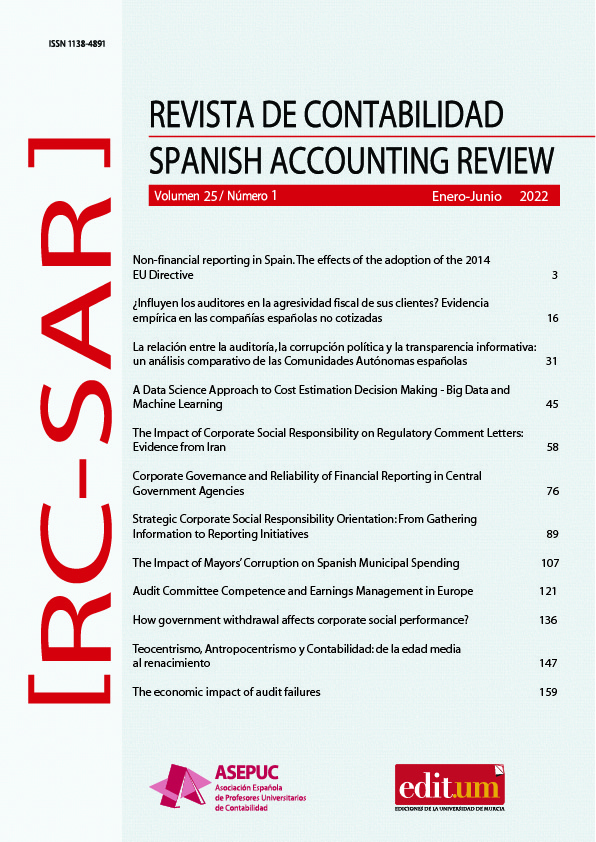
Audit Committee Competence and Earnings Management in Europe
Competencia del Comité de Auditoría y gestión de los beneficios en Europa
Supporting Agencies
- We thank Philip Jaggs for his comments on a previous version of the paper. We also thank the Spanish Ministry of Economics, Industry and Competitiveness for financial support (ECO2017-84864-P). All the remaining errors are solely the authors’ responsibility.
Abstract
This study analyses the association between the competence of audit committee members and earnings management in a sample of 142 non-financial firms from France, Germany, Italy, Spain, and the United Kingdom over the 2006–2013 period. We measure members’ competence through their dedication and expertise. We find that outside directorships have a dual effect, such that a balanced level of dedication to the audit committee (roughly two outside directorships) reduces earnings management. We examine four types of expertise: audit, non-audit accounting, non-accounting financial, and supervisory expertise. We find a negative relation between earnings management and the audit experience of committee members, and that the other types of expertise play no relevant role. We also find that the contribution of audit experts to curbing earnings management proves particularly important in smaller and less active committees, as well as in smaller and busier boards.
Downloads
-
Abstract1284
-
PDF1362
-
HTML241
References
Abernathy, J. L., Herrmann, D., Kang, T., & Krishnan, G. V. (2013). Audit committee financial expertise and properties of analyst earnings forecasts. Advances in Accounting, 29(1), 1-11. https://doi.org/10.1016/j.adiac.2012.12.001
Albring, S., Robinson, D., & Robinson, M. (2014). Audit committee financial expertise, corporate governance, and the voluntary switch from auditor-provided to non-auditor-provided tax services. Advances in Accounting, 30(1), 81-94. https://doi.org/10.1016/j.adiac.2013.12.007
Almarayeh, T. S., Aibar-Guzmán, B., & Abdullatif, M. (2020). ¿Influye la calidad de la auditoría en la gestión de resultados en los mercados emergentes? Evidencia de Jordania. Revista de Contabilidad - Spanish Accounting Review, 23(1), 64-74. https://doi.org/10.6018/rcsar.365091
Archambeault, D., & DeZoort, F. T. (2001). Auditor opinion shopping and the audit committee: An analysis of suspicious auditor switches. International Journal of Auditing, 5, 33-52. https://doi.org/10.1111/1099-1123.00324
Baatour, K., Ben Othman, H., & Hussainey, K. (2017). The effect of multiple directorships on real and accrual-based earnings management: Evidence from Saudi listed firms. Accounting Research Journal, 30(4), 395-412. https://doi.org/10.1108/arj-06-2015-0081
Baccouche, S., Hadriche, M., & Omri, A. (2013). The Impact Of Audit Committee Multiple-Directorships On Earnings Management: Evidence From France. Journal of Applied Business Research, 29(5), 1333-42. https://doi.org/10.19030/jabr.v29i5.8017
Baccouche, S., Hadriche, M., & Omri, A. (2014). Multiple directorships and board meeting frequency: evidence from France. Applied Financial Economics, 24(14), 983-92. https://doi.org/10.1080/09603107.2014.920475
Baccouche, S., & Omri, A. (2014). Multiple directorships of board members and earnings management: An empirical evidence from French listed companies. Journal of Economic and Financial Modelling, 2(1), 13-23
Badolato, P. G., Donelson, D. C., & Ege, M. (2014). Audit committee financial expertise and earnings management: The role of status. Journal of Accounting and Economics, 58(2), 208-30. https://doi.org/10.1016/j.jacceco.2014.08.006
Bajra, U., & Cadez, S. (2018). Audit committees and financial reporting quality: The 8th EU Company Law Directive perspective. Economic Systems, 42(1), 151-63. https://doi.org/10.1016/j.ecosys.2017.03.002
Banderlipe II, M. R. S. (2009). The Impact of Selected Corporate Governance Variables in Mitigating Earnings Management in the Philippines. DLSU Business & Economics Review, 19(1), 17-27. https://doi.org/10.3860/ber.v19i1.1110
Baxter, P., & Cotter, J. (2009). Audit committees and earnings quality. Accounting & Finance, 49(2), 267-90. https://doi.org/10.1111/j.1467-629X.2008.00290.x
Bedard, J., Chtourou, S. M., & Courteau, L. (2004). The effect of audit committee expertise, independence, and activity on aggressive earnings management. Auditing: A Journal of Practice & Theory, 23(2), 13-35. https://doi.org/10.2308/aud.2004.23.2.13
Biedma López, E., Ruiz Barbadillo, E., & Gómez Aguilar, N. (2011). ¿Cómo actúan las empresas frente a la dependencia económica del auditor?: El papel del comité de auditoría. Revista de Contabilidad-Spanish Accounting Review, 14(1), 87-119. https://doi.org/10.1016/s1138-4891(11)70023-1
Bilal, Chen, S., & Komal, B. (2018). Audit committee financial expertise and earnings quality: A meta-analysis. Journal of Business Research, 84, 253-70. https://doi.org/10.1016/j.jbusres.2017.11.048
Blundell, R., & Bond, S. (1998). Initial conditions and moment restrictions in dynamic panel data models. Journal of Econometrics, 87(1), 115-43. https://doi.org/10.1016/S0304-4076(98)00009-8
Braiotta, L., & Zhou, J. (2008). An exploratory study of the effects of the European Union 8th Directive on Company Law on audit committees: Evidence from EU companies listed on the US stock exchanges. Advances in Accounting, 24(2), 262-71. https://doi.org/10.1016/j.adiac.2008.09.001
Brown, S. J., & Warner, J. B. (1985). Using daily stock returns: The case of event studies. Journal of Financial Economics, 14(1), 3-31. https://doi.org/10.1016/0304-405X(85)90042-X
Bryan, D., Liu, M. C., Tiras, S. L., & Zhuang, Z. (2013). Optimal versus suboptimal choices of accounting expertise on audit committees and earnings quality. Review of Accounting Studies, 18(4), 1123-58. https://doi.org/10.1007/s11142-013-9229-8
Cooper, D. R., & Schindler, P. S. (2003) Research methods. Boston, MA: Irwin.
Chen, K. Y., & Zhou, J. (2007). Audit committee, board characteristics, and auditor switch decisions by Andersen's clients. Contemporary Accounting Research, 24(4), 1085-117. https://doi.org/10.1506/car.24.4.2
Chen, Y. M., Moroney, R., & Houghton, K. (2005). Audit committee composition and the use of an industry specialist audit firm. Accounting and Finance, 45, 217-39. https://doi.org/10.1111/j.1467-629x.2004.00136.x
De Vlaminck, N., & Sarens, G. (2015). The relationship between audit committee characteristics and financial statement quality: evidence from Belgium. Journal of Management & Governance, 19(1), 145-66. https://doi.org/10.1007/s10997-013-9282-5
Dechow, P., Ge, W., & Schrand, C. (2010). Understanding earnings quality: A review of the proxies, their determinants and their consequences. Journal of Accounting and Economics, 50(2), 344-401. https://doi.org/10.1016/j.jacceco.2010.09.001
Dechow, P. M., & Dichev, I. D. (2002). The Quality of Accruals and Earnings: The Role of Accrual Estimation Errors. The Accounting Review, 77(S-1), 35-59. https://doi.org/10.2308/accr.2002.77.s-1.35
Dechow, P. M., & Skinner, D. J. (2000). Earnings management: Reconciling the views of accounting academics, practitioners, and regulators. Accounting Horizons, 14(2), 235-50. https://doi.org/10.2308/acch.2000.14.2.235
Dechow, P. M., Sloan, R. G., & Sweeney, A. (1995). Detecting earnings management. The Accounting Review, 70(2), 193-225.
DeFond, M. L., Hann, R. N., & Hu, X. (2005). Does the market value financial expertise on audit committees of boards of directors? Journal of Accounting Research, 43(2), 153-93. https://doi.org/10.1111/j.1475-679x.2005.00166.x
DeZoort, F. T., & Salterio, S. E. (2001). The effects of corporate governance experience and financial-reporting and audit knowledge on audit committee members' judgments. Auditing: A Journal of Practice & Theory, 20(2), 31-47. https://doi.org/10.2308/aud.2001.20.2.31
Dhaliwal, D., Naiker, V., & Navissi, F. (2010). The association between accruals quality and the characteristics of accounting experts and mix of expertise on audit committees. Contemporary Accounting Research, 27(3), 787-827. https://doi.org/10.1111/j.1911-3846.2010.01027.x
Dichev, I. D., Graham, J. R., Harvey, C. R., & Rajgopal, S. (2013). Earnings quality: Evidence from the field. Journal of Accounting and Economics, 56(2–3, Supplement 1), 1-33. https://doi.org/10.1016/j.jacceco.2013.05.004
Edwards, M. (2019). Expert Directors. University of Colorado Law Review, 90, 1051-109.
Erkens, D. H., & Bonner, S. E. (2013). The role of firm status in appointments of accounting financial experts to audit committees. The Accounting Review, 88(1), 107-36. https://doi.org/10.2308/accr-50261
ESMA and EBA (2018). Guidelines on the assessment of the suitability of members of the management body and key function holders.
Espinosa-Pike, M., & Barrainkua, I. (2016). An exploratory study of the pressures and ethical dilemmas in the audit conflict. Revista de Contabilidad-Spanish Accounting Review, 19(1), 10-20. https://doi.org/10.1016/j.rcsar.2014.10.001
European Central Bank (2018). Guide to fit and proper assessments. Frankfurt.
Fich, E. M., & Shivdasani, A. (2006). Are busy boards effective monitors? Journal of Finance, 61(2), 689-724. https://doi.org/10.1111/j.1540-6261.2006.00852.x
Garven, S. (2015). The effects of board and audit committee characteristics on real earnings management: Do boards and audit committees play a role in its promotion or constraint? Academy of Accounting and Financial Studies Journal, 19(1), 67-84.
Ghafran, C., & O'Sullivan, N. (2013). The governance role of audit committees: reviewing a decade of evidence. International Journal of Management Reviews, 15(4), 381-407. https://doi.org/10.1111/j.1468-2370.2012.00347.x
Gómez Aguilar, N., Biedma Lopez, E., & Ruiz Barbadillo, E. (2018). The effect of audit partner rotation on audit quality. Revista de Contabilidad-Spanish Accounting Review, 21(1), 7-18. https://doi.org/10.1016/j.rcsar.2017.03.001
González-Díaz, B., García-Fernández, R., & López-Díaz, A. (2015). Auditor tenure and audit quality in Spanish state-owned foundations. Revista de Contabilidad-Spanish Accounting Review, 18(2), 115-26. https://doi.org/10.1016/j.rcsar.2014.04.001
Habbash, M., Sindezingue, C., & Salama, A. (2013). The effect of audit committee characteristics on earnings management: Evidence from the United Kingdom. International Journal of Disclosure and Governance, 10(1), 13-38. https://doi.org/10.1057/jdg.2012.2
Heckman, J. (1979). Sample selection bias as a specification error. Econometrica, 47(1), 153-61.
Hohenfels, D. (2016). Auditor tenure and perceived earnings quality. International Journal of Auditing, 20(3), 224-38. https://doi.org/10.1111/ijau.12069
Hoitash, U., Hoitash, R., & Bedard, J. C. (2009). Corporate governance and internal control over financial reporting: A comparison of regulatory regimes. The Accounting Review, 84(3), 839-67. https://doi.org/10.2308/accr.2009.84.3.839
Hribar, P., & Collins, D. W. (2002). Errors in estimating accruals: Implications for empirical research. Journal of Accounting Research, 40(1), 105-34. https://doi.org/10.1111/1475-679X.00041
Inaam, Z. (2016). Audit committee effectiveness, audit quality and earnings management: a meta-analysis. International Journal of Law and Management, 58(2), 179-96. https://doi.org/10.1108/ijlma-01-2015-0006
Inaam, Z., & Khamoussi, H. (2016). Audit committee effectiveness, audit quality and earnings management: a meta-analysis. International Journal of Law and Management, 58(2), 179-96. https://doi.org/10.1108/IJLMA-01-2015-0006
Jiraporn, P., Sang-Kim, Y., & Davidson III, W. N. (2008). Multiple Directorships and Corporate Diversification. Journal of Empirical Finance, 15, 418-35. https://doi.org/10.1016/j.jempfin.2007.07.002
Jiraporn, P., Singh, M., & Lee, C. I. (2009). Ineffective corporate governance: Director busyness and board committee memberships. Journal of Banking & Finance, 33, 819-28. https://doi.org/10.1016/j.jbankfin.2008.09.020
Jones, J. J. (1991). Earnings management during import relief investigations. Journal of Accounting Research, 29(2), 193-228. https://doi.org/10.2307/2491047
Karamanou, I., & Vafeas, N. (2005). The association between corporate boards, audit. committees, and management earnings forecasts: An empirical analysis. Journal of Accounting Research, 43(3), 453-86. https://doi.org/10.1111/j.1475-679X.2005.00177.x
Kothari, S. P., Leone, A. J., & Wasley, C. E. (2005). Performance matched discretionary accrual measures. Journal of Accounting and Economics, 39(1), 163-97. https://doi.org/10.1016/j.jacceco.2004.11.002
Krishnan, G. V., & Visvanathan, G. (2008). Does the SOX definition of an accounting expert matter? The association between audit committee directors' accounting expertise and accounting conservatism. Contemporary Accounting Research, 25(3), 827-58. https://doi.org/10.1506/car.25.3.7
Krishnan, J., & Krishnan, J. (1997). Litigation risk and auditor resignations. Accounting Review, 539-60.
Krishnan, J., & Lee, J. E. (2009). Audit committee financial expertise, litigation risk, and corporate governance. Auditing: A Journal of Practice & Theory, 28(1), 241-61. https://doi.org/10.2308/aud.2009.28.1.241
Kusnadi, Y., Leong, K. S., Suwardy, T., & Wang, J. (2016). Audit Committees and Financial Reporting Quality in Singapore. Journal of Business Ethics, 139(1), 197-214. https://doi.org/10.1007/s10551-015-2679-0
Lin, J. W., & Hwang, M. I. (2010). Audit quality, corporate governance, and earnings management: A meta-analysis. International Journal of Auditing, 14(1), 57-77. https://doi.org/10.1111/j.1099-1123.2009.00403.x
Liu, M. H. C., Tiras, S. L., & Zhuang, Z. (2014). Audit committee accounting expertise, expectations management, and nonnegative earnings surprises. Journal of Accounting and Public Policy, 33(2), 145-66. https://doi.org/10.1016/j.jaccpubpol.2013.12.004
Lo, A. W. Y., Wong, R. M. K., & Firth, M. (2010). Can corporate governance deter management from manipulating earnings? Evidence from related-party sales transactions in China. Journal of Corporate Finance, 16(2), 225-35. https://doi.org/10.1016/j.jcorpfin.2009.11.002
Mansor, N., Che Ahmad, A., Ahmad-Zaluki, N. A., & Osman, A. H. (2013). Corporate governance and earnings management: A study on the Malaysian family and non-family owned PLCs. Procedia Economics and Finance, 7, 221-29. https://doi.org/10.1016/S2212-5671(13)00238-4
Masulis, R. W., & Mobbs, S. (2011). Are all inside directors the same? Evidence from the external directorship market. Journal of Finance, 66(3), 823-72. https://doi.org/10.1111/j.1540-6261.2011.01653.x
McMullen, D. A., & Raghunandan, K. (1996). Enhancing audit committee effectiveness. Journal of Accountancy, 182(2), 79-81.
Naiker, V., & Sharma, D. S. (2009). Former audit partners on the audit committee and internal control deficiencies. The Accounting Review, 84(2), 559-87. https://doi.org/10.2308/accr.2009.84.2.559
Palazuelos Cobo, E., Montoya del Corte, J., & Herrero Crespo, Á. (2017). Determinantes de la continuidad en la contratación de la auditoría de forma voluntaria: evidencia para el caso de España. Revista de Contabilidad-Spanish Accounting Review, 20(1), 63-72. https://doi.org/10.1016/j.rcsar.2016.06.001
Piot, C., & Rémi, J. (2007). External Auditors, Audit Committees and Earnings Management in France. European Accounting Review, 16(2), 429 - 54. https://doi.org/10.1080/09638180701391030
Pollock, T. G., Chen, G., Jackson, E. M., & Hambrick, D. C. (2010). How much prestige is enough? Assessing the value of multiple types of high-status affiliates for young firms. Journal of Business Venturing, 25(1), 6-23. https://doi.org/10.1016/j.jbusvent.2009.01.003
Rickett, L. K., Maggina, A., & Alam, P. (2016). Auditor tenure and accounting conservatism: evidence from Greece. Managerial Auditing Journal, 31(6-7), 538-65. https://doi.org/10.1108/MAJ-10-2014-1103
Saleh, N. M., Iskandar, T. M., & Rahmat, M. M. (2005). Earnings management and board characteristics: Evidence from Malaysia. Jurnal Pengurusan (UKM Journal of Management), 24, 77-103
Sarkar, J., Sarkar, S., & Sen, K. (2008). Board of Directors and Opportunistic Earnings Management: Evidence from India. Journal of Accounting, Auditing & Finance, 23(4), 517-51. https://doi.org/10.1177/0148558x0802300405
Securities and Exchange Commission (2003). Disclosure Required by Sections 406 and 407 of the Sarbanes-Oxley Act of 2002. Release Nos. 33-8177, 34-47235. Washington: SEC.
Sharma, V. (2011). Independent directors and the propensity to pay dividends. Journal of Corporate Finance, 17, 1001-15. https://doi.org/10.1016/j.jcorpfin.2011.05.003
Siam, Y. A., Idris, M., & Al-Okdeh, S. (2018). The Moderating Role of Family Control on the Relationship between Audit Committee Financial Expertise and Earnings Management. International Journal of Business and Management, 13(12), 31-37. https://doi.org/10.5539/ijbm.v13n12p31
Siregar, S. V., & Utama, S. (2008). Type of earnings management and the effect of ownership structure, firm size, and corporate-governance practices: Evidence from Indonesia. The International Journal of Accounting, 43, 1-27. https://doi.org/10.1016/j.intacc.2008.01.001
Stice, J. D. (1991). Using financial and market information to identify pre-engagement factors associated with lawsuits against auditors. Accounting Review, 66(3), 516-33.
Studenmund, A. H. (1997) Using Econometrics: A Practical Approach. Boston: Addison-Wesley.
Sultana, N., Singh, H., & Rahman, A. (2019). Experience of Audit Committee Members and Audit Quality. European Accounting Review, 28(5), 947-75. https://doi.org/10.1080/09638180.2019.1569543
Sun, F., Wei, X., & Xu, Y. (2012). Audit committee characteristics and loss reserve error. Managerial Auditing Journal, 27(4), 355-77. https://doi.org/10.1108/02686901211217978
Sun, J., Lan, G., & Liu, G. (2014). Independent audit committee characteristics and real earnings management. Managerial Auditing Journal, 29(2), 153-72. https://doi.org/10.1108/maj-05-2013-0865
Vafeas, N., & Waegelein, J. F. (2007). The association between audit committees, compensation incentives, and corporate audit fees. Review of Quantitative Finance and Accounting, 28(3), 241-55. https://doi.org/10.1007/s11156-006-0012-9
Wooldridge, J. M. (2010) Econometric analysis of cross section and panel data. Cambridge, Massachusetts, USA: MIT Press.
Xie, B., Davidson, W. N., & Dadalt, P. J. (2003). Earnings management and corporate governance: the role of the board and the audit committee. Journal of Corporate Finance, 9, 295-316. https://doi.org/10.1016/S0929-1199(02)00006-8
Yang, J. S., & Krishnan, J. (2005). Audit committees and quarterly earnings management. International Journal of Auditing, 9(3), 201-19. https://doi.org/10.1111/j.1099-1123.2005.00278.x
Zalata, A. M., Tauringana, V., & Tingbani, I. (2018). Audit committee financial expertise, gender, and earnings management: Does gender of the financial expert matter? International Review of Financial Analysis, 55, 170-83. https://doi.org/10.1016/j.irfa.2017.11.002
Zaman, M., Hudaib, M., & Haniffa, R. (2011). Corporate governance quality, audit fees and non-audit services fees. Journal of Business Finance & Accounting, 38(1-2), 165-97. doi.
Zhang, Y., Zhou, J., & Zhou, N. (2007). Audit committee quality, auditor independence, and internal control weaknesses. Journal of Accounting and Public Policy, 26(3), 300-27. https://doi.org/10.1016/j.jaccpubpol.2007.03.001
Copyright (c) 2022 Revista de Contabilidad - Spanish Accounting Review

This work is licensed under a Creative Commons Attribution 4.0 International License.
The publications in this journal are subject to the following terms:
1. Ediciones de la Universidad de Murcia (EDITUM) and ASEPUC conserve the patrimonial rights (copyright) of the published manuscripts, and favour and allow their reuse under the licence of use indicated in point 2.
2. The manuscripts are published in the electronic edition of the journal under an Attribution-NonCommercial-NoDerivatives 4.0 International licence. It allows to copy, distribute and include the article in a collective work (for example, an anthology), as long as there is no commercial purpose, the article is not altered or modified and the original work is properly cited. This journal is free of charge for the Open Access publication. ASEPUC and EDITUM finance the productiona and publication costs of the manuscripts.
3. Conditions for self-archiving. Authors are permitted and encouraged to electronically disseminate the published version of their works, as it favors their circulation and dissemination and thus a possible increase in their citation and reach among the academic community.