Contabilidad de gestión y racionalización en el ejército: el caso de los Hospitales Militares Españoles en el siglo xviii
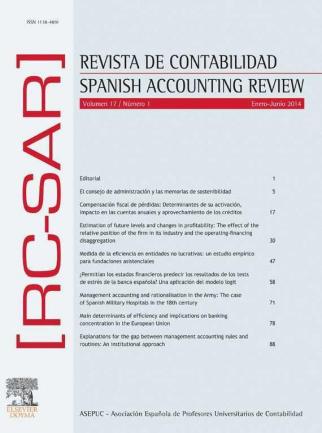
Management accounting and rationalisation in the Army: The case of Spanish Military Hospitals in the 18th century
Resumen
El presente trabajo analiza una de las áreas menos desarrolladas de investigación en contabilidad, como es la contabilidad en el Ejército. A pesar de la cantidad de literatura en relación con industrias asociadas al Ejército, es escasa la porción dedicada al Ejército per se. Por este motivo, este trabajo analiza el proceso de racionalización desarrollado en el siglo XVIII en los Hospitales Militares en España, como resultado de la suspensión de pagos de las Finanzas Reales. Como resultado de este proceso, los Hospitales Militares se convirtieron en los más desarrollados del país y supusieron la aparición del rol del Contralor (Controller) dentro del hospital, considerando así a la contabilidad como un elemento fundamental.
Descargas
-
Resumen470
-
PDF 207
Citas
[Arcarazo and Lorén, 2008] L.A. Arcarazo, M.P. Lorén. La Asistencia Sanitaria Militar en Zaragoza desde el siglo XVIII: Los hospitales militares. Sanidad Militar, 64 (2008), pp. 134-153
[Baños and Gutiérrez, 2011] J. Baños, F. Gutiérrez. The rise and fall of the intendants system in Spain (1718–1724): Accounting (not) for control purposes. Working paper presented at the XVI workshop on management and accounting ‘Memorial Raymond Konopka’,
[Carmona et al., 1997] S.M. Carmona, Ezzamel, F. Gutiérrez. Control and cost accounting practices in the Spanish royal tobacco factory. Accounting, Organizations and Society, 22 (1997), pp. 411-446
[Chwastiask, 1999] M. Chwastiask. Accounting and the Cold War: The transformation of waste into riches. Critical Perspectives on Accounting, 10 (1999), pp. 747-771
[Chwastiask, 2001] M. Chwastiask. Taming the untamable: Planning, programming and budgeting and the normalization of war. Accounting, Organizations and Society, 26 (2001), pp. 501-519
[Chwastiask, 2006] M. Chwastiask. Rationality, performance measures and representations of reality: Planning, programming and budgeting and the Vietnam War. Critical Perspectives on Accounting, 17 (2006), pp. 29-55
[Corpas, 2005] F.J. Corpas. Contabilidad Militar. La Evolución de los Sistemas de Información Económica en el Ejército Español. Ministerio de Defensa, (2005)
[De Castro, 2004] C. De Castro. A la sombra de Felipe V: José Grimaldo, Ministro Responsable. Marcial Pons, (2004)
[Fernández, 1977] P. Fernández. El decreto de suspensión de pagos de 1739: Análisis e implicaciones. Moneda y Crédito, 142 (1977), pp. 51-85
[Fernández-Revuelta et al., 2002] L. Fernández-Revuelta, D. Gómez, K. Robson. Fuerzas Motrices del Valle de Lecrín, 1936–9: Accounting reports and ideological struggles in time of civil war. Accounting, Business and Financial History, 12 (2002), pp. 347-366
[Fleischman and Tyson, 2000] R.K. Fleischman, T. Tyson. Parallels between US and UK cost accountancy in the World War I era. Accounting, Business and Financial History, 10 (2000), pp. 191-212
[Funnell, 1997] W. Funnell. Military influences on public sector accounting and auditing 1830–1880. Accounting History, 2 (1997), pp. 9-31
[Funnell, 2005] W. Funnell. Accounting on the frontline: Military efficiency and the South African War. Accounting and Business Research, 35 (2005), pp. 307-326
[Funnell, 2009] W. Funnell. Military. The Routledge companion to accounting history,
[Hoskin and Macve, 1988] K. Hoskin, R. Macve. The genesis of accountability: The west point connections. Accounting, Organizations and Society, 13 (1988), pp. 37-73
[Hoskin and Macve, 2000] K. Hoskin, R. Macve. Knowing More as Knowing Less? Alternative Histories of Cost and Management Accounting in the U.S. and the U.K.. Accounting Historians Journal, 27 (2000), pp. 91-149
[Lemarchand, 2002] Y. Lemarchand. The military origins of the French management accounting model: A return to the mechanisms of accounting change. Accounting History, 7 (2002), pp. 23-57
[Loft, 1993] A. Loft. Accounting and visibility: A discussion of the link between cost accounting and control in the history of a factory. Accounting research in Lund,
[Massons, 1994] J.M. Massons. Historia de la sanidad militar española. Pomares-Corredor, (1994)
[Miller, 1994] P. Miller. Introduction. Accounting as social and institutional practice,
[Miller and O’Leary, 1987] P. Miller, T. O’Leary. Accounting and the construction of the governable person. Accounting, Organizations and Society, 12 (1987), pp. 235-265
[Puell, 2008] F. Puell. Historia de la protección social militar (1265–1978). De la Ley de Partidas al ISFAS. ISFAS, (2008)
[Raquejo, 1992] A. Raquejo. Historia de la Administración y Fiscalización Económica de las Fuerzas Armadas. Publicaciones del Ministerio de Defensa, (1992)
[Riera, 1992] J. Riera. Ordenanzas y asientos de hospitales militares en España (siglo XVIII). Universidad de Valladolid, (1992)
[Sarrailh, 1992] J. Sarrailh. La España ilustrada de la segunda mitad del siglo XVIII. Fondo de Cultura Económica, (1992)
[Teijeiro, 2002] J.M. Teijeiro. La Intervención de la Real Hacienda Militar en el siglo XVIII. La Hacienda Militar. 500 años de Intervención en las Fuerzas Armadas,
[Tyson, 1993] T. Tyson. Keeping the record straight: Foucauldian revisionism and nineteenth century US cost accounting history. Accounting, Auditing and Accountability Journal, 6 (1993), pp. 4-16
[Vega, 1988] A. Vega. Los Hospitales Militares en España durante el siglo XVIII (1739–1787). Economía, sociedad y medicina hospitalaria. Universidad de Valladolid, (1988)
[Zambon and Zan, 2007] S. Zambon, L. Zan. Controlling expenditure, or the slow emergence of costing at the Venice Arsenal, 1586–1633. Accounting, Business and Financial History, 17 (2007), pp. 105-128
Las obras que se publican en esta revista están sujetas a los siguientes términos:
1. Ediciones de la Universidad de Murcia (EDITUM) y ASEPUC conservan los derechos patrimoniales (copyright) de las obras publicadas, y favorece y permite la reutilización de las mismas bajo la licencia de uso indicada en el punto 2.
2. Las obras se publican en la edición electrónica de la revista bajo una licencia de Creative Commons Reconocimiento-NoComercial-SinObraDerivada 4.0 Internacional. Permite copiar, distribuir e incluir el artículo en un trabajo colectivo (por ejemplo, una antología), siempre y cuando no exista una finalidad comercial, no se altere ni modifique el artículo y se cite apropiadamente el trabajo original. Esta revista no tiene tarifa por la publicación Open Access. ASEPUC y EDITUM financian los costes de producción y publicación de los manuscritos.
3. Condiciones de auto-archivo. Se permite y se anima a los autores a difundir electrónicamente la versión publicada de sus obras, ya que favorece su circulación y difusión y con ello un posible aumento en su citación y alcance entre la comunidad académica.