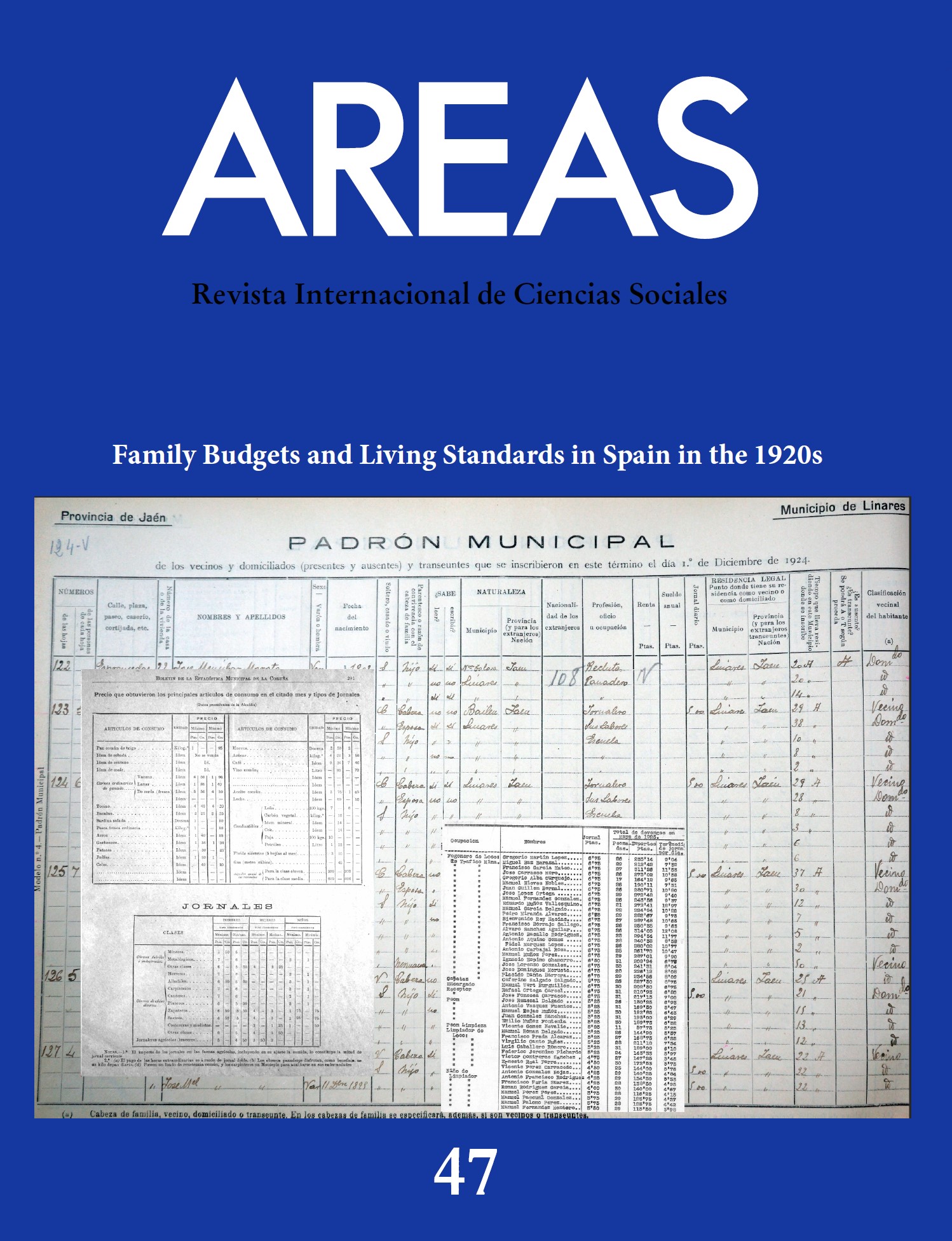
Presupuestos familiares y niveles de vida en una ciudad portuaria del norte de España: A Coruña, 1924
Resumen
El objetivo principal de este artículo es conocer los niveles de vida de la clase obrera de la principal ciudad portuaria de Galicia a mediados de los años veinte del siglo XX. En publicaciones anteriores se ha calculado las tasas de actividad en la Galicia urbana y rural para mediados del siglo XIX y primer tercio del siglo XX ), corrigiendo el subregistro de los padrones para el sector primario y secundario con datos de empresa y diferentes fuentes estadísticas. Los resultados han dado a la luz tasas de actividad elevadas, sobre todo en municipios industriales. Además, también se ha realizado investigación previa sobre presupuestos familiares, que cuestiona la difusión del modelo del male bread-winner a nivel sectorial – los sectores textil y conservero - de Cataluña y Galicia respectivamente. Retomando el empleo de los presupuestos familiares desde una perspectiva microhistórica, en este artículo nos proponemos reconstruir el nivel de vida de las familias obreras de la ciudad portuaria de A Coruña con el fin de constatar si los ingresos de las mujeres fueron necesarios para superar posibles déficits. Realizaremos este estudio para las principales ocupaciones de esta economía urbana, la cual, aún en estas primeras décadas del siglo XX, era un puerto comercial y pesquero importante, el segundo de la región por detrás de Vigo. Además, la actividad industrial ofrecía oportunidades de empleo a muchas mujeres (tabaco, confección) y el servicio doméstico seguía siendo la principal actividad femenina. Aunque nos encontramos que ni el censo de 1920 ni el padrón de 1924 registraban la actividad de todas las mujeres de la ciudad, las tasa era del 33%.
La estructura del artículo es la siguiente. En el primer apartado explicamos la metodología y fuentes usadas. En el segundo el funcionamiento de los mercados de trabajo de A Coruña en el primer tercio del siglo XX y su estructura ocupacional desde una perspectiva de género, identificando las principales ocupaciones masculinas y femeninas. En el tercer apartado se reconstruyen los ingresos familiares de los años veinte del siglo XX para diferentes ocupaciones y tipos de familias. En el cuarto se elaboran las principales partidas de gasto, para en el quinto presentar los presupuestos familiares por grupos ocupacionales junto con sus déficits y/o superávits.
Descargas
-
Resumen659
-
PDF 256
-
HTML 212
Citas
ALLEN, Robert (2015): “The high wage economy and the industrial revolution: a restatement”, Economic History Review, 68 (1), pp. 1-22.
ARBAIZA VILALLONGA, Mercedes (2000): “La cuestión social como cuestión de género: Feminidad y Trabajo en España (1860-1930)”, Historia Contemporánea, 21, pp. 395-458.
BORDERÍAS, Cristina and MUÑOZ-ABELEDO, Luisa (2018): “¿Quién llevaba el pan a casa en la España de 1924? Trabajo y economías familiares de jornaleros y pescadores en Cataluña y Galicia”, Revista de Historia Industrial, 74, pp. 77-106.
BORDERÍAS, Cristina; MUÑOZ-ABELEDO, Luisa and CUSSO, Xavier (2022): “Male breadwinners in Spanish cities (1914-1930)”, Revista de Historia Industrial, 84, pp. 59-98.
BORDERÍAS, Cristina and CUSSÓ, Xavier (2023): “Male Wages, Household Budgets and Living Standards of Barcelona’s Working Class (1856-1917)”, Investigaciones de Historia Económica, 19, pp. 3-21.
BOTER, Corinne (2020): “Living standards and the life cycle: reconstructing household income and consumption in the early twentieth-century Netherlands”, Economic History Review, 73, pp. 1050–1073.
BURNETTE, Joyce (2024): “How not to measure the standard of living: Male wages, non-market production and household income in nineteenth-century Europe”, Economic History Review, DOI: 10.1111/ehr.13339.
GARCÍA-ZÚÑIGA, Mario (2011): “La evolución de los días de trabajo en España, 1250-1918” Comunicación, X Congreso Internacional de la Asociación Española de Historia Económica, Sevilla.
HORRELL, Sara; HUMPHRIES, Jane and WEISDORF, Jacob (2021): “Family standards of living over the long run, England 1280-1850”, Past and Present, 250, pp. 87–134.
HORRELL, Sara, HUMPHRIES, Jane and WEISDORF, Jacob (2022): “Beyond the male breadwinner: life-cycle living standards of intact and disrupted English working families, 1260-1850”, Economic History Review, 75, pp. 530–560.
LE PLAY, Fréderic; SIERRA ÁLVAREZ, José; DOMÍNGUEZ MARTÍN, Rafael (1990): Campesinos y pescadores del norte de España: tres monografías de familias trabajadoras a mediados del siglo XIX. Madrid: Ministerio de Agricultura, Alimentación y Medio Ambiente.
LINDOSO TATO, Elvira and MIRÁS ARAUJO, Jesús (2001): “La trayectoria de una economía urbana. A Coruña (1868-1936)”, in El republicanismo coruñés en la historia. A Coruña, Ayuntamiento (ed. lit.), pp. 31-38.
MALUQUER DE MOTES, Jordi (2006): “La paradisiaca estabilidad de la anteguerra. Elaboración de un índice de precios de consumo en España”, Revista de Historia económica, 24 (2), pp. 333-382
MALUQUER DE MOTES, Jordi (2013): “La inflación en España. Un índice de precios de consumo, 1830-2012”. Estudios de historia económica, 64, pp.1-147.
MARCO-GRACIA, Javier and DELGADO, Pablo (2024): “So rich, so poor. Household income and consumption in urban Spain in the early twentieth century (Zaragoza, 1924)” Documento de Trabajo 2024-01 Facultad de Economía y Empresa Universidad de Zaragoza.
MIRAS ARAUJO, Jesús (2004): “El puerto y la actividad económica en la ciudad de A Coruña, 1914-1935” Scripta Nova: Revista electrónica de geografía y ciencias sociales, 8, pp. 157-180.
MIRAS ARAUJO, Jesús (2009): Un proyecto de historia urbana centrada en una ciudad media: A Coruña y su evolución económica. En Delgado Viñas, C., Rueda Hernanz, G. e Sazatornil Ruiz, L., Historiografía sobre tipos y características históricas, artísticas y geográficas de las ciudades y pueblos de España, Santander, pp. 201-206.
MUÑOZ-ABELEDO, Luisa, TABOADA-MELLA, Salomé and VERDUGO-MATÉS, R.M. (2015). “Condicionantes de la actividad femenina en la Galicia de mediados del siglo XIX”. Historia Agraria 79, pp. 39-80.
MUÑOZ-ABELEDO, Luisa, TABOADA-MELLA, Salomé, and VERDUGO-MATÉS, Rosa.M. (2019): “Determinantes de la participación femenina en el mercado de trabajo en la Galicia rural y urbana de 1924”. Revista de Historia Industrial, 24, pp. 161-186.
MUÑOZ-ABELEDO, Luisa and VERDUGO-MATÉS, Rosa (2023). “New Evidence for Women’s Labor Participation and Occupational Structure in Northwest Spain, 1877-1930”. Journal of Interdisciplinary History LIII (4), pp. 571-598.
PRECEDO LEDO, Andrés and SÁNCHEZ ARÉVALO Juan (1989): “Los cambios en la estructura demográfica familiar y su difusión en el sistema de asentamientos humanos en la provincia de la Coruña”, Semata: Ciencias sociais e humanidades, 2, (Issue dedicated to: Parentesco, familia y matrimonio en la historia de Galicia, José Carlos Bermejo Barrera (cord.)), pp. 205-216.
RODRÍGUEZ SANTAMARIA, Benigno (1923): Diccionario de artes de pesca de España y sus posesiones Madrid, Sucesores de Rivadeneyra.
- 10-01-2025 (2)
- 31-12-2024 (1)
Derechos de autor 2024 Áreas. Revista Internacional de Ciencias Sociales

Esta obra está bajo una licencia internacional Creative Commons Reconocimiento-NoComercial-SinObraDerivada 3.0.
Las obras que se publican en esta revista están sujetas a los siguientes términos:
1. El Servicio de Publicaciones de la Universidad de Murcia (la editorial) conserva los derechos patrimoniales (copyright) de las obras publicadas, y favorece y permite la reutilización de las mismas bajo la licencia de uso indicada en el punto 2.
2. Las obras se publican en la edición electrónica de la revista bajo una licencia Creative Commons Reconocimiento-NoComercial-SinObraDerivada 3.0 España (texto legal). Se pueden copiar, usar, difundir, transmitir y exponer públicamente, siempre que: i) se cite la autoría y la fuente original de su publicación (revista, editorial y URL de la obra); ii) no se usen para fines comerciales; iii) se mencione la existencia y especificaciones de esta licencia de uso.
3. Condiciones de auto-archivo. Se permite y se anima a los autores a difundir electrónicamente las versiones pre-print (versión antes de ser evaluada) y/o post-print (versión evaluada y aceptada para su publicación) de sus obras antes de su publicación, ya que favorece su circulación y difusión más temprana y con ello un posible aumento en su citación y alcance entre la comunidad académica. Color RoMEO: verde.